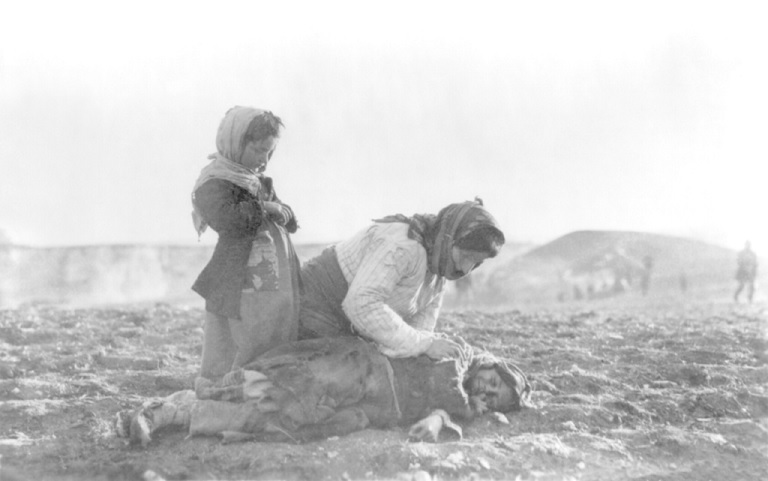
It was a heartbreaking tragedy in a century of heartbreaking tragedies. One of the most powerful accounts of the genocide can be found in Ambassador Morgenthau’s Story, the memoir of Henry Morgenthau, Sr., who was the US Ambassador to the Ottoman Empire at the time, and who first reported many of the sickening details to the world. I read excerpts from it in a 2017 video, which I encourage you to watch. As I say at the end, “A horrible story, but it’s important that we remember it.”
However, today I want to focus on another aspect of the Armenian Genocide: Armenian Genocide Denial.
No Turk now living participated in the Armenian Genocide, and no reasonable person can blame today’s Republic of Turkey, successor to the Ottoman Empire, for murdering so many innocent people 100 years ago. But one can certainly blame the Turkish government for murdering truth, by means of the significant efforts it has put into covering up, minimizing, and obfuscating what happened in 1915. We can start with the guy at the top, Turkey's Islamist president, Recip Erdogan.
Each time some government around the world condemns the massacre, Erdogan can be counted on to lash out and spew threats, as he did in 2016 when the German Bundestag passed a resolution labeling the massacres as genocide. “Our attitude on the Armenian issue has been clear from the beginning,” he said in a speech. “We will never accept the accusations of genocide.” He then threatened to unleash a flood of Syrian refugees into the Balkans. “Turkey will stop being a barrier in front of the problems of Europe. We will leave you to your own worries.”
Last October, when the US House of Representatives passed a similar resolution, The New York Times reported that Erdogan sank to the tu quoque fallacy: “The countries who have stains of genocide, slavery, colonialism in their history have no right to give lessons to Turkey.” It's a fallacy of irrelevancy: the historic atrocities that the United States committed against its black and Native American populations, which, like the Armenian Genocide we should never forget, have no bearing on, and do not mitigate, the blood on the hands of the Ottoman Empire. And yet, when the resolution passed the Senate unanimously in December, Erdogan doubled down on his faulty logic and threatened a reciprocal vote in the Turkish Parliament about Native Americans.
Far more insidious than Erdogan shooting off his mouth, and predating his presidency by decades, are efforts by the Turkish government to shut down dissenting opinions by weaponizing Armenian Genocide Denial among US academics. In the words of a 1998 “Statement by Concerned Scholars and Writers,” among them Arthur Miller, Kurt Vonnegut, and Henry Morgenthau III, “Turkey’s efforts to sanitize its history now include the funding of chairs in Turkish studies—with strings attached—at American universities.”
The lid was blown off the cozy relationship between the Republic of Turkey and some US academics in 1990 when the Turkish Ambassador, Nuzhet Kandemir, sent a letter to Robert J. Lifton of the City University of New York, concerning Dr. Lifton’s 1986 book The Nazi Doctors: Medical Killing and the Psychology of Genocide. “Needless to say,” Kandemir wrote, “I was shocked by references in your work to the so-called ‘Armenian genocide’ allegedly perpetrated by the Ottoman Turks during World War I.” Note the use of sarcastic quotation marks and the weasel words so-called and allegedly. Despite the distinguished reputation of the recipient, the letter was chock full of condescension; it ended, “I am enclosing copies of works by two American experts on the history of Turco-Armenian relations, Professors Justin McCarthy and Heath Lowry, and hope that in the interest of objectivity and fairness you will not only read them but also reflect having done so in any future works you may publish.”
But the bombshell was this: in addition to enclosing these works, the Embassy also mistakenly enclosed a draft version of the letter that had been ghost written for the ambassador by this same Heath Lowry, along with a cover memo from Lowry to the ambassador explaining the complications of expressing “our unhappiness with Lifton” and addressing “our problem.” [Emphasis mine]. Lowry was, at the time, Founding Director of the Institute of Turkish Studies at Georgetown University, a think tank he had established with a $3 million grant from the Turkish government. In 1993, Lowry went on to occupy the Ataturk Chair in Turkish Studies at Princeton University, also endowed by the Turkish Government, to the tune of $1.5 million, one of at least four such chairs around the country.
The story became public knowledge in 1995 when Dr. Lifton and two co-authors published a detailed account in Holocaust and Genocide Studies which included facsimiles of the Kandemir letter and its unintended enclosures. And apparently either Lifton or his co-authors did familiarize themselves with the work of Professor Lowry, because they wrote, "Lowry's own work contains many questionable assertions and conclusions...His conclusions do not in fact follow from his analysis or the evidence he can marshal. Quite astonishing, however, is his claim that what Talaat, a principal architect of the Armenian genocide, had in mind for the Armenians was not destruction, but 'segregation,' that the fate of the Armenians was to be that of African Americans in the South in 1915."
The scandal resulted in protests against Lowry's appointment to Princeton (see "Princeton Is Accused of Fronting For the Turkish Government" in The New York Times, May 22, 1996), but to no avail. Lowry remained as Ataturk Chair until 2013, apparently suffering little to no professional damage, and interference by the Turkish government in American academia didn't go away, as revealed by a subsequent incident reported by The Washington Post: When an Institute of Turkish Studies board chairman, Binghamton University professor Donald Quataert called for more research into the Armenian Genocide, one of Ambassador Kandemir's successors, Nabi Sensoy, threatened the Institute's funding, resulting in the ouster of Professor Quataert from the board. Although Sensoy denied the accusations, several other board members resigned in protest.
The evidence that the Armenian Genocide occurred is overwhelming. The whole thing was conducted in public; everyone could see the caravans of forcibly displaced Armenians jamming the roads of Turkey. Thanks to Ambassador Morgenthau’s efforts at collecting reports from American consulates all over the country, we not only have his own memoir, but there were 150 articles about the genocide in The New York Times while it was happening. Furthermore, there are diplomatic cables from other governments, most notably the Ottomans’ own ally, Germany; photographs of the caravans and the corpses; interviews with survivors; testimony from the courts martial of the officials responsible, held at the insistence of the British occupying force after the war; and, from within the Ottoman government, the infamous telegrams of the aforementioned "architect of the Armenian genocide," Talaat Pasha.
In the face of such a mountain of evidence, only the most wacko members of the tin-foil hat squad attempt to deny that the Genocide happened at all. Instead, the Turkish regime and its lap dogs take three dubious lines of attack: 1) The Armenians brought it on themselves. 2) The number of dead has been exaggerated. 3) It wasn’t really genocide. Incidentally, Justin McCarthy, the second of the two "experts" named in the Kandemir letter, has been at the forefront of promoting the first two arguments. Taking each argument in turn:
Dubious Line of Attack #1: The Armenians brought it on themselves
We find this argument, for example, in the Kandemir letter, where he refers to the Genocide as “a tragic civil war (initiated by Armenian nationalists).” Other variations are that the Armenians allied with the Ottoman's World War I enemy, Russia, Russia, Russia, and were therefore a threat to the Ottoman State and fair game in wartime.
Yes, there was an Armenian nationalist movement dating back to the 1800s—a century of nationalist movements around the world. And yes, Armenian volunteers really did join with Russian forces in the Caucasus Campaign during World War I, and helped hand the Turks their asses at the Battle of Sarikamish.
This type of argument is always used by those who seek to murder and ethnically cleanse those they hate. And it's always “true,” because in any group you can find a few people who did bad things. A Jewish man, Herschel Grynszpan, really did murder the German diplomat Ernst vom Rath—which was the pretext the Nazi demagogues used to incite the Germans to Kristallnacht in 1938. There really are violent Rohingya nationalist groups, which is the pretext used in Myanmar today to burn Rohingya villages and murder women and children (see my 2017 post The Rohingya Persecution: A Primer).
But it’s nevertheless a despicable argument, which blames the victim. As with the Nazi Holocaust and the Rohingya persecution, the hundreds of thousands of disarmed victims of the Armenian genocide were innocent. Many were women, children, and elderly, deep in the Turkish heartland, far from the battlefield. They hadn’t allied with the enemies of Ottoman Empire, and weren’t a threat to anybody.
Dubious Line of Attack #2: The number of dead has been exaggerated
As with the victims of communism, calculating the number of victims of the Armenian Genocide is complicated. It’s easy to get bogged down in methodology and go down the rathole of the accuracy of Ottoman censuses in the years before the war. So let me cut through the Gordian Knot: even if the lowest estimate of the number of victims is correct—about 500,000—the Armenian Genocide is still a horrible atrocity and a stain on the history of the Ottoman Empire.
Dubious Line of Attack #3: It wasn’t really genocide
To paraphrase South Park’s Gerald Broflovski, it’s not genocide because we don’t call it that.
This argument is based on a point of legal nicety—whether the massacre of Armenians conforms to the definition of genocide as spelled out in the 1948 UN Convention on the Prevention and Punishment of the Crime of Genocide. The sticking point is whether the Ottomans had “intent to destroy” the Armenian people. Arguing along similar lines, Bernard Lewis said that the massacres were not “a deliberate preconceived decision of the Ottoman government,” a viewpoint that put him on the receiving end of a lawsuit in France.
I have, in other contexts, expressed the greatest admiration for Professor Lewis. But he was way off base on this one. It is, quite frankly, a pedantic and ridiculous argument.
Aside from the fact that we routinely use words in ordinary discourse in ways that are different from their technical, legal meanings, the Ottomans did pursue a deliberate, preconceived policy intended to destroy the Armenian people. We know that from a bunch of the sources, including Ambassador Morgenthau, who met routinely with Ottoman officials. “When the Turkish authorities gave the orders for these deportations,” he wrote, “they were merely giving the death warrant to a whole race; they understood this well, and, in their conversations with me, they made no particular attempt to conceal the fact.”
Even without these sources, the idea that the Ottoman officials merely sought to relocate Armenians, and didn’t intend to kill them, is absurd. That individuals who had worked their way up to the highest level of government could think that it was remotely possible to relocate two million or so people, on foot, through hostile populations, to a desert region with no infrastructure to provide food or shelter, without significant numbers of them being killed, staggers the imagination.
In any case, it’s never very productive to debate what to call something. If we can’t agree on calling the massacre of Armenians a genocide, let's at least agree that it was a horrible atrocity. An atrocity whose truths must be conscientiously preserved with painstaking scholarly objectivity, so that there is never again such a bloody and tragic chapter in human history.
|
Michael Isenberg drinks bourbon and writes novels. His latest book, The Thread of Reason, is a murder mystery that takes place in Baghdad in the year 1092, and tells the story of the conflict between science and shari’ah in medieval Islam. It is available on Amazon.com
Please follow Mike on Facebook and Twitter. Subscribe to Islam: the Good, the Bad, and the Everyday Photo credit(s): Armenian Weekly |


