Showing posts with label Turkey. Show all posts

Tuesday, April 21, 2020

Turkey's Lap Dogs

The Quisling Academics of the Armenian Genocide Denial Industry.

This Friday we observe a solemn anniversary: April 24, 1915, the beginning—amid the throes of World War I—of the massacre of somewhere between half a million and a one and a half million Armenians by the Ottoman Turks. Many victims were outright bound and executed. Others died of thirst, exhaustion, and the attacks of local populations as they were “relocated” to the Syrian Desert.

It was a heartbreaking tragedy in a century of heartbreaking tragedies. One of the most powerful accounts of the genocide can be found in Ambassador Morgenthau’s Story, the memoir of Henry Morgenthau, Sr., who was the US Ambassador to the Ottoman Empire at the time, and who first reported many of the sickening details to the world. I read excerpts from it in a 2017 video, which I encourage you to watch. As I say at the end, “A horrible story, but it’s important that we remember it.”

However, today I want to focus on another aspect of the Armenian Genocide: Armenian Genocide Denial.

No Turk now living participated in the Armenian Genocide, and no reasonable person can blame today’s Republic of Turkey, successor to the Ottoman Empire, for murdering so many innocent people 100 years ago. But one can certainly blame the Turkish government for murdering truth, by means of the significant efforts it has put into covering up, minimizing, and obfuscating what happened in 1915. We can start with the guy at the top, Turkey's Islamist president, Recip Erdogan.

Each time some government around the world condemns the massacre, Erdogan can be counted on to lash out and spew threats, as he did in 2016 when the German Bundestag passed a resolution labeling the massacres as genocide. “Our attitude on the Armenian issue has been clear from the beginning,” he said in a speech. “We will never accept the accusations of genocide.” He then threatened to unleash a flood of Syrian refugees into the Balkans. “Turkey will stop being a barrier in front of the problems of Europe. We will leave you to your own worries.”

Last October, when the US House of Representatives passed a similar resolution, The New York Times reported that Erdogan sank to the tu quoque fallacy: “The countries who have stains of genocide, slavery, colonialism in their history have no right to give lessons to Turkey.” It's a fallacy of irrelevancy: the historic atrocities that the United States committed against its black and Native American populations, which, like the Armenian Genocide we should never forget, have no bearing on, and do not mitigate, the blood on the hands of the Ottoman Empire. And yet, when the resolution passed the Senate unanimously in December, Erdogan doubled down on his faulty logic and threatened a reciprocal vote in the Turkish Parliament about Native Americans.

Far more insidious than Erdogan shooting off his mouth, and predating his presidency by decades, are efforts by the Turkish government to shut down dissenting opinions by weaponizing Armenian Genocide Denial among US academics. In the words of a 1998 “Statement by Concerned Scholars and Writers,” among them Arthur Miller, Kurt Vonnegut, and Henry Morgenthau III, “Turkey’s efforts to sanitize its history now include the funding of chairs in Turkish studies—with strings attached—at American universities.”

The lid was blown off the cozy relationship between the Republic of Turkey and some US academics in 1990 when the Turkish Ambassador, Nuzhet Kandemir, sent a letter to Robert J. Lifton of the City University of New York, concerning Dr. Lifton’s 1986 book The Nazi Doctors: Medical Killing and the Psychology of Genocide. “Needless to say,” Kandemir wrote, “I was shocked by references in your work to the so-called ‘Armenian genocide’ allegedly perpetrated by the Ottoman Turks during World War I.” Note the use of sarcastic quotation marks and the weasel words so-called and allegedly. Despite the distinguished reputation of the recipient, the letter was chock full of condescension; it ended, “I am enclosing copies of works by two American experts on the history of Turco-Armenian relations, Professors Justin McCarthy and Heath Lowry, and hope that in the interest of objectivity and fairness you will not only read them but also reflect having done so in any future works you may publish.”

But the bombshell was this: in addition to enclosing these works, the Embassy also mistakenly enclosed a draft version of the letter that had been ghost written for the ambassador by this same Heath Lowry, along with a cover memo from Lowry to the ambassador explaining the complications of expressing “our unhappiness with Lifton” and addressing “our problem.” [Emphasis mine]. Lowry was, at the time, Founding Director of the Institute of Turkish Studies at Georgetown University, a think tank he had established with a $3 million grant from the Turkish government. In 1993, Lowry went on to occupy the Ataturk Chair in Turkish Studies at Princeton University, also endowed by the Turkish Government, to the tune of $1.5 million, one of at least four such chairs around the country.

The story became public knowledge in 1995 when Dr. Lifton and two co-authors published a detailed account in Holocaust and Genocide Studies which included facsimiles of the Kandemir letter and its unintended enclosures. And apparently either Lifton or his co-authors did familiarize themselves with the work of Professor Lowry, because they wrote, "Lowry's own work contains many questionable assertions and conclusions...His conclusions do not in fact follow from his analysis or the evidence he can marshal. Quite astonishing, however, is his claim that what Talaat, a principal architect of the Armenian genocide, had in mind for the Armenians was not destruction, but 'segregation,' that the fate of the Armenians was to be that of African Americans in the South in 1915."

The scandal resulted in protests against Lowry's appointment to Princeton (see "Princeton Is Accused of Fronting For the Turkish Government" in The New York Times, May 22, 1996), but to no avail. Lowry remained as Ataturk Chair until 2013, apparently suffering little to no professional damage, and interference by the Turkish government in American academia didn't go away, as revealed by a subsequent incident reported by The Washington Post: When an Institute of Turkish Studies board chairman, Binghamton University professor Donald Quataert called for more research into the Armenian Genocide, one of Ambassador Kandemir's successors, Nabi Sensoy, threatened the Institute's funding, resulting in the ouster of Professor Quataert from the board. Although Sensoy denied the accusations, several other board members resigned in protest.

*           *           *

The evidence that the Armenian Genocide occurred is overwhelming. The whole thing was conducted in public; everyone could see the caravans of forcibly displaced Armenians jamming the roads of Turkey. Thanks to Ambassador Morgenthau’s efforts at collecting reports from American consulates all over the country, we not only have his own memoir, but there were 150 articles about the genocide in The New York Times while it was happening. Furthermore, there are diplomatic cables from other governments, most notably the Ottomans’ own ally, Germany; photographs of the caravans and the corpses; interviews with survivors; testimony from the courts martial of the officials responsible, held at the insistence of the British occupying force after the war; and, from within the Ottoman government, the infamous telegrams of the aforementioned "architect of the Armenian genocide," Talaat Pasha.

In the face of such a mountain of evidence, only the most wacko members of the tin-foil hat squad attempt to deny that the Genocide happened at all. Instead, the Turkish regime and its lap dogs take three dubious lines of attack: 1) The Armenians brought it on themselves. 2) The number of dead has been exaggerated. 3) It wasn’t really genocide. Incidentally, Justin McCarthy, the second of the two "experts" named in the Kandemir letter, has been at the forefront of promoting the first two arguments. Taking each argument in turn:

Dubious Line of Attack #1: The Armenians brought it on themselves

We find this argument, for example, in the Kandemir letter, where he refers to the Genocide as “a tragic civil war (initiated by Armenian nationalists).” Other variations are that the Armenians allied with the Ottoman's World War I enemy, Russia, Russia, Russia, and were therefore a threat to the Ottoman State and fair game in wartime.

Yes, there was an Armenian nationalist movement dating back to the 1800s—a century of nationalist movements around the world. And yes, Armenian volunteers really did join with Russian forces in the Caucasus Campaign during World War I, and helped hand the Turks their asses at the Battle of Sarikamish.

This type of argument is always used by those who seek to murder and ethnically cleanse those they hate. And it's always “true,” because in any group you can find a few people who did bad things. A Jewish man, Herschel Grynszpan, really did murder the German diplomat Ernst vom Rath—which was the pretext the Nazi demagogues used to incite the Germans to Kristallnacht in 1938. There really are violent Rohingya nationalist groups, which is the pretext used in Myanmar today to burn Rohingya villages and murder women and children (see my 2017 post The Rohingya Persecution: A Primer).

But it’s nevertheless a despicable argument, which blames the victim. As with the Nazi Holocaust and the Rohingya persecution, the hundreds of thousands of disarmed victims of the Armenian genocide were innocent. Many were women, children, and elderly, deep in the Turkish heartland, far from the battlefield. They hadn’t allied with the enemies of Ottoman Empire, and weren’t a threat to anybody.

Dubious Line of Attack #2: The number of dead has been exaggerated

As with the victims of communism, calculating the number of victims of the Armenian Genocide is complicated. It’s easy to get bogged down in methodology and go down the rathole of the accuracy of Ottoman censuses in the years before the war. So let me cut through the Gordian Knot: even if the lowest estimate of the number of victims is correct—about 500,000—the Armenian Genocide is still a horrible atrocity and a stain on the history of the Ottoman Empire.

Dubious Line of Attack #3: It wasn’t really genocide

To paraphrase South Park’s Gerald Broflovski, it’s not genocide because we don’t call it that.

This argument is based on a point of legal nicety—whether the massacre of Armenians conforms to the definition of genocide as spelled out in the 1948 UN Convention on the Prevention and Punishment of the Crime of Genocide. The sticking point is whether the Ottomans had “intent to destroy” the Armenian people. Arguing along similar lines, Bernard Lewis said that the massacres were not “a deliberate preconceived decision of the Ottoman government,” a viewpoint that put him on the receiving end of a lawsuit in France.

I have, in other contexts, expressed the greatest admiration for Professor Lewis. But he was way off base on this one. It is, quite frankly, a pedantic and ridiculous argument.

Aside from the fact that we routinely use words in ordinary discourse in ways that are different from their technical, legal meanings, the Ottomans did pursue a deliberate, preconceived policy intended to destroy the Armenian people. We know that from a bunch of the sources, including Ambassador Morgenthau, who met routinely with Ottoman officials. “When the Turkish authorities gave the orders for these deportations,” he wrote, “they were merely giving the death warrant to a whole race; they understood this well, and, in their conversations with me, they made no particular attempt to conceal the fact.”

Even without these sources, the idea that the Ottoman officials merely sought to relocate Armenians, and didn’t intend to kill them, is absurd. That individuals who had worked their way up to the highest level of government could think that it was remotely possible to relocate two million or so people, on foot, through hostile populations, to a desert region with no infrastructure to provide food or shelter, without significant numbers of them being killed, staggers the imagination.

In any case, it’s never very productive to debate what to call something. If we can’t agree on calling the massacre of Armenians a genocide, let's at least agree that it was a horrible atrocity. An atrocity whose truths must be conscientiously preserved with painstaking scholarly objectivity, so that there is never again such a bloody and tragic chapter in human history.

Michael Isenberg drinks bourbon and writes novels. His latest book, The Thread of Reason, is a murder mystery that takes place in Baghdad in the year 1092, and tells the story of the conflict between science and shari’ah in medieval Islam. It is available on Amazon.com

Please follow Mike on Facebook and Twitter.

Subscribe to Islam: the Good, the Bad, and the Everyday

Photo credit(s): Armenian Weekly

Wednesday, October 9, 2019

Brave Sir Donald Ran Away

President Trump’s decision to pull US troops out of northeastern Syria will be a disaster for the US. Here’s why…

By Michael Isenberg.

As I write this, Turkish tanks are massing at the border of Syria, and Turkish warplanes are pummeling civilian regions in the northeast part of that country.

The president of Turkey, Islamist Recip Erdogan, explained the objectives for this operation two weeks ago. He stood up at the UN—whose mission, according to its charter is “the suppression of acts of aggression”—and announced his plans for an act of aggression. Specifically, he intends to forcibly carve off a 32 km slice of northern Syria which he described, in Orwellian tones, as a “peace corridor.”

Mr. Erdogan has wanted to seize this Syrian territory along his southern border for some time. He claims that the YPG, the Kurdish militia units in northern Syria, are allied with the PKK, the extremist Kurdish Workers Party in his own country, although most observers outside of Turkey dispute that.

The only thing that has been stopping Erdogan up to now is the presence of US troops in the region who are protecting the Kurds. President Trump tweeted today that there are only 50 US soldiers involved. Not a large deployment. Just enough to let the Turks know that war against the Kurds would mean war against the United States.

Until Monday. Following a weekend phone conversation with Mr. Erdogan, President Trump announced that he was removing the troops. He spun the decision as part of an overall strategy to keep his campaign promises. “I was elected on getting out of these ridiculous endless wars,” he tweeted, “where our great Military functions as a policing operation to the benefit of people who don’t even like the USA.”

But a press release from the Pentagon yesterday cast the decision in a very different light:

The Department's position has been and remains that establishing a safe zone in northern Syria is the best path forward to maintaining stability.

Unfortunately, Turkey has chosen to act unilaterally. As a result we have moved the U.S. forces in northern Syria out of the path of potential Turkish incursion to ensure their safety. We have made no changes to our force presence in Syria at this time.

It’s not hard to read between the lines here. On his phone call with Trump, Erdogan threatened to invade the “peace corridor” regardless of what the US did. Trump crumbled. He should have told Erdogan, "If a US soldier gets so much as a scratch at the hands of Turkish forces, we'll mine the f--king Bosporus." Nixon would have done it. But instead, brave Sir Donald ran away.

He really needs to stop having these phone calls with foreign leaders.

Pulling out of northern Syria is a terrible decision. As I wrote on Twitter, “The #Kurds allied with the US & fought & died in the front lines to defeat #ISIS. Now @RealDonaldTrump is throwing them under the bus. It's not right, and it's not good for the US. No one is going to ally with us if they see we don't stand by our allies.”

Let me be clear: I don’t advocate US troops forcing regime change in Syria. That ship has sailed. Nor do I advocate some vague open-ended mission to pacify the entire country. But I do advocate a limited, well-defined mission in the northern part of the country to protect the Kurds. They earned that much from us.

Trump compared the US role to a “policing operation” and I’d like to explore that metaphor. I agree that the US should never have become northern Syria's policeman. But it is unconscionable to take on that role, as we have done, and then, when a murderer and thief shows up on the stoop and starts kicking in the door, tell the poor homeowner, “We changed our mind. We don’t want to be the police anymore. Good luck to you.”

The comparison of the Erdogan regime to a murderer and a thief who threatens the lives and property of the Kurds is not an exaggeration. Turkey already seized the western end of its “peace corridor,” the area around Afrin, last year (red area on map). According to the BBC, which cited the Syrian Observatory for Human Rights, “almost 300 civilians were killed in the eight-week battle, along with 1,500 Kurdish militiamen…At least 137,000 civilians fled their homes.” The Turks’ name for the invasion, “Operation Olive Branch,” at first appeared to be yet another messed up bit of Orwellian Newspeak, but turned out to be singularly appropriate when reports emerged that the occupying army was stealing the olive crop from the people of Afrin.

Saleh Ibo, deputy chairmen of the Afrin Agricultural Council, says “80% of the people of Afrin made their living through olives and olive oil. The Turkish state already forced most of the people to migrate with their invasion. And now they are trying to get the remaining people to leave Afrin through violence and financial ruin to complete the demographic change.” He accuses the Turks of not only confiscating the olive harvest, but of taking processing equipment out of the district, and even cutting down significant numbers of the olive trees themselves, guaranteeing that the people of Afrin will not only not receive the payoff from their labors this year, but will have no way of earning a living there in the future.

The Turkish government isn’t even trying to hide its looting. It admits to taking at least 600 tons of olives back to Turkey. Speaking to Parliament, Bekir Pakdemirli, the agricultural minister, fessed up. “We do not want revenues to fall into PKK hands,” he explained. “We want the revenues from Afrin... to come to us. This region is under our hegemony.”

President Trump’s decision to pull out US troops now exposes all of Northern Syria to the looting and ethnic cleansing that the Turks inflicted on Afrin.

Upon tweeting my opposition to the US pullout, I was instantly under attack, and received a number of tweets calling me names, including this one from a woman in a military family: “Then you go, or send your kids. My family sacrificed enough. All you people calling for war never fought or had a family member fighting there and won’t in the future either. Then the troops come home sick and you bastards give illegal aliens better treatment. SFTFU”

Well, at least it wasn’t as insulting as another tweet I received. That one called me a leftist.

Despite her indulgence in the ad hominem fallacy, the woman from the military family does make a serious point, which I’d like to address: that US foreign wars are causing severe hardships on our soldiers and veterans and it’s time for the US to put down its burden as the world’s policeman and bring our troops home.

I freely acknowledge they’ve made more sacrifices than I ever did. I have the greatest respect and admiration for this woman and her family, and all of our fellow citizens who sign up completely voluntarily to go to the worst s—tholes on earth in the service of our country. But it’s because I respect and admire them that I think it’s a mistake to pull out of northern Syria. Because the pullout is going to cause much greater hardships for our soldiers down the road.

Polonius may have been a “foolish prating knave,” but he got one thing right: “Beware of entrance to a quarrel,” he said, “but being in, bear't that the opposed may beware of thee.” Sadly, in Syria, the US did neither.

The best way to get out of “ridiculous endless wars” and keep US troops out of harm’s way is not to enter them in the first place (Beware of entrance to a quarrel). That's why I opposed US intervention in Syria when the Obama Administration stepped up our entanglement there back in 2013. But once you’re in, things get complicated, and if you walk away, instead of seeing that the opposed may beware of thee, there are serious consequences.

Anyone who’s lived through the last fifty years of history has seen these consequences unfold in front of their eyes. In 1975, the US walked away from its commitments to South Vietnam in the face of a renewed North Vietnamese invasion. During the next four years, encouraged by what it saw as weakness on the part of the United States, communist insurgents overran the nations of Indochina, and seven additional nations in other parts of the world. A hundred million people lost their freedom, and, in the genocides and massacres that followed, some five million people lost their lives at the hands of their new rulers.

Perhaps more significant for our current Middle East involvement was the 1993 decision by the Clinton Administration to pull US forces out of Somalia in the wake of unexpected casualties in the “Black Hawk Down” incident and the Battle of Mogadishu. Our opponent there, warlord Muhammad Aidid, received material and training from al-Qaeda. What happened in Mogadishu wasn't lost on al-Qaeda's leader, Osama bin Laden. In a 1998 interview with ABC News’s John Miller, he said that the Mujahideen veterans fighting in Somalia,

were surprised at the low morale of the American soldiers and realized more than before that the America soldiers are paper tigers. After a few blows, the Americans ran away in defeat. After a few blows, they forgot about being the world leader and the leader of the new world order.

They left, dragging their corpses and their shameful defeat, and stopped using such titles.

They learned in America that this name [i.e., God] is larger than them. When this great defeat took place I was in Sudan, and it pleased me very much, just as it pleases all Muslims.

Like the communists, bin Laden was encouraged by what he saw as the weakness of the United States. The deaths of 3,000 people in the September 11 attacks three years later were the tragic consequences.

Osama bin Laden is dead, but the US still has enemies. The next Osama bin Laden is out there, watching the US run away in defeat from northern Syria without even a few blows, and drawing his own conclusions. I hope he will not be encouraged by Trump’s foolish withdrawal to launch future attacks against the United States, attacks which once again will require us to put American troops in harm’s way.

But sadly, history tells us otherwise.

Michael Isenberg drinks bourbon and writes novels. His latest book, The Thread of Reason, is a murder mystery that takes place in Baghdad in the year 1092, and tells the story of the conflict between science and shari’ah in medieval Islam. It is available on Amazon.com

Photo credit(s): BBC, Twitter

Tuesday, September 18, 2018

How to Stand up to Putin

Russia/Syria Attack on Idlib off the Table—For Now.
By Michael Isenberg.

What a difference a few days make.

I wrote in my Mideast Week in Review on Friday that Idlib province, in northwest Syria, was under siege by Russian and Syrian government forces. Idlib is the last rebel stronghold in the country (not counting Turkish and Kurdish-controlled areas) and a government victory there would signal that Syria's long, bloody civil war was nearing its end, with the ruthless dictator Bashar Assad coming out on top. World leaders were alarmed about a looming humanitarian disaster for the three million civilians living in Idlib. The possible use of chemical weapons was a particular concern, with all parties staking out their positions in case of that eventuality.

Although fears of an imminent ground attack had eased—Russian air strikes had tapered off at the end of the week—the prospect of a negotiated settlement was dim. There was just too little that the government and the rebels, who are overwhelmingly jihadist, had to offer each other. An attempt was made nevertheless; it failed. A summit was held the previous weekend in Tehran between Iran’s Hassan Rouhani and Russia’s Vladimir Putin—who are allied with the Assad regime—and Turkey’s Recep Erdogan, who sides with the rebels. But the conference broke up without reaching agreement on Idlib.

So the world breathed a sigh of relief yesterday when Mr. Putin and Mr. Erdogan emerged from a meeting in Sochi, Russia and announced in a press conference that they had agreed to create a 10-to-20 mile demilitarized buffer zone between Russian/Syrian and rebel forces. The attack on Idlib was off—for now.

There appears to have been two factors in President Putin’s change of heart between Tehran and Sochi. One was that he has bigger fish to fry. It is significant that in his statement at the press conference, he led off with remarks about Russian-Turkish trade and cultural ties, rather than Idlib. One can only hope that he is beginning to find the Russian commitment to propping up Syria’s Assad to be a drain on his country’s resources, and wishes to focus on more productive pursuits.

But perhaps more significant is the buildup of Turkish forces in and around Idlib. The Syrian Observatory for Human Rights reported seeing a military convoy cross the border from Turkey into the region on Thursday. According to The Independent,

Turkey has amassed armoured vehicles, artillery guns, and tanks along the border with Syria, with some equipment moving across the frontier, according to Turkish news outlets and video footage posted to the internet.

Turkey has also begun to bolster a dozen outposts it operates in and around Idlib with additional troops and military vehicles...

It has transferred arms and ammunition to its Free Syria Army (FSA) rebel allies, pro-Ankara newspapers reported, though some experts say the distribution of weapons won’t affect the outcome of any conflict...

Syrian forces aided by Russian air power could easily overrun the outposts. But Turkey’s moves have upped the geopolitical cost of any attempt to take Idlib by the pro-Assad camp.

Although the Turkish escalation wasn’t considered enough to alter the military outcome, it appears to have given Putin second thoughts. There’s a lesson here. It doesn’t take much to get a bully to back down—provided you show you’re serious about backing up your words with action.

US President Donald Trump had some words of his own on the subject—he tweeted on September 3 that “President Bashar al-Assad of Syria must not recklessly attack Idlib Province”—but he does not appear to have influenced Mr. Putin significantly. That Sochi was a Turkish/Russian show just goes to demonstrate how far the US has to go to regain a leadership role in the region after so many years of Barack Obama’s feckless policy of unenforced "redlines."

While the delay of any attack is good news for the people of Idlib, it is unclear what the long term result will be. The Syrian government, through its official news agency SANA, said that it “welcomed the agreement on Idleb Province.” But it described the plan as “time-bound” and promised that the Assad regime was still committed to “reestablishing security and stability to each inch that was struck by terrorism as it stresses determination to go ahead in its war against terrorism until all the Syrian territories are liberated whether by military operations or by local reconciliations.”

The end game in Syria is now very much up in the air.

Michael Isenberg drinks bourbon and writes novels. His latest book, The Thread of Reason, is a murder mystery that takes place in Baghdad in the year 1092, and tells the story of the conflict between science and shari’ah in medieval Islam. It is available on Amazon.com

Photo credit(s): Reuters

Sunday, March 25, 2018

Mideast Week in Review

by Michael Isenberg.

  • Syria war end game.
  • Israel sentences slap video teen to eight months in prison.

    The war in Syria dominated the news from the Middle East this week. Government forces continued to make gains in the Eastern Ghouta region. 70% of the district, on the outskirts of Damascus, has now fallen into the hands of the Assad regime. The area had been under rebel control since 2013.

    The operation by the Assad regime and its Russian ally has been brutal. The BBC reports more than 1,400 civilians have been killed. Among these, fifteen children and two women died in an underground school that was struck by Russian missiles.

    With the capture of Eastern Ghouta, the Syria War is in its end game and, sadly, it's an Assad victory. Not that the other options were great. But at least the destruction will stop soon.

    Separately, in the north of the country, Free Syrian Army forces, backed by Turkey, have taken control the Kurdish town of Afrin. The Turkish government claims that the Kurdish People’s Protection Units (YPG), which controlled the area, is part of the Kurdistan Worker’s Party (PKK), a rebel group within Turkey which the government considers a terrorist organization. The US disputes the claim that the groups are in cahoots. Turkish president Recep Erdogan intends to create a buffer zone in northern Syria along the Turkish border. “The military operation will go on until the terror corridor through Manbij, Ain al-Arab, Tal Abyad, Ras al-Ain, Qamishli has been wiped out,” he said.

    The Trump Administration has done little to protect the Kurds from Turkish aggression. Given that the Kurds allied with the United States in the battle against ISIS, and fought in the front lines, it is shameful that we are not doing more to help them. That may change, however, as American troops are stationed in some of the towns threatened by Erdogan.

    There were reports of looting by the rebel forces. According to the BBC, “AFP news agency journalists in Afrin also saw rebels break into shops, restaurants, and houses, and leave with food, electronic equipment, blankets and other goods.” And we thought the Free Syrian Army were the good guys.

    Also related to Syria, the Israeli government this week declassified video and other documents concerning its bombing of a suspected Syrian nuclear reactor in 2007. This is the first public admission by the Jewish state that it was behind the destruction of the facility. Pundits believe the timing of the release is intended as a warning to Iran that Israel will respond similarly to Iran's nuclear ambitions. Indeed a tweet from Prime Minister Netanyahu, that “Israel's policy was and remains consistent - to prevent our enemies from arming themselves with nuclear weapons,” seems to confirm that interpretation.

    Read more—

  • Syria war: Rebel evacuations from Eastern Ghouta gather pace (BBC)
  • Syria war: Air strike 'kills children in Eastern Ghouta school’
  • Syria war: Turkish-led forces oust Kurdish fighters from heart of Afrin (BBC)
  • Syria war: Afrin looted by Turkish-backed rebels (BBC)
  • Israel admits striking suspected Syrian nuclear reactor in 2007 (BBC)


    In a plea deal, an Israeli military court sentenced 17-year old Ahed Tamimi to eight months in prison. You may recall Ms. Tamimi as the Palestinian teen who was pictured in a viral video slapping an Israel soldier.

    In my humble opinion, Israel made a mistake in prosecuting Tamimi. The video was a propaganda victory for the Jewish state, showing Israeli restraint in the face of Palestinian provocation. By imprisoning Tamimi, Israel is turning victory into defeat by creating a martyr for the Palestinian cause.

    Read more—

  • Ahed Tamimi: Palestinian slap video teen gets eight months in plea deal (BBC)

    Michael Isenberg drinks bourbon and writes novels. His latest book, The Thread of Reason, is a murder mystery that takes place in Baghdad in the year 1092, and tells the story of the conflict between science and shari’ah in medieval Islam. Check it out on Amazon.com.

    Photo credits: IHS Conflict Monitor, Twitter

  • Monday, September 25, 2017

    Now trending: Kurdistan

    Today is referendum day in Kurdish northern Iraq. Some four million voters turned out to weigh in on whether to secede from the country and establish an independent nation. The Kurds are the fourth largest ethnic group in the Middle East (after Arabs, Persians, and Turks) and the only one out of the four without a state of their own. The referendum is non-binding and will not lead immediately to independence, but if it passes, it should give the Kurds considerable leverage to negotiate with Baghdad for their departure.

    In many parts of the region, a festive atmosphere has reigned for days:

    On Twitter, #Kurdistan is trending.

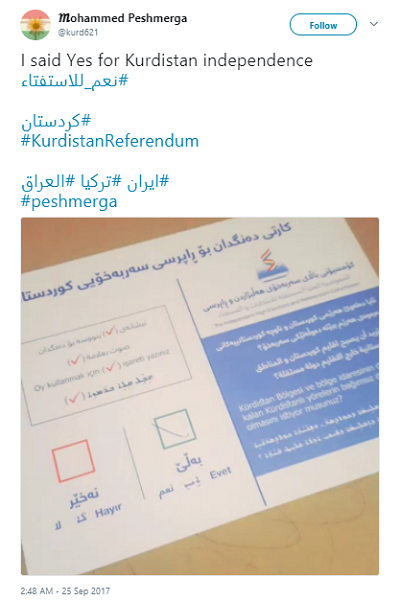
    Just as in the west, many want to broadcast their votes:

    I couldn’t tell if this voter was giving the finger to independence or to someone who voted against it. The caption wasn’t much help, but it’s nice to know that some gestures are universal.

    Many wish the Kurds well:

    Nevertheless, the bid for Kurdish independence has almost no support among the governments of the world, especially Turkey and Iran, who worry that their own Kurdish populations will get ideas.

    Some find significance in the decision of the Turkish and Iraqi armies to begin joint exercises near the Kurdish border today:

    Israel is one of the few nations that have announced support for Kurdish independence. Many welcome this,

    But others see something sinister, as in this loathsome anti-Semitic cartoon:

    Incidentally, despite being depicted as sitting next to Israel at the feast, the US government opposes independence.

    Julian Assange, of Wikileaks fame, posted this cartoon:

    It depicts the Kurdish nation, pierced by the arrows of Iraq, Turkey, ISIS, Iran, and a few others I don’t recognize. Nevertheless, the Kurds persist and climb the ladder of freedom out of the abyss and into the sunlight.

    As we await the results of the vote, I hope that proves prophetic.

    Michael Isenberg writes about the Muslim world, medieval and modern. His forthcoming novel, The Thread of Reason, is a murder mystery that takes place in Baghdad in the year 1092. It depicts the war for the Muslim soul between those who seek to enforce shari’a strictly, persecute Jews and Christians, and stamp out "un-Islamic" science, and those who wink at a few sins, tolerate their non-Muslim neighbors, and write science books instead of burning them.

    Sunday, July 2, 2017

    Mideast Week in Review

    by Michael Isenberg

  • US Rattles Sabers in Syria.
  • Turkish Police Forcibly Shut Down Gay Pride Parade.
  • ISIS on the Ropes.


    US Rattles Sabers in Syria: White House Press Secretary Sean Spicer on Monday accused the government of Syrian President Bashar Assad of making preparations for a chemical attack.

    The warning comes on the heels of the horrific April 4 tragedy in Khan Sheikhoun, in the northeast of the country. Approximately eighty people died, convulsing and suffocating, from what the Organisation for the Prohibition of Chemical Weapons (OPCW) subsequently determined was Sarin gas. Although government aircraft from the Shayrat airbase did conduct a strike in Khan Sheikhoun at the time, the Assad regime denied they deployed chemical weapons. The Russian Defense Ministry suggested that perhaps the airstrike had detonated Sarin weapons that the Islamists who controlled Khan Sheikhoun had stored on the ground.

    Unconvinced, The US lobbed 59 cruise missiles at Shayrat, at a cost of somewhere around $60 million dollars. Despite the high price tag, they apparently had little effect, since now Mr. Spicer warns of this new attack in the wake of what he called “activities” at the airbase. Glad to see Mr. Trump is being a careful custodian of the taxpayers' dollars. Mr. Spicer threatened that if “Mr. Assad conducts another mass murder attack using chemical weapons, he and his military will pay a heavy price.”

    When a few days later, no attack had occurred, the US declared victory. “It appears that they took the warning seriously,” Secretary of Defense Mattis said. I suppose that’s possible. Of course, it’s also possible that there never was a planned attack.

    Read more—

  • Syria chemical attack may be being prepared, US warns (BBC)
  • Statement from the Press Secretary (White House)
  • Syria took US chemical attack warning seriously – Mattis (BBC)
  • Khan Shaykhun chemical attack (Wikipedia)
  • Here’s how much it costs to replace the 59 Tomahawk missiles Trump fired on Syria (Market Watch)


    Turkish Police Forcibly Shut Down Gay Pride Parade: This week marks the 48th anniversary of the Stonewall Riots in New York City, generally considered the start of the gay rights movement. To commemorate the occasion, gay activists marched in pride parades in cities throughout the world.

    But not in Istanbul.

    For the third year in a row, city authorities banned the march. Some forty activists showed up anyway. Police arrested at least four of them and disbursed the rest by shooting them with rubber bullets.

    Some observers see the ban as part of the Islamicization of Turkey under President Erdogan. That is certainly a concern, in light of Mr. Erdogan's Islamist roots. But as I've noted previously, so far Mr. Erdogan has been governing as an authoritarian, attacking freedom of the press and the independence of the judiciary, but not particularly an Islamist.

    This week also marked the trials of the eleven activists arrested at last year’s abortive march. Ironically, they were all acquitted.

    Read more—

  • Turkish police break up gay pride protest in Istanbul (Guardian)


    ISIS on the Ropes: The Islamic State seems to be gasping its last breath, or at least its last breath in the form of a state. Coalition forces are closing in on Mosul and Raqqa, its last major strongholds in Iraq and Syria respectively. In Mosul, Iraqi forces entered the site of the al-Nuri Mosque, an 800-year-old landmark named after Saladin's one-time employer. Sadly, it is now in ruins: ISIS blew it up as it retreated. In Raqqa meanwhile, an alliance of Arab and Kurdish forces, backed by the United States, have the city surrounded.

    ISIS will no doubt survive the loss of its territory, but in a different form, mutating into something more in the mold of al-Qaeda.

    Read more—

  • Battle for Mosul: Ruins of Great Mosque of al-Nuri retaken (BBC)
  • Syria war: US-backed forces 'surround IS in Raqqa' (BBC)


    Michael Isenberg writes about the Muslim world, medieval and modern. His forthcoming novel, The Thread of Reason, is a murder mystery that takes place in Baghdad in the year 1092 and depicts the battle for the Muslim soul between those who embrace science and tolerance, and those who throw in their lot with mysticism and persecution.

    Photo credits: NBC News

  • Sunday, May 28, 2017

    Mideast Week in Review

  • Trump in Saudi, Israel
  • Turkey State of Emergency
  • Iran Election Aftermath
  • Liberation of Mosul
  • Manchester Bombing
  • Egypt Bus Attack

    by Michael Isenberg

    Trump in Saudi, Israel: Donald Trump visited Saudi Arabia and Israel this week, as the first two stops on his first foreign tour as President of the United States.

    On Sunday, Mr. Trump addressed the Arab Islamic American Summit. Those of you who follow me on social media know that I’m not a fan of the president, but I’m willing to give credit where credit is due. His Riyadh speech hit the bullseye. He called out terrorists for what they are, “barbaric criminals who seek to obliterate human life.” What a welcome change from the cringing, apologetic tone of Mr. Obama! I found it significant that he mentioned ideology six times. IMHO, he showed real insight into the War on Terror: it's a War of Ideas. Terrorists become terrorists because they accept an ideology that tells them to become terrorists.

    Following his speech, he joined King Salman of Saudi Arabia and President as-Sisi of Egypt at the opening of the Global Center for Combating Extremist Ideology. As far as I can tell, the Center, which is located in Riyadh, is a boiler room for countering jihadism on social media. While combating extremist ideology is pretty much my raison d'etre these days, there’s something creepily Orwellian about governments, some of which are already highly repressive, countering any form of speech. In any case, the three heads of state let themselves be photographed holding on to a glowing orb. The unfortunate visual, combined with the Center's sinister mission, put many in mind of a certain organization of supervillains, and #HailHydra trended for a day. But by Monday Mr. Trump was in Israel and the Interwebs had a new thing to speculate about: what did he write in the note that he left at the Western Wall?

    Read more—

  • Trump Gets One Right
  • Make Hydra Great Again
  • So, just what did Trump's note in the Western Wall say? (BBC)


    Turkey State of Emergency: The New York Times reported that in Turkey on Sunday, President Recep Erdogan stated that the state of emergency put into place after last year’s coup attempt would stay in place until “welfare and peace” returned to the nation of 80 million. According to the Times report, under the emergency measures, thousands have been jailed, and websites blocked, with no parliamentary oversight.

    Read more—

  • Erdogan Says He Will Extend His Sweeping Rule Over Turkey (NYT)
  • The Real Problem with Erdogan


    Iran Election Aftermath:Iran President Hasan Rouhani is getting back to work following his overwhelming victory in the May 19 election. The BBC reports that he faces three major challenges: 1) unemployment, 2) opposition to reform from Supreme Leader Ali Khamanei, and 3) relations with the United States.

    The third challenge was underscored by Mr. Trump during the course of his travels. In his Riyadh speech he said, “Until the Iranian regime is willing to be a partner for peace, all nations of conscience must work together to isolate Iran, deny it funding for terrorism, and pray for the day when the Iranian people have the just and righteous government they deserve.” In Israel, he vowed, “Iran will never have nuclear weapons, that I can tell you.” But Mr. Rouhani scoffed at the words of his American counterpart, which he called, “Just a show.”

    Read more—

  • Iran's President Rouhani has quite the to-do list (BBC)
  • Trump tells Israel Iran will never have nuclear weapons (BBC)
  • Rouhani dismisses Trump warning over Iran 'threat' (BBC)


    Liberation of Mosul: The slow but steady advance of the Iraqi army and its allies into the city of Mosul continues. While east Mosul is now under government control, ISIS remains entrenched in the western sector of the city.

    Liberation has not been without its cost in human life. The United States confirmed on Friday that 105 civilians died in a US air strike in March. The US had targeted two ISIS snipers with precision-guided munitions, tragically unaware that the building was used to store explosives and was also a place of refuge for residents who had been driven from their homes.

    With liberation, come the stories: the true horrors of life under ISIS. According to the BBC, these include the murder of a seven year old girl. She died screaming in front of her mother, who was also screaming, as female members of the religious police bit and pinched her to death for the crime of being alone with a male shop owner when she went to buy candy.

    Read more—

  • US air strike on IS killed 105 civilians in Iraq's Mosul (BBC)
  • Lipstick and dresses return to Mosul’s streets (BBC)


    Manchester Bombing:Tragedy struck Manchester, England Monday night when a suicide bomber detonated an explosion at an Ariane Grande concert. Twenty-two victims, as young as eight years old, died in the calamity, their hopes and dreams snuffed out in an instant.

    As the week progressed, a portrait, albeit a fuzzy one, emerged of the monster responsible. Twenty-two-year old Salman Abedi was born in England, but his ties to the Mideast are extensive. His parents are Libyan refugees. The Telegraph reports that his father belongs to the Libyan Islamic Fighting Group, "a well-known militant Islamist group in Libya, which is proscribed in Britain." The younger Abedi is thought to have traveled recently in Syria and Libya. There is some question as to when and how he became radicalized. According to some reports, he drank alcohol until as late as last year, but his travels changed him. His sister said, “I think he saw children—Muslim children—dying everywhere, and wanted revenge.” I am skeptical. IMHO, jihadism is motivated primarily by its own ideology; anything the West has done is secondary. There is some evidence this was the case with Abedi. Contradicting accounts of a recent conversion to jihadism, The Telegraph writes there were at least five reports to authorities of incidents, going back five years, of Abedi showing sympathy to terrorists. These included telling friends that "being a suicide bomber was okay," and getting banned from the local mosque after a run-in with an imam who had given a sermon condemning terrorism.

    So Abedi was on the authorities' radar long before he launched his hideous attack. It occurred to me that he had that in common with Dzhokhar Tsarnaev, the older of the Boston Marathon bombers, and Omar Mateen, the Pulse nightclub shooter. In all three cases, the authorities failed to prevent them from carrying out their evil intentions. There hasn’t been much discussion about why counter-terrorist agencies have been unable to do more in these cases. Possibly they are overwhelmed with such reports, and are unable to distinguish the real threats. Possibly red tape limits their ability to act. Clearly it’s something that the US and its allies need to take a closer look at.

    Read more—

  • Remembering the Manchester Victims
  • Everything we know about Manchester suicide bomber Salman Abedi (Telegraph)
  • Security services missed five opportunities to stop the Manchester bomber (Telegraph)
  • Manchester attack: The Libya-jihad connection (BBC)


    Egypt Bus Attack: Alas, Manchester was not the only significant terrorist attack this week. Near Cairo on Friday, armed militants stopped and boarded a bus full of Coptic Christians on their way to a monastery in the desert. The militants, who wore masks, opened fire, murdering at least 29. ISIS has claimed responsibility.

    Read more—

  • Egypt: At least 28 dead as gunmen fire on bus carrying Coptic Christians (CNN)

    Michael Isenberg writes about the Muslim world, medieval and modern, exposing Islamists and supporting reformers. His forthcoming novel, The Thread of Reason, is a murder mystery that takes place in Baghdad in the year 1092 and depicts the battle for the Muslim soul between those who embraced science and tolerance, and those who threw in their lot with mysticism and persecution instead.

    Photo credit: The Telegraph

  • Saturday, July 16, 2016

    The Real Problem with Erdogan

    Last night saw a coup attempt in Turkey. Seeking to overthrow the government of President Recip Erdogan, a military faction positioned tanks around the Istanbul airport, closed bridges, buzzed Ankara in airplanes, and attempted to take over TV stations. It was quickly quashed. As of now, nearly 3,000 soldiers are under arrest following fighting that killed some 200 people. Prime Minister Yildirim says the situation is “completely under control.” President Erdogan promises that the insurgents “will pay a heavy price.”

    Not a lot is known yet about the insurgents. Conventional wisdom has it that their cause is one of secularism against Islamism. An analysis by the BBC's Middle East Editor, Jeremy Bowen, is typical. In a sidebar titled "Why did coup happen?," Mr. Bowen writes that Erdogan “is a political Islamist who has rejected modern Turkey's secular heritage.” It’s a heritage that Turkey—and the Turkish military—take extremely seriously, dating back to the 1920s and Kemal Ataturk, the founder of the Turkish Republic.

    It’s true that Erdogan has Islamist roots. He came up through the ranks in the Welfare Party, which was banned by Turkey’s Constitutional Court in 1998 for its opposition to the nation’s secular charter. The following year, Erdogan was jailed for reciting an Islamist poem.

    In spite of his early history, Erdogan has not been that much of an Islamist since he's been in power. The controversies that have characterized his eleven years as prime minister and two years as president have little to do with religion.

    No, the real problem with Erdogan is not Islamism, but rather, in the words of Mr. Bowen, “Mr. Erdogan has become increasingly authoritarian and is trying to turn himself into a strong executive president.”

    Examples abound of attacks on freedom of the press and separation of powers:

  • According to one report, over 1,800 journalists have lost their jobs under the AKP government.
  • In 2014, Twitter and YouTube were blocked in Turkey for two months.
  • This year, thirty “Academics for Peace,” who had signed a petition critical of military operations against the Kurds, were briefly jailed.
  • Traditionally, the President of Turkey is a figurehead, expected to be neutral in political matters. However, Erdogan has been actively involved in Parliamentary elections.
  • Most serious of all, there have been purges of the judiciary and subsequent packing of the bench with AKP supporters. The failure of the coup has given Erdogan an excuse to crack down on the independence of the judiciary even further. The BBC reports that 2,800 judges were fired today in the wake of the coup attempt.

    I would be remiss if I didn't address some counter-examples, so here goes: Erdogan's Justice and Development Party (known by its Turkish initials AKP) has twice been dragged in front of the Constitutional Court in attempts to shut it down for infringing on the separation of mosque and state. But both attempts failed. It's also been alleged that Erdogan provided support to Islamic State; that charge hasn't stuck either. In fact, one of his accusers, US Vice President Joe Biden, ended up having to apologize. If any support did occur, it was probably more about opposing Assad than supporting Islamism. And although there have been restrictions placed on the sale and advertising of alcohol, they aren't that different from what exists in the United States.

    All-in-all, Erdogan more closely resembles a strongman in the mold of Vladimir Putin than an Islamist like Muhammad Morsi. Some of my anti-Islamist friends will no doubt say that he’s playing his cards close to his chest, and he plans to implement a theocracy just as soon as he has consolidated enough power to get away with it. They might be right. But Erdogan’s not really a close-to-his-chest type. He’s more a shoot-from-the-hip, Donald Trump type, with a history of outrageous statements comparing Israelis to Nazis or telling female journalists, “know your place.”

    In any case, regardless of whether there's a master plan for theocracy, I hope, for the sake of the Turkish people, that Mr. Erdogan never becomes powerful enough to implement one. Unfortunately, the failure of last night's coup will make the continuing concentration of power in Mr. Erdogan's hands that much harder to prevent.

    Michael Isenberg writes about the Muslim world, medieval and modern. For his take on the roots of Islamism, see his talk The Islamic in Islamic State on YouTube.