Tuesday, April 28, 2020

Running from what Allah had ordained...

...to what Allah has ordained.
Islam and Plague Part 1: The Theologians.

When one thinks of the relationship between science and religion, the great historical conflicts between the two typically come to mind: the persecution of Galileo by the Roman Catholic Church, for example, or the trial of John Scopes for teaching evolution. Science makes some claim and Religion replies, “That’s heresy!”

But there’s another phenomenon that I've observed over the years. It's kind of the opposite: Science makes some claim, and Religion replies, “We knew it all along!”

Christian writers claim to find conservation of energy, the Big Bang Theory, and dinosaurs in the Bible. Hindus see Heisenberg Uncertainty in Vedic wisdom about the ultimate unknowability of reality. While I was growing up, I often heard my Jewish co-religionists express great pride that our Bronze Age ancestors were millennia ahead of the curve in their insight into the trichinella worm.

One example of this that is particularly timely, thanks to the coronavirus crisis, is that Islam had unique insight into infectious diseases and quarantine centuries before the advent of modern medicine. One hadith in particular (a hadith is a saying of Muhammad or one of his Companions) has been quoted in numerous articles, including this one in The New Yorker: “If you hear of an outbreak of plague in a land, do not enter it; but if the plague breaks out in a place while you are in it, do not leave that place (Sahih Bukhari, Volume 7, Book 71, Number 624).”

Or as today's Koronavirus Karens put it, "Stay the f--k home!"

As I shall show, the alleged foresight of medieval Islam regarding modern germ theory has been greatly exaggerated. Nevertheless, what Muslims did believe—though often contradictory—is interesting in its own right, caught up as it was with fundamental questions about God's power and human destiny. In this post I’ll explore what scripture and theology had to say on the subject. The views of Avicenna and other scientists will be the topic of a future post.

It is impossible to separate any discussion of Islam and plague from the faith’s core tenets, in particular the belief that Allah is all-powerful and everything that happens in Heaven and on Earth unfolds according to His Will. Muslim theologians, especially those of the Ashari school, argued that Will and omnipotence are in fact Allah’s primary attributes. He is not bound by any laws of nature or justice. Miracles are not a departure from the natural order because there is no natural order, no causation, only Allah’s Will. As for the will of human beings—so-called "free" will—there's no such thing as that either. That fantasy is pure blasphemy; it limits Allah's power.

The writings of the towering eleventh century scholar, Abu Hamid Ghazali, is representative of medieval theologians in general and the Ashari school in particular. He delves into the topic at length in his Revival of the Science of Religion in the chapter “Tawhid wa Tawakkal (Monotheism and Reliance on God)”: “Man's will and strength are guided by another,” he writes. “A man is the object or intermediary of God's will and power flow…He who attributes everything to anything other than God is misguided…Everything was written.” The last part echoes verses 54:52-53 of the Quran: "Everything they do is in the writings. And everything small and great is written down."

Such theology inevitably leads to fatalism, a reluctance to act in the face of the impossibility of changing Allah’s decrees. The best we can do is resign ourselves patiently to them, and rely on the benevolence of Allah to ensure that all will turn out well for those who believe. In modern times, Edward Said railed against this characterization of Muslims, which he saw as a racist stereotype: the passive “Oriental.”

But stereotype or not, there is no doubt fatalism is deeply rooted in Muslim scripture. A search on Quran.com for the word patient (صبر) turned up eighty-seven hits. Verse 29:58-60 is typical: “Excellent the reward of the workers, who are patient and on their Lord they rely! And how many a living creature carries not its sustenance! Allah sustains it and yourselves.”

Or as another religion put it, "Consider the lilies of the field; they toil not, neither do they spin."

In another work, The Book of Counsel for Kings, Ghazali told a rather poignant story about the impossibility of taking action to thwart what Allah has written for us. A companion of King Solomon saw Death eyeing him. Fearful that his end was imminent, he asked Solomon to use his magic to teleport him to India in order to escape Death's clutches. Once there, he died that very day. The story ends with Death telling Solomon that the reason he was staring at the man was that he was surprised that someone whose soul was destined to be collected in India could possibly be so far from there.

Even among those Muslims who were inclined toward a more scientific view of the universe, there was a fatalistic streak. It permeates the Rubaiyyat of Omar Khayyam for example. We are

Impotent Pieces of the Game He plays
Upon this Chequer-board of Nights and Days;

If you’ve read my novel The Thread of Reason, you know that despite their on-again off-again friendship, Khayyam and Ghazali were polar opposites, in both personality and in philosophy. When they agreed on something, it must have been deeply ingrained in the culture indeed.

And yet, Muslims are not entirely passive in the face of a deterministic universe. Like all of us, they plan, and work, and fight, as if doing so will have some effect on the world. They lock their doors to prevent thieves from stealing their property and repair their houses to prevent the walls from collapsing. They pray in the hopes of modifying heaven’s terrible decrees. The even eat.

With his characteristic disdain for those who disagree with him, Ghazali explains,

Some think that the meaning of God-reliance is to give up earnings, to give up efforts, and to lie upon the ground like [a] thrown plank or like meat on a [skewer of] wood. This is the conjecture of the fools, it is unlawful in Shari’ah which praises God-reliant men.
For example,

When you are hungry and food is placed before you it is not God-reliance to give it up. This is against law of nature. Similarly if you do not cultivate land and hope for crops or if you do not cohabit with [your] wife but still hope to have a child, it will be madness and not God-reliance.
He then provides a dozen anecdotes about saints who didn’t cultivate the land, or otherwise provide for themselves, and Allah provided for them anyway.

It’s a paradox. Ghazali quotes a hadith which captures it nicely: “The Prophet said to a desert Arab: Why have you let loose your camel? He said: I let it loose depending on God. He said: Tie it and depend on God.”

Or as another religion put it, “Put your faith in God, my boys, and keep your powder dry.”

Any discussion of Islam and medicine in general, and plague in particular, has to be understood in the context of this somewhat dual view of Allah’s omnipotence and man’s agency.

As with other things, Islam teaches that health and disease are entirely controlled by the Will of Allah. And even when there appear to be natural forces at play, such as contagion from one individual to another, it is in fact Allah who is pulling the strings. Thus, we read in the Hadith:

Allah's Apostle said, “There is no contagion, nor jaundice, nor vermin [without Allah’s permission]” A Bedouin stood up and said, "Then what about my camels? They are [as healthy as] deer on the sand, but when a mangy camel comes and mixes with them, they all get infected with mange." The Prophet said, "Then who conveyed the (mange) disease to the first one?" (Sahih Bukhari, Volume 7, Book 71, Number 615)

Disease strikes according to Allah’s plan, which, although it may not seem like it, is benevolent, and should not, therefore, be opposed:

Narrated 'Aisha: (the wife of the Prophet) that she asked Allah's Apostle about plague, and Allah's Apostle informed her saying, "Plague was a punishment which Allah used to send on whom He wished, but Allah made it a blessing for the believers. None (among the believers) remains patient in a land in which plague has broken out and considers that nothing will befall him except what Allah has ordained for him, but that Allah will grant him a reward similar to that of a martyr." (Sahih Bukhari, Volume 7, Book 71, Number 630)

There are two aspects of this I want to emphasize: the seemingly odd notion that plague can be a "blessing," and the last part, the part that says “Allah will grant him a reward similar to that of a martyr,” I can’t underscore its significance enough. It puts a believer who is killed by plague in the same category as a jihadi who is killed in a holy war: they both automatically go to heaven. Another hadith makes this explicit:

The martyrs are of five kinds: one who dies of plague; one who dies of diarrhea (or cholera) ; one who is drowned; one who is buried under debris and one who dies fighting in the way of Allah (Sahih Muslim Book 020, Number 4705).

The insistence that health and disease are entirely a matter of the Will of Allah doesn't preclude doing something about it. The same paradox that exists about other areas of life applies here as well. The book on medicine in Bukhari’s collection of Hadith contains accounts of Muhammad recommending all sorts of antidotes and treatments: dates, cupping, caraway seeds, camel urine, honey (for stomach ailments), talbina (a porridge of barley, milk, and honey), truffle water (for diseases of the eye), incense (inhaled like snuff for tonsillitis and pleurisy), and ruqya (exorcism—for snakebite and scorpion sting). The only treatments he explicitly opposes are cauterization and relieving tonsil pain in children by pressing on the palate with your fingers.

In one hadith, quoted by Ghazali, Muhammad is challenged point blank about the apparent contradiction: “The Prophet was asked about medicines and spells and enchantments: Can they annul the decree God?” Muhammad’s way out: “It is also God's decree.”

We have an early case study on how this paradoxical view of destiny and agency plays out in practice during the reign of the caliph Omar (634-644). Omar had been a Companion of Muhammad and it was during his caliphate that Muslim armies fanned out across the Middle East on a campaign of conquest. In the year 638 or 639, the Plague of Amwas (Emmaus) broke out. Readers of the New Testament will recognize the locale: it’s the village near Jerusalem where Jesus appeared to his disciples after the resurrection. The uncertainty in the date of the plague might indicate there were two waves of infection, as was the case with the Spanish Flu of 1918 and, as some fear, may be the case with coronavirus. As for what kind of disease it was, the sources don’t say, but historians believe it was Bubonic Plague, an aftershock of the Plague of Justinian that ravaged the Byzantine Empire starting in 541.

Omar's dilemma was whether to leave his troops where they were or to withdraw them to safer ground. After travelling about the country, consulting various advisors, and suffering some miscommunications with the commander, Abu 'Ubaida bin Al-Jarrah—there was a whole rigmarole that I won't bore you with—he finally settled on withdrawal. A hadith tells us the decision subjected him to considerable criticism:

Abu 'Ubaida bin Al-Jarrah said (to 'Umar), "Are you running away from what Allah had ordained?" Omar said, "Would that someone else had said such a thing, O Abu 'Ubaida! Yes, we are running from what Allah had ordained to what Allah has ordained.

No matter which choice Omar made, what Allah ordained would prevail. Indeed, his decision to move the troops to safety did not prevent the plague from decimating the army. Twenty five thousand Muslims died, including Abu ‘Ubaida.

The hadith continues,

At that time 'Abdur-Rahman bin 'Auf, who had been absent because of some job, came and said, "I have some knowledge about this. I have heard Allah's Apostle saying, 'If you hear about it (an outbreak of plague) in a land, do not go to it; but if plague breaks out in a country where you are staying, do not run away from it.'” Omar thanked Allah and returned to Medina. (Sahih Bukhari, Volume 7, Book 71, Number 625)

Which brings us full circle to the hadith with which I started this post, and we can now revisit it within the framework of medieval Muslim theology. The reiteration of the hadith inside a broader narrative about Allah’s Will being carried out at Emmaus, regardless of what we impotent humans do, is a smoking gun, giving us context that wasn’t available in the shorter version I cited above. Other variations (Sahih Muslim Book 026 Number 5493-5499) are equally enlightening; they say explicitly that the reason one should neither go to a place that is plague-stricken, nor flee from one, is “It is a calamity or a disease which Allah sent to a group of the Children of Israel, or to the people who were before you.”

Clearly, as it was understood by the theologians of the time, the hadith is not about anticipating modern quarantine methods to prevent the spread of disease. Rather it is a command to be patient and acquiescent in the face of Allah’s plan. If Allah's plan is to punish you with plague for your sins, you cannot escape death by fleeing from it. If His plan is not to "bless" you with plague for your faith, you cannot achieve martyrdom by chasing after it. Either way, do not try to change the outcome. You cannot succeed.

NEXT UP—What the medieval Muslim scientists had to say. As we will see, it is equally rife with contradictions.

Michael Isenberg drinks bourbon and writes novels. His latest book, The Thread of Reason, is a murder mystery that takes place in Baghdad in the year 1092, and tells the story of the conflict between science and shari’ah in medieval Islam. It is available on Amazon.com

Please follow Mike on Facebook and Twitter.

Subscribe to Islam: the Good, the Bad, and the Everyday

Tuesday, April 21, 2020

Turkey's Lap Dogs

The Quisling Academics of the Armenian Genocide Denial Industry.

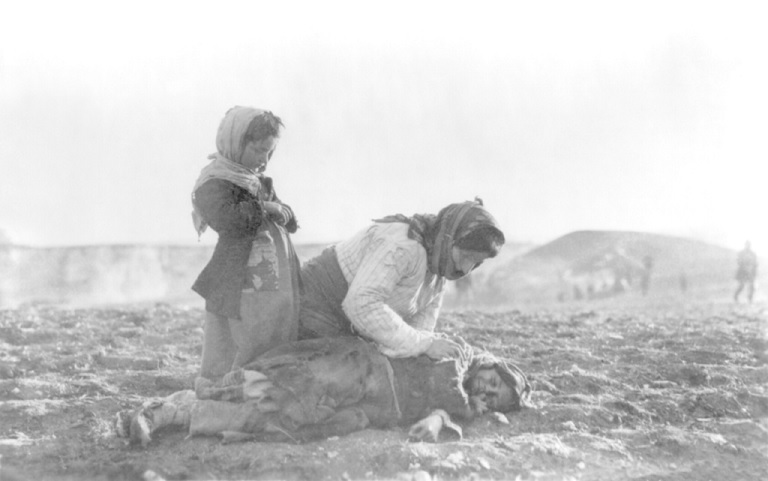
This Friday we observe a solemn anniversary: April 24, 1915, the beginning—amid the throes of World War I—of the massacre of somewhere between half a million and a one and a half million Armenians by the Ottoman Turks. Many victims were outright bound and executed. Others died of thirst, exhaustion, and the attacks of local populations as they were “relocated” to the Syrian Desert.

It was a heartbreaking tragedy in a century of heartbreaking tragedies. One of the most powerful accounts of the genocide can be found in Ambassador Morgenthau’s Story, the memoir of Henry Morgenthau, Sr., who was the US Ambassador to the Ottoman Empire at the time, and who first reported many of the sickening details to the world. I read excerpts from it in a 2017 video, which I encourage you to watch. As I say at the end, “A horrible story, but it’s important that we remember it.”

However, today I want to focus on another aspect of the Armenian Genocide: Armenian Genocide Denial.

No Turk now living participated in the Armenian Genocide, and no reasonable person can blame today’s Republic of Turkey, successor to the Ottoman Empire, for murdering so many innocent people 100 years ago. But one can certainly blame the Turkish government for murdering truth, by means of the significant efforts it has put into covering up, minimizing, and obfuscating what happened in 1915. We can start with the guy at the top, Turkey's Islamist president, Recip Erdogan.

Each time some government around the world condemns the massacre, Erdogan can be counted on to lash out and spew threats, as he did in 2016 when the German Bundestag passed a resolution labeling the massacres as genocide. “Our attitude on the Armenian issue has been clear from the beginning,” he said in a speech. “We will never accept the accusations of genocide.” He then threatened to unleash a flood of Syrian refugees into the Balkans. “Turkey will stop being a barrier in front of the problems of Europe. We will leave you to your own worries.”

Last October, when the US House of Representatives passed a similar resolution, The New York Times reported that Erdogan sank to the tu quoque fallacy: “The countries who have stains of genocide, slavery, colonialism in their history have no right to give lessons to Turkey.” It's a fallacy of irrelevancy: the historic atrocities that the United States committed against its black and Native American populations, which, like the Armenian Genocide we should never forget, have no bearing on, and do not mitigate, the blood on the hands of the Ottoman Empire. And yet, when the resolution passed the Senate unanimously in December, Erdogan doubled down on his faulty logic and threatened a reciprocal vote in the Turkish Parliament about Native Americans.

Far more insidious than Erdogan shooting off his mouth, and predating his presidency by decades, are efforts by the Turkish government to shut down dissenting opinions by weaponizing Armenian Genocide Denial among US academics. In the words of a 1998 “Statement by Concerned Scholars and Writers,” among them Arthur Miller, Kurt Vonnegut, and Henry Morgenthau III, “Turkey’s efforts to sanitize its history now include the funding of chairs in Turkish studies—with strings attached—at American universities.”

The lid was blown off the cozy relationship between the Republic of Turkey and some US academics in 1990 when the Turkish Ambassador, Nuzhet Kandemir, sent a letter to Robert J. Lifton of the City University of New York, concerning Dr. Lifton’s 1986 book The Nazi Doctors: Medical Killing and the Psychology of Genocide. “Needless to say,” Kandemir wrote, “I was shocked by references in your work to the so-called ‘Armenian genocide’ allegedly perpetrated by the Ottoman Turks during World War I.” Note the use of sarcastic quotation marks and the weasel words so-called and allegedly. Despite the distinguished reputation of the recipient, the letter was chock full of condescension; it ended, “I am enclosing copies of works by two American experts on the history of Turco-Armenian relations, Professors Justin McCarthy and Heath Lowry, and hope that in the interest of objectivity and fairness you will not only read them but also reflect having done so in any future works you may publish.”

But the bombshell was this: in addition to enclosing these works, the Embassy also mistakenly enclosed a draft version of the letter that had been ghost written for the ambassador by this same Heath Lowry, along with a cover memo from Lowry to the ambassador explaining the complications of expressing “our unhappiness with Lifton” and addressing “our problem.” [Emphasis mine]. Lowry was, at the time, Founding Director of the Institute of Turkish Studies at Georgetown University, a think tank he had established with a $3 million grant from the Turkish government. In 1993, Lowry went on to occupy the Ataturk Chair in Turkish Studies at Princeton University, also endowed by the Turkish Government, to the tune of $1.5 million, one of at least four such chairs around the country.

The story became public knowledge in 1995 when Dr. Lifton and two co-authors published a detailed account in Holocaust and Genocide Studies which included facsimiles of the Kandemir letter and its unintended enclosures. And apparently either Lifton or his co-authors did familiarize themselves with the work of Professor Lowry, because they wrote, "Lowry's own work contains many questionable assertions and conclusions...His conclusions do not in fact follow from his analysis or the evidence he can marshal. Quite astonishing, however, is his claim that what Talaat, a principal architect of the Armenian genocide, had in mind for the Armenians was not destruction, but 'segregation,' that the fate of the Armenians was to be that of African Americans in the South in 1915."

The scandal resulted in protests against Lowry's appointment to Princeton (see "Princeton Is Accused of Fronting For the Turkish Government" in The New York Times, May 22, 1996), but to no avail. Lowry remained as Ataturk Chair until 2013, apparently suffering little to no professional damage, and interference by the Turkish government in American academia didn't go away, as revealed by a subsequent incident reported by The Washington Post: When an Institute of Turkish Studies board chairman, Binghamton University professor Donald Quataert called for more research into the Armenian Genocide, one of Ambassador Kandemir's successors, Nabi Sensoy, threatened the Institute's funding, resulting in the ouster of Professor Quataert from the board. Although Sensoy denied the accusations, several other board members resigned in protest.

*           *           *

The evidence that the Armenian Genocide occurred is overwhelming. The whole thing was conducted in public; everyone could see the caravans of forcibly displaced Armenians jamming the roads of Turkey. Thanks to Ambassador Morgenthau’s efforts at collecting reports from American consulates all over the country, we not only have his own memoir, but there were 150 articles about the genocide in The New York Times while it was happening. Furthermore, there are diplomatic cables from other governments, most notably the Ottomans’ own ally, Germany; photographs of the caravans and the corpses; interviews with survivors; testimony from the courts martial of the officials responsible, held at the insistence of the British occupying force after the war; and, from within the Ottoman government, the infamous telegrams of the aforementioned "architect of the Armenian genocide," Talaat Pasha.

In the face of such a mountain of evidence, only the most wacko members of the tin-foil hat squad attempt to deny that the Genocide happened at all. Instead, the Turkish regime and its lap dogs take three dubious lines of attack: 1) The Armenians brought it on themselves. 2) The number of dead has been exaggerated. 3) It wasn’t really genocide. Incidentally, Justin McCarthy, the second of the two "experts" named in the Kandemir letter, has been at the forefront of promoting the first two arguments. Taking each argument in turn:

Dubious Line of Attack #1: The Armenians brought it on themselves

We find this argument, for example, in the Kandemir letter, where he refers to the Genocide as “a tragic civil war (initiated by Armenian nationalists).” Other variations are that the Armenians allied with the Ottoman's World War I enemy, Russia, Russia, Russia, and were therefore a threat to the Ottoman State and fair game in wartime.

Yes, there was an Armenian nationalist movement dating back to the 1800s—a century of nationalist movements around the world. And yes, Armenian volunteers really did join with Russian forces in the Caucasus Campaign during World War I, and helped hand the Turks their asses at the Battle of Sarikamish.

This type of argument is always used by those who seek to murder and ethnically cleanse those they hate. And it's always “true,” because in any group you can find a few people who did bad things. A Jewish man, Herschel Grynszpan, really did murder the German diplomat Ernst vom Rath—which was the pretext the Nazi demagogues used to incite the Germans to Kristallnacht in 1938. There really are violent Rohingya nationalist groups, which is the pretext used in Myanmar today to burn Rohingya villages and murder women and children (see my 2017 post The Rohingya Persecution: A Primer).

But it’s nevertheless a despicable argument, which blames the victim. As with the Nazi Holocaust and the Rohingya persecution, the hundreds of thousands of disarmed victims of the Armenian genocide were innocent. Many were women, children, and elderly, deep in the Turkish heartland, far from the battlefield. They hadn’t allied with the enemies of Ottoman Empire, and weren’t a threat to anybody.

Dubious Line of Attack #2: The number of dead has been exaggerated

As with the victims of communism, calculating the number of victims of the Armenian Genocide is complicated. It’s easy to get bogged down in methodology and go down the rathole of the accuracy of Ottoman censuses in the years before the war. So let me cut through the Gordian Knot: even if the lowest estimate of the number of victims is correct—about 500,000—the Armenian Genocide is still a horrible atrocity and a stain on the history of the Ottoman Empire.

Dubious Line of Attack #3: It wasn’t really genocide

To paraphrase South Park’s Gerald Broflovski, it’s not genocide because we don’t call it that.

This argument is based on a point of legal nicety—whether the massacre of Armenians conforms to the definition of genocide as spelled out in the 1948 UN Convention on the Prevention and Punishment of the Crime of Genocide. The sticking point is whether the Ottomans had “intent to destroy” the Armenian people. Arguing along similar lines, Bernard Lewis said that the massacres were not “a deliberate preconceived decision of the Ottoman government,” a viewpoint that put him on the receiving end of a lawsuit in France.

I have, in other contexts, expressed the greatest admiration for Professor Lewis. But he was way off base on this one. It is, quite frankly, a pedantic and ridiculous argument.

Aside from the fact that we routinely use words in ordinary discourse in ways that are different from their technical, legal meanings, the Ottomans did pursue a deliberate, preconceived policy intended to destroy the Armenian people. We know that from a bunch of the sources, including Ambassador Morgenthau, who met routinely with Ottoman officials. “When the Turkish authorities gave the orders for these deportations,” he wrote, “they were merely giving the death warrant to a whole race; they understood this well, and, in their conversations with me, they made no particular attempt to conceal the fact.”

Even without these sources, the idea that the Ottoman officials merely sought to relocate Armenians, and didn’t intend to kill them, is absurd. That individuals who had worked their way up to the highest level of government could think that it was remotely possible to relocate two million or so people, on foot, through hostile populations, to a desert region with no infrastructure to provide food or shelter, without significant numbers of them being killed, staggers the imagination.

In any case, it’s never very productive to debate what to call something. If we can’t agree on calling the massacre of Armenians a genocide, let's at least agree that it was a horrible atrocity. An atrocity whose truths must be conscientiously preserved with painstaking scholarly objectivity, so that there is never again such a bloody and tragic chapter in human history.

Michael Isenberg drinks bourbon and writes novels. His latest book, The Thread of Reason, is a murder mystery that takes place in Baghdad in the year 1092, and tells the story of the conflict between science and shari’ah in medieval Islam. It is available on Amazon.com

Please follow Mike on Facebook and Twitter.

Subscribe to Islam: the Good, the Bad, and the Everyday

Photo credit(s): Armenian Weekly

Tuesday, April 14, 2020

Sultan v. Caliph

A Medieval Smackdown.
by Michael Isenberg.

More of the real-life history behind The Thread of Reason.
CONTAINS SPOILERS.

The Muslim world of the 11th century—when my novel The Thread of Reason takes place—was a divided world.

On the one side were the moderates: they patronized the sciences, treated Jews and Christians with tolerance, and were willing to wink at wine drinking and other occasional breaches of Muslim law, the shari’ah.

On the other side were the hardliners; they were skeptical of the sciences, attempted to persecute Jews and Christians, and sought strict enforcement of the shari’ah.

In the political realm, this conflict was mirrored by the conflict between caliph and sultan.

The caliph—from the Arabic calapha, meaning to follow or succeed—was the successor to Muhammad. Ruling from his palace in Baghdad, the caliph was (since 750 AD), a member of the Abbasid Dynasty, descended from Muhammad’s Uncle Abbas. The caliph was the supreme authority in the Muslim world, the “Commander of the Faithful”. The sultan was merely his strong right arm, carrying out his policies and enforcing the shari'ah.

At least that was the theory.

In practice, the sultan had the army, and was therefore the real power.

During the latter half of the eleventh century, the sultans were Turks, members of the Seljuq Dynasty. Their propaganda presented them as the defenders of the caliph and of orthodox Islam. And yet, in many ways, they weren’t very good Muslims. They drank wine and wore silk, both prohibited in the shari’ah. As I’ve written previously, they had Jewish officials working for them, and when one of these officials came into conflict with a Muslim, and the caliph's government attempted to retaliate by decreeing strict enforcement of the restrictions on Jews and Christians that are in the shari'ah, the sultan Malik-shah and his vizier (prime minister), Nizam al-Mulk, stood by their own man, took the Jews’ side, and made the caliph back off from the hated decree. Indeed, Malik-shah and Nizam al-Mulk were in constant conflict with the caliphs, whom they tried to control by ensuring the caliph’s vizier was one of their own guys. At the time The Thread of Reason takes place, this office was filled by one of Nizam al-Mulk's own sons-in-law. For all these reasons, scholars have recently come to refer to the notion that the sultans were the defenders of orthodoxy as “The Great Seljuq Myth.”

It was inevitable that such a conflict would come to a head. By the fall of 1092, Malik-shah was determined to have it out with the caliph.

Malik-shah

Nizam al-Mulk apparently opposed the plan, and blamed it on Shiite troublemakers who had infiltrated the government. According to Nizam al-Mulk’s guide to government, The Book of Politics,

The most damaging and odious enemies to the religion of Muhammad are also the worst enemies of the Master of the World [i.e., the sultan].

These people who, today, have power in the government, and who make propaganda for the Shiite creed, belonging to this sect: they carry out their affairs in secret, they employ violence, they indulge in proselytism, and they talk the Master of the World into the idea of annihilating the Abbasid dynasty.

If I wanted to lift the lid that covers this pot, what evils would come out! [1]

Despite the opposition of his vizier, Malik-shah was determined to proceed. In October of that year, he traveled from his capital in Isfahan up to Baghdad, his third such visit. Along the way, Nizam al-Mulk was brutally assassinated, as I described in my previous post, “The Murder that Started it All.”

Free from the overbearing influence of his vizier, the sultan continued on to Baghdad. The historian ibn Khallikhan (d. 1282), tells us what happened next:

We shall here relate a singular circumstance: When [Malik-shah] entered Baghdad for the third time, the caliph had two sons, one of whom was [subsequently] the imam al-Mustazhir billah; the other, who bore the name of Abu 'l-Fadl Jaafar, was the son of the sultan's daughter. The caliph had solemnly designated as his successor the first named of these two, because he was the elder, but the sultan insisted that he should revoke the nomination, declare Abu 'l-Fadl heir to the caliphate, put him in possession of Baghdad and then remove himself to Basra. The caliph felt the greatest repugnance to execute what had been required of him; he used every effort to change the sultan's determination and, finding all his remonstrances fruitless, he asked and obtained a delay of ten days in order to make the necessary preparations for his departure. It is related that, during these days, he kept a rigourous fast and, when he did take food, he sat upon ashes and invoqued the assistance of the Almighty God against the sultan. That period of time had not yet elapsed when the sultan fell ill and died, and the caliph was thus delivered from his trouble. [2]

The death of the sultan Malik-shah, and the resulting deliverance of the caliph, was a victory for the forces of shari'ah over the forces of moderation, one from which the Muslim world would never recover. In another paragraph, ibn Khallikan fills in the details about the sultan's death, so convenient for the caliph:

He entered [Baghdad] for the third time in the beginning of the month of Shawwal, 485 (Nov.A. D. 1092), and set off immediately on a hunting party, in the direction of the Dujail. Having then killed an antelope and eaten of its flesh, he was taken ill and had to be bled; but, as enough of blood was not drawn from him, he returned to Baghdad very unwell and none of his officers were admitted into his presence. He entered the city on the 15th of Shawwal, 485 (18th Nov. A. D. 1092), and died the next day. He was born on the 9th of the first Jumada, 447 (6th August, A. D. 1055). Some say that his death was caused by a poisoned tooth-pick. His funeral was conducted in the most private manner; no prayer was said over the grave, no sittings of condolence were held, no hair was cut off the tails of horses, though such a thing was customary in the case of persons such as he. One would have thought he had been snatched away bodily from the world. His corpse was borne to Ispahan and interred in the great college appropriated to the Shafites and Hanefites. [3]

Even in an age where accidental death was common, it defies imagination that the death of Malik-shah, coming so closely on the heels of the assassination of Nizam al-Mulk, and right after he had told the caliph to get out of town, would be due to eating a bad antelope. For what I think really happened, see The Thread of Reason.

Michael Isenberg drinks bourbon and writes novels. His latest book, The Thread of Reason, is a murder mystery that takes place in Baghdad in the year 1092, and tells the story of the conflict between science and shari’ah in medieval Islam. It is available on Amazon.com

Please follow Mike on Facebook and Twitter.

Subscribe to Islam: the Good, the Bad, and the Everyday

Photo credit(s): Wikipedia (Public Domain)

[1] Nizam al-Mulk (1018-1092), Siasset Namèh ou Traité de Gouvernement (The Book of Politics or Treatise on Government), Angers: Imprimerie Orientale de A. Burdin et Cie, (1893), trans. Charles Schefer, 243. The translation from the French is mine.
[2] Khallikan, Shams al-Dīn Abū Al-ʿAbbās Aḥmad Ibn Muḥammad ibn (1211-1282),
Ibn Khallikan’s Biographical Dictionary [Wafayāt al-aʿyān wa-anbāʾ abnāʾ az-zamān (Deaths of Eminent Men and History of the Sons of the Epoch)], Vol. III, Paris: Oriental Translation Fund of Great Britain and Ireland (1868), B. MacGuckin de Slane, tr., p. 445.
[3] Ibid, pp. 444-445.

Tuesday, April 7, 2020

Getting Medieval on your You-Know-What

The Greater Jihad and the Lesser Jihad.
Part III of a Series—What Does Jihad Really Mean?

Speak of jihad as Islamic Holy War and some Social Justice Warrior, or perhaps an academic, will inevitably “correct” you. “Jihad is one of the most misunderstood concepts in Islam,” they’ll intone piously. “Americans," a word they utter with just a hint of contempt, “think of it as bloodshed, as a war of the Muslim against the unbeliever. But really jihad, which literally means ‘struggle’ or ‘exertion,’ is an internal struggle, a struggle against your own soul to overcome your weaknesses.” They might go on to explain that the internal struggle is the “Greater Jihad” while the war against the unbeliever, which is always defensive, is the “Lesser Jihad.” They're blissfully oblivious to the fact that even a “lesser” jihad is still a jihad, a religious obligation for Muslims, and that therefore they're contradicting themselves when they say that jihad isn't Holy War at all.

So what does jihad really mean?

In Part I of this series, I explored what the Quran has to say on the subject. I looked up every instance of the word jihad and its various forms (jahid, tujahidun, etc.). There were forty-one of them. I found that in the majority of cases, it was ambiguous. The Quran commands Muslims to “struggle (tujahidun) in the Way of Allah” without actually saying what that means. But in six cases it is clearly a conflict between Muslims and non-Muslims, and in two cases it is clearly an armed conflict. In no cases are there any reason to think it means an internal struggle.

However, despite pride of place, the Quran is not the only source of authority in Islam. The Hadith—the narratives about Muhammad and his Companions—are almost as important to the jurists. The use of the term jihad in the Hadith was the subject of Part II. This was a more ambitious project, as the search returned nearly 800 hadith containing some form of the word jihad. As in the Quran, many are ambiguous. I did find one hadith in which Muhammad describes a jihadist as “one who strives against his own soul.” But only one. The majority of the relevant narratives are clearly about violent conflict against the unbeliever. And they even state, in no uncertain terms, what the greatest jihad is:

It was narrated that ‘Amr bin ‘Abasah said: I came to the Prophet (May the Prayer and Peace of Allah be upon him) and said: “O Messenger of Allah, which Jihad is best?” He said: “(That of a man) whose blood is shed and his horse is wounded.” (Sunan ibn Majah, Book of Jihad)

Around the year 900, six collections of Hadith (seven according to the Maliki school of thought) had been canonized—designated the official collections that, together with the Quran, form the basis of the shari’ah in Sunni Islam.

But that didn’t end discussion about jihad (or anything else for that matter). Over the next few centuries, the Great Medieval Commentators of the Muslim religion would study, rehash, dissect, analyze and analogize the Law. What they had to say about jihad is the topic of this installment.

I wouldn’t have known where to start, had it not been for some helpful discussions with Andrew Bostom (in 2011! Where does the time go?) and his collection of Muslim and western writings on the subject, The Legacy of Jihad: Islamic Holy War and the Fate of Non-Muslims, so let me give him a shout out right at the outset. The Legacy of Jihad is an excellent reference on the topic, and is available on Amazon.com.

We do, in the era of the Great Commentators, encounter for the first time the concept of a “greater” and “lesser” jihad in which the Jihad of the Soul is the greater. According to a 2005 article by Sh. G. F. Haddad, “Documentation of ‘Greater Jihad’ hadith,” it appears as a hadith in the Tarikh Baghdad (History of Baghdad) of al-Khatib al-Baghdadi (d. 1071),

The Prophet (Peace by upon him) and his Family and Companions (blessings and peace) returned from one of his expeditions and said: "You have come for the best. You have come from the smaller jihad to the greater jihad." They said, "What is the greater jihad, Messenger of Allah?" He said: "The servant's struggle against his lust."

A similar account occurs in Al-Zuhd Al-Kabir by al-Khatib’s contemporary Abu Bakr al-Bayhaqi (d. 1066). In the next generation, Abu Hamid Ghazali (d. 1111)—with whom you’re familiar if you’ve read my novel The Thread of Reason—recounts this hadith in his massive encyclopedia of Islam, Reviving the Science of Religion (Vol. 3, Ch. 2 “Efforts for Good Conduct in the Ways of God”).

Despite such distinguished sources, the hadith is problematic. It doesn’t appear until four centuries after the death of Muhammad, and Bayhaqi says that the chain of transmission—the sequence of narrators between Bayhaqi and the prophet himself—“contains weakness.” The notion of chain of transmission is a core concept in Hadith scholarship, used to distinguish genuine hadith from fabricated ones. Furthermore, not only does this hadith not appear in one of the canonical collections, and therefore doesn’t carry the force of law, but it directly contradicts the hadith I cited above about the best form of jihad being that of a man whose blood is shed, which appears in the Sunan ibn Majah and does carry the force of law. Or as PeaceWithRealism.org put it, rather more bluntly, “Muhammad never made such a statement.”

In any case, the “Greater Jihad” hadith, the notion that jihad is an internal struggle, is not typical of what most of the Great Muslim Commentators of the Middle Ages have to say about the subject: that jihad is about getting medieval on your You-Know-What if you're an unbeliever. And they say it far less ambiguously than the Quran and the Hadith. They were writing law books, and they put the discussions about jihad in the same chapters as the regulations for conducting warfare. So the link between the two is unmistakable.

These legal manuals address such questions as whether jihad is purely defensive (absolutely not); whether it is permissible to kill non-combatants such as women and children (most authors say no) or monks and hermits (more of a controversy there); whether cruel weapons like mangonels, fire, and flooding are permitted (most authors say yes); whether it is permissible to kill prisoners (depends on the circumstances); whether one must kill the enemy with weapons or if it’s permissible to set them on fire (opinions vary); the laws governing plunder; and under what circumstances a retreat or a truce is permissible. It is generally agreed that the enemy must be called upon, before hostilities begin, to choose between conversion to Islam, submission to Muslim rule and payment of the jizya, or death. But there’s some debate as to whether one must call upon them to convert a second time before resuming hostilities after a truce.

Ghazali, for example, in his Kitab al-Wajiz fi Fiqh Madhab al-Imam Shafi’i (Book of the Summary of Jurisprudence of the School of Imam Shafi’i), writes,

One must go on jihad (i.e. warlike razzias or raids) at least once a year…one may use a catapult against them [non-Muslims] when they are in a fortress, even if among them are women and children. One may set fire to them and/or drown them…If a person of the ahl al-kitab [People of the Book, i.e. Jews and Christians] is enslaved, his marriage is revoked…One may cut down their trees…One may destroy their useless books. Jihadists may take as booty whatever they decide…they may steal as much food as they need.

As the title indicates, Ghazali’s book is an epitome of the work of Abu Abdullah al-Shafi’i (d. 820). Looking at al-Shafi’i’s own work is enlightening, because in his discussion of jihad he cites a number of verses from the Quran about warfare, even though they don’t specifically mention jihad. For example, 9:29 (which is also cited by many other authors in the context of jihad), “Fight against those who do not believe in Allah nor in the last Day, and do not make forbidden what Allah and His messenger have made forbidden, and do not practice the religion of truth, of those who have been given the Book, until they pay the jizya off-hand, being subdued.” Thus, in places where the Quran is ambiguous as to whether warfare=jihad, Imam Shafi’i connects the dots.

We tend to think of Averroes (d. 1198) as a philosopher rather than a scholar of shari’ah—the one true disciple of Aristotle in Islam—but he was a judge as well, and wrote several legal works, one of which, Bidayat al-Mudjtahid (The Beginning of Jurisprudence) has come down to us. In the chapter on jihad, he covers many of these same issues. In good, Aristotelian fashion, he gives a thorough account of the opinions on them prior to his. I highly recommend reading it (it’s in Dr. Bostom’s book) to get a flavor of what commentary on the shari’ah was like.

These are not fringe figures or bastions of a medieval past who are no longer relevant today. Imam al-Shafi’i was the founder of one of the four great schools of law that comprise Sunni Islam. Even today the Shafi’i school predominates in East Africa, Indonesia, Yemen, and parts of Egypt and Turkey.

Abu Hamid Ghazali has been called “the greatest Muslim after Muhammad.” His work was bedside reading for Hassan al-Banna, founder of the Muslim Brotherhood, and has been quoted in ISIS propaganda.

Averroes was not only a prominent jurist and one of the most significant philosophers in the history of Islam but, thanks to his role in reintroducing Aristotle to Europe, one of the most significant philosophers in the history of the world.

These three just represent the tip of the iceberg. Over a period of 600 years, al-Fazari (d. after 802), al-Tabari (d. 923), al-Qayrawani (d. 996), al-Mawardi (d. 1058), Ibn Hazm (d. 1064), Sheikh Burhanuddin Ali of Marhginan (d. 1196), Ibn Qudama (d. 1223), Ibn Taymiyya (d. 1328), Ziauddin Barani (d. 1357), Ibn al-Khatib (d. 1374), and Ibn Khaldun (d. 1406) all wrote about jihad in a similar vein. As Darío Fernández-Morera points out in his book The Myth of the Andalusian Paradise, which I reviewed a while back, most of these Great Commentators not only present the warfare-against-the-unbeliever view of jihad, but that’s the only view they present.

These scholars were respected figures in a civilization that revered scholars. Many had the ears of kings. So what they wrote didn’t merely get sealed in books and stored harmlessly in libraries. People acted on them, with real world consequences. If we have any doubt about how to interpret them, we need not confine ourselves to the words on the page. We can look at how their contemporaries interpreted them, by how they put them into practice. In Professor Fernández-Morera’s words,

Now, it is certainly possible that, for centuries, the medieval Muslim scholars who interpreted the sacred Islamic texts, as well as Muslim military leaders (including perhaps Muhammad himself when he led his armies into battle against infidels unwilling to submit), misunderstood (unlike today’s experts in Islamic studies) the primarily peaceful and “defensive” meaning of “jihad,” and that, as a result of this mistake, Muslim armies erroneously went and, always defensively, conquered half the known world. Or perhaps these conquering Muslim armies were, somehow, merely “exerting” themselves “to resist temptation and overcome evil.”

Nevertheless, what the correct understanding of the term is according to today’s expert academic interpreters matters little for what actually happened.

In the final installment of this series, I'll address what modern commentators have to say about jihad.

Michael Isenberg drinks bourbon and writes novels. His latest book, The Thread of Reason, is a murder mystery that takes place in Baghdad in the year 1092, and tells the story of the conflict between science and shari’ah in medieval Islam. It is available on Amazon.com

Please follow Mike on Facebook and Twitter.

Subscribe to Islam: the Good, the Bad, and the Everyday

Tuesday, March 31, 2020

And Serve it with Mustard, God Willing

The Joy of Cooking—Tenth Century Style.

We may live without poetry, music, and art;
We may live without conscience, and live without heart;
We may live without friends; we may live without books;
But civilized man cannot live without cooks.
He may live without books,—what is knowledge but grieving?
He may live without hope,—what is hope but deceiving?
He may live without love,—what is passion but pining?
But where is the man that can live without dining?

          ― Edward Robert Bulwer-Lytton, The Dinner Hour

One of the things that struck me during my research into the medieval Muslim world is the many ways in which that society, though separated from ours by a thousand years, is nonetheless familiar. And one of the most significant areas of similarity is food. Food was not merely a means of subsistence in the apartments, houses, and palaces of tenth century Islam. It was cuisine. An art form where as much craftsmanship went into the presentation as into the spices. There were multi-course feasts, food fads, take-out meals, celebrity chefs, utensils given as wedding gifts, advice about diet and health, guides to table manners—and cookbooks.

One such cookbook that has come down to us went by the rather ponderous title The Book of Cookery: Preparing Salubrious Foods and Delectable Dishes Extracted from Medical Books and Told by Proficient Cooks and the Wise, written by one Abu Muhammad al-Muzaffar ibn Nasr al-Warraq. It was translated into English by Nawal Nasrallah, and published in 2007 as Annals of the Caliphs’ Kitchens.

The Book of Cookery is a veritable encyclopedia of food, comparable to the comprehensive kitchen bibles like The Joy of Cooking or the Better Homes and Gardens Cookbook that we all relied on before the Internet came along, and some of us still do. In addition to recipes, there are stories and poems—all about food of course. In God’s Banquet: Food in Classical Arabic Literature, Geert van Gelder calls the poems “the equivalent of the luscious color photographs of modern cookery-books.” The book therefore gives us an invaluable slice of life in the medieval Muslim world, which I'd like to share with you. It's a slice not to be found in the historical chronicles, which, to paraphrase Jean-Henri Fabre, are too busy recording the names of all the royal bastards to bother with a recipe for wheat.

There are plenty recipes for wheat to be found in the Book of Cookery. Harissa, a porridge of grains and shredded meat was a particular favorite (and obviously something different than the North African chili paste we associate with the term today). But porridge is just the beginning. There are stews, roasts, omelets, puddings, kebabs, sausages, trail mixes, sweet syrups for beverages, tapas-like small plates to enjoy with wine, desserts very much like modern baklava, and meat-filled pastries of the sort that every culture on the planet thinks makes its own cuisine unique and special (and which was also called harissa in some places).

The book begins with a complete guide to food and health, based on the ancient Greek theory of the four humors: blood, phlegm, green bile, and black bile. According to this theory, illness was the result of the humors getting out of balance, and the cure was to eat foods with opposite properties of temperature and moisture in order to compensate. Green bile, for instance, was thought to be hot and dry and therefore an excess of it caused fevers. Thus, to cure fever, it needed to be balanced by foods that were cool and moist. Gourds and pomegranates feature prominently.

Still, not all the cures are quite so, well, medieval. I'm sure this recipe for homemade cough drops was every bit as effective as Robitussin AC (the one with codeine in it):

Take 5 mithqals sugar-candy, 5 mithqals excellent-quality frankincense, 1 mithqal opium.

Pound the ingredients separately. Knead them into paste by adding some cold water to them. Set mixture aside for a short while then form it into small balls, the size of the stone of the fruit of the medlar-tree each.

Put one piece under the tongue once a day.

The final chapters contain a lengthy guide to table etiquette. Contrary to what you may have seen from stereotyped Arabs in mid-twentieth century movies, belching at the table was not considered good manners.

Virtually nothing is known about al-Warraq himself, but we nevertheless have a few clues as to how The Book of Cookery came about. In Arabic, “warraq” means paper. Thus, he would have been in the publishing business. He wrote in the book’s preface, “You asked of me, may God bestow longevity upon you, to write a book on dishes cooked for kings, caliphs, lords, and dignitaries, and here it is, may God bestow longevity upon you, an illustrious and fine collection.” Clearly some anonymous person, who was particularly interested in the cuisine of the royal palaces, had commissioned this work. From there we can speculate as to why. Just like us, the people of the tenth century were fascinated by the lifestyles of the rich and famous. The nouveau riche and the upper middle classes not only wanted to know what their rulers ate—they wanted to be able to duplicate the dishes in their own kitchens (more about that later).

Indeed the rulers took dining seriously. The translator explains that mastering a few dishes was an essential part of the courtier’s art, and a few rulers held cooking contests or were even cooks themselves. Harun ar-Rashid was perhaps the most famous of the caliphs, thanks to the accounts in the The Thousand and One Nights of his nocturnal, incognito prowls about Baghdad. I’ve written previously about his fondness for drinking parties. Apparently he was equally fond of food; he used to beat the cooks if meals weren't to his satisfaction. But his half-brother, Ibrahim, was the real gourmet in the family—an accomplished chef in his own right, and author of a widely read cookbook. It was smart, too. In an era when the brothers of the caliph often spent their lives chained up, because of the threat they posed as potential claimants the throne, a brother who had no apparent interests other than gracious living (Ibrahim's other passions were poetry and music) would be viewed as no threat at all. Al-Warraq apparently had access to his cookbook; some of the recipes and poems are included in The Book of Cookery.

Ibrahim figures in a story that illustrates both how lavish the royal table could be, as well as the rewards that were showered on the top chefs. He had a slave named Bid’a, who “was an exceptionally skillful cook and was the most-gifted expert in making cold dishes and desserts. She was the best, ever.”

During the reign of al-Amin, son of Harun ar-Rashid (so Ibrahim’s nephew), the caliph, hearing what an excellent cook Bid’a was, asked Ibrahim to have her make him some sikbaj—beef stewed in vinegar with eggplant, carrots, and onion, and seasoned with salt, cilantro, coriander, and saffron. And although that may sound like a rather homespun meal to serve in a palace, it’s clear from the recipe—which is included in The Book of Cookery—that it is much fancier than it sounds. In addition to chunks of beef and kid, there are thirteen whole chickens, an entire lamb, and as many quails and sparrows as fit in the pot. The recipe gives very detailed instructions for the presentation:

Take the deepest, largest, and widest bowl available. Put in it pieces of bread cut like triangles and ladle enough broth onto the bread to saturate it.

Now take out the kneeling lamb and place it in the middle of the bowl, as it is—kneeling. Place the chickens and chicks all around it. Arrange the beef chunks into sections around them, and use the kid meat portions as dividers between beef sections. Take out the innards, cut them into triangles, and spread them on top of the meat. [Before you do this,] spread the eggplant, onion, and carrots on the meat, interspersed with portions of the pullets, sparrows and small birds. Decorate the dish with slices of rolled sandwiches, thin meat patties, [four different kinds of sausages], and pieces of cheese. Arrange these as dividers between sections. Whatever empty spaces you see in the dish, fill them in with some nice-looking green herb.

Scatter chopped parsley and rue all over the dish, and serve it with mustard, God willing.

The finished dish, we are told,

looked like a flower orchard embellished and ornamented with all kinds of adornments, like an illustrious bride or a decorated sword.

When the dish was presented, al-Amin was with the exclusive company of Ibrahim, Ishaq al-Mawsili [a famous singer], and just one of his attendants—he was his favorite. Al-Amin was all admiration when he looked at it and its aromas hit his nose. When he tasted it, he found it quite delicious and started sampling all the varieties that were in it. He then said, “Uncle, this dish contains thirty kinds of food, which makes any other dishes unnecessary.”

All that food for four people. I imagine there must have been some leftovers.

In any case, al-Amin was so delighted that he showered his uncle with gifts: “three cases of top quality perfumes, three boats that belonged to [Harun ar-]Rashid, and three bags of money.” Sadly Bid’a, who had done all the work after all, was not quite so well rewarded in that slaveholding society. Still, she was not forgotten. The caliph gave her a necklace that was worth 30,000 silver dirhems. To put that in perspective, it would take a skilled craftsman about fifteen years to earn that much.

A spectacular meal, to be sure. And yet, the cuisine of the caliphs’ kitchens wasn’t that far removed from the food that graced the tables of the middle classes. They ate sikbaj as well. But, as the following anecdote shows, they were definitely interested in how it was done in the palaces. And, as you’ll see, they discovered one important difference:

It is told that a group of men used to get together for a game of chess until midday. For the rest of the day they would socialize at the house of whoever was the host at the time. It happened once that one of the sultan’s chefs stopped by and was invited to join the group, which he did. From then on he started coming on the days when he was free of duty.

Once, the chess-group host asked him to prepare for them a meal similar to what he usually did for the sultan and his choice fell on sikbaj. The sultan’s chef asked the host, “Who is your cook?” The host said his boy servant does the cooking and called for him. The chef asked the servant, “How do you cook sikbaj?” So the boy described the procedure to him and the chef said, “Go and bring me the pot you use in cooking the dish.” The boy did, and the chef asked him to wash it with clay [i.e. smear the pot with clay and then rinse it off with water], which he did repeatedly. Each time he washed the pot, the chef would sniff at it and demand the boy to wash it one more time. He then told him to wash it with parsley, which he did. The chef sniffed at it again and said, “Yes, it is clean now, go and cook sikbaj in it the way you usually do every day.” Having said that, the chef resumed his chess game. The host was under the impression the chef would at some point add his own spices to the dish but he never budged.

When the table was spread and sikbaj was served, they all marveled at its beauty and excellent aroma. It was noticeably different from what they had been served before and they were curious to know the reason. The chef said, “Do you think that dishes cooked in the sultan’s kitchen are any different from the familiar ones? The ingredients used there are none other than vinegar, greens, meat, eggplant, gourd, saffron, and the like. Indeed, meticulous cleanliness of the ingredients and the pots is all that it takes.”

Michael Isenberg drinks bourbon and writes novels. His latest book, The Thread of Reason, is a murder mystery that takes place in Baghdad in the year 1092, and tells the story of the conflict between science and shari’ah in medieval Islam. It is available on Amazon.com

Please follow Mike on Facebook and Twitter.

Subscribe to Islam: the Good, the Bad, and the Everyday

Photo credit(s): The Feast Podcast

Tuesday, March 24, 2020

Another Fine Mess

An end to America’s longest war is in sight. But don’t trust the Taliban.

By Michael Isenberg.

My sincere wishes that everyone is staying healthy and in good spirits during the coronavirus outbreak.

The crisis has overshadowed many other news stories, including a potentially huge one: On February 29, at a ceremony in Doha, Qatar, the US Special Representative Zalmay Khalilzad and Taliban co-founder Mullah Baradar signed an “Agreement for Bringing Peace to Afghanistan.” In case you missed it, here is a brief primer on how we got to this point, what the provisions of the agreement are, and where we go from here.

People forget that the war in Afghanistan wasn’t like the war in Iraq. They’re both lumped together now, both “forever wars.” But Iraq was something we chose to do—foolishly, as it turns out. Afghanistan was something we had to do.

The Taliban, which ruled that country, allowed al-Qaeda to use it as a base of operations for terrorist attacks against the West, including the September 11 attacks in the United States. Three thousand people were killed. No responsible government can allow a threat against its own people like that to continue. And so we invaded and have been trying to figure out a way to get out of the mess ever since. But there didn't seem to be one, until now.

In an appearance on Fox and Friends, Secretary of State Mike Pompeo talked about how the new agreement came about: “One of the reasons the Taliban entered into this agreement is because President Trump let us unleash on them. So over the last two and a half years we have been taking it to the Taliban under President Trump. It’s why they came to us and said we want to have a chance for a different course in Afghanistan.”

The negotiations, facilitated by the Qatari government, took place amid a general feeling among all parties that the military situation in Afghanistan had reached a stalemate, and that any progress required a negotiated settlement.

The negotiations haven't been a straight line. Concerned that the ongoing violence raging in the country was excessive, President Trump ordered US negotiators to walk away from the table last September, demanding that the Taliban reduce the level of violence before negotiations continue. Which they did, coming back in December. Indeed, in the week prior to the signing of the agreement, attacks in Afghanistan were reduced sixty to seventy percent, the lowest level in four years. Afghans took advantage of the respite to, among other things, hold bicycle races and dance in the streets.

The agreement itself is startlingly brief, only four pages. And it feels like half of those are filled up with the rather long-winded name the US uses for its opposite number: “The Islamic Emirate of Afghanistan which is not recognized by the United States as a state and is known as the Taliban.” I can't help wondering how many hours of negotiation went into that.

The verbiage appears sixteen times, but still, there is some substance buried among the epithets. The main provisions are:

  • US Military Withdrawal: Within 135 days, the 13,000 troops currently in Afghanistan will be drawn down to 8,600, with the remainder to be withdrawn within fourteen months.

  • End to Taliban Support for Terrorist Operations Against the West: “The Taliban will not allow any of its members, other individuals or groups, including al-Qa’ida, to use the soil of Afghanistan to threaten the security of the United States and its allies…[and] will prevent any group or individual in Afghanistan from threatening the security of the United States and its allies, and will prevent them from recruiting, training, and fundraising and will not host them in accordance with the commitments in this agreement.”

    In the view of Secretary Pompeo, this provision is the most significant accomplishment of the negotiations. “We did what President Obama had tried to do, which was to get the Taliban to make a public break with al-Qaeda.”

  • End to Sanctions: All US Sanctions against Taliban to be lifted by August 27.

  • Prisoner Exchange: “As a confidence building measure,” up to 5,000 prisoners of the Taliban and 1,000 prisoners “of the other side” are to be released by March 10. A “senior administration official” described these numbers as “aspirational.”

  • Negotiations on the Future of Afghanistan: Even with this agreement in place, and US forces withdrawn, Afghanistan remains a divided, unstable, and violent country. The agreement calls for talks on a political settlement to begin on March 10. A senior administration official explained, “The United States will be present, but this will be an intra-Afghan negotiation,” which will include not only the Afghan government and the Taliban, but also tribal representatives and women’s rights advocates.

    The prospect of an end to America’s longest war—US troops have been in Afghanistan over 18 years—is certainly something to hope for. As Secretary Pompeo said at the signing ceremony, “I am determined to ensure that there are fewer young men and women sitting at Walter Reed and there are fewer young men and women that never return home to their families. And that I am equally determined to make sure that there is never again a terror attack from Afghanistan.”

    And yet there are grounds to be concerned.

    The implementation of the agreement is off to a rocky start due to a number of problems:

    First, the government of Afghanistan is in disarray. A presidential election last fall pitted incumbent Ashraf Ghani against Abdullah Abdullah, chief executive of the unity government and former foreign minister. It ended in recriminations and accusations of fraud. After nearly six months, Mr. Ghani was finally declared the winner and took the oath of office on March 9. Mr. Abdullah simultaneously held his own inauguration in the next room.

    Amid the chaos, further aggravated by the coronavirus crisis, the government hasn’t got its team organized for the intra-Afghan negotiations—they were to have been in Oslo—and two weeks after the March 10 scheduled start, talks have yet to begin.

    Second, the agreement is between the United States and the Taliban; the Afghan government has not bought into all its provisions. The prisoner exchange is a particular sticking point. “The release of prisoners [is] not in the United States' authority,” Mr. Ghani said. “It is the authority of the Government of Afghanistan.” The New York Times reports that Mr. Ghani “would not release the prisoners without concessions from the Taliban, who have refused.”

    Finally, and most tragically, the reduction in violence during the hopeful days leading up to the agreement was short-lived. Attacks have surged since February 29. In fact, just on Friday, a Taliban raid on a government outpost in Zabul Province killed twenty-four Afghani security forces. Significantly, President Trump discussed his concerns about this with Mullah Baradar, the first contact ever between a US president and a Taliban leader.

    But even if these initial hurdles are overcome, this agreement is still deeply flawed.

    The issue is enforcement. We can trust the Taliban as we would adders fanged. And there is no enforcement mechanism spelled out in the four-page agreement to ensure they uphold their end of the agreement. In a letter to Secretary Pompeo, Liz Cheney and twenty-one other Republican members of Congress expressed their concern:

    The Taliban is a terrorist group that celebrates suicide attacks. Haibatullah Akhundzada, the overall leader of the Taliban, sacrificed his own son in a suicide bombing in 2017. Akhundzada’s top deputy, Sirajuddin Haqqani, runs a network that specializes in devastating suicide bombings, including some of the most heinous attacks in the history of the war. The American people cannot rely on these terrorists to safeguard their security.

    The Taliban also has a history of extracting concessions in exchange for false assurances. They will accept nothing less than a full-scale U.S. withdrawal from Afghanistan as they seek to establish their totalitarian “Islamic Emirate.” Our withdrawal would then allow terrorist groups in Afghanistan to grow stronger and establish safe havens from which to plot attacks against us. Any promises the Taliban may have made to the U.S. related to counterterrorism cannot be trusted, not least because the group is a long-time ally of al-Qaeda.

    Secretary Pompeo is aware of the issues. “Look, we’re not naïve,” he said, “We all know who the Taliban are and what they have done to America.”

    To ensure enforcement, there are two additional parts to the agreement which aren’t going to be released to the public. State Department officials assure us that they contain “some confidential procedures for implementation and verification of the agreement itself,” but officials are uncomfortably vague and even contradictory as to what these procedures are or what would trigger them.

    The situation is not unlike the one in Vietnam almost half a century ago. The Nixon Administration negotiated a treaty to end what was then America’s longest war. The treaty was the best one they could have gotten under the circumstances—the administration's hand was considerably weakened by Democrats in Congress, who were on the verge of cutting off funding for the war. The resulting treaty was far from ideal: it allowed 160,000 North Vietnamese troops to remain in South Vietnam. President Nguyen Van Thieu of South Vietnam objected strenuously to this, but President Nixon brought him around with assurances that the US “will react strongly in the event the agreement is violated.”

    Trouble was, when North Vietnam violated the treaty two years later, Nixon was no longer president, and the US not only did not return to Vietnam, but Congress wouldn’t even approve funds for badly needed military supplies to enable the South Vietnamese to fight off the North themselves. Indeed, one freshman senator, a certain Joseph Robinette Biden Jr., wouldn’t even agree to fund the evacuation of Vietnamese refugees.

    The US decision to cut and run from Southeast Asia, and the resulting fall of South Vietnam, Cambodia, and Laos, had far-reaching consequences. The governments that filled the vacuum were vengeful, cruel, and bloody. Globally, the Soviet Union concluded that the US was a paper tiger which didn’t have the stomach to stand by its allies. The Soviets launced a worldwide campaign of wars of “liberation.” With the US paralyzed by fear of "another Vietnam", a 100 million people lost their freedom and at least 5 million lost their lives as one country after another was taken over by the Marxists: Ethiopia (1974), Angola (1975), Benin (1975), Mozambique (1975), Nicaragua (1979), Grenada (1979), and, to bring the discussion full circle, Afghanistan (1978)—the Soviet invasion of that country set in motion the events that led to the September 11 attacks and the US invasion there.

    The agreement with the Taliban is good news. As in Vietnam, it’s probably the best agreement we could have gotten. Our troops—all volunteers—have traveled to one of the worst hellholes on earth and sacrificed more than anyone should have to in order to contain terrorism in Afghanistan. It’s time to bring them home to their families.

    But we need to avoid the mistakes of Vietnam. We need to keep a close eye on the Taliban and be prepared to go back if they violate the agreement. A tall order, but if we don’t, we’ll be in the same position again fifty years from now, trying to figure out how to extricate ourselves from another fine mess.

    Michael Isenberg drinks bourbon and writes novels. His latest book, The Thread of Reason, is a murder mystery that takes place in Baghdad in the year 1092, and tells the story of the conflict between science and shari’ah in medieval Islam. It is available on Amazon.com

    Please follow Mike on Facebook and Twitter.

    Subscribe to Islam: the Good, the Bad, and the Everyday

  • Tuesday, February 18, 2020

    Without a Friend

    by Michael Isenberg.

    CONTAINS SPOILERS FOR THE THREAD OF REASON.

    In my novel The Thread of Reason, I describe an altercation in a Baghdad marketplace between a Jewish official and a rug seller. The incident is a true story, and it offers us a view into the highest level politics among the Muslims of the time, and the lot of Jews and Christians living among them.

    The imbroglio came amid deep-seated political tension between the caliph and his vizier (prime minister) Abu Shuja on the one hand, and the sultan and his vizier Nizam al-Mulk, on the other. Technically, the caliph is head of the Muslim religion, the “Commander of the Faithful,” and the sultan is merely his servant. But as we see in this account by the historian ibn al-Athir (1160-1233), the incident in the market not only led to dire consequences, but revealed where the true power lay:

    In Rabi’ I of this year [Apr 23 to May 22 1091], the vizier Abu Shuja was dismissed from the post of caliph’s vizier. His dismissal came in this manner. A Jew in Baghdad, called Abu Sa’d ibn Samha, acted as the steward of the sultan and Nizam al-Mulk. A man selling carpets met him and gave him a blow which knocked the turban from his head. The man was seized, carried off to the Diwan [ministry] and questioned as to the reason for his action. He replied, “He treated me as inferior to himself.” Gohara’in [the sultan's governor in Baghdad], accompanied by Ibn Samha the Jew, went to the Sultan’s camp to complain, and both were unanimous in their complaints against the vizier Abu Shuja. After they had gone, the caliph’s warrant was issued [Apr 7 or 12, 1091], that the Dhimmis should be compelled to wear their distinctive dress, to wear what the Commander of the Faithful Umar ibn al-Khattab (God be pleased with him) had stipulated for them. They fled to various hide-aways. Some converted to Islam, among them Abu S’ad al-Ala’ ibn al-Hasan ibn Wahb ibn Musilaya, the secretary, and his nephew, Abu Nasr Hibat Allah ibn al-Hasan ibn Ali, the chief intelligence officer, who both made their conversion at the hands of the caliph.

    It was also reported to the sultan and Nizam al-Mulk that the vizier was frustrating their purposes and disparaging their achievements, so much so that, when news of the sultan’s conquest of Samarqand came, he said, “This is nothing to send victory communiques about, as though he had conquered the [Christian] Byzantine lands. Is not all he has done to march against true believing Muslims, allowing them to be subjected to treatment that is unacceptable for polytheists?”

    When Gohara’in and ibn Samha came to the camp and complained of the vizier to the sultan and Nizam al-Mulk, telling them of all that he was saying about them and of his frustrating their purposes, they sent to the caliph asking that he be dismissed, and it was done. He was ordered to confine himself to his residence. He was dismissed on a Thursday, and when the order was given he recited:

    He took the office without an enemy,
    He gave it up without a friend.

    On the following day, a Friday [10 Ramadan/24 October—note that this conflicts with the April/May date given previously], he left his house on foot to go to the mosque. A vast crowd (of his supporters) gathered around him, and he was order to stay at home.

    In addition to the visibility it gives us into the politics of the sultan and the caliph—and the attempts by the sultan to control the caliph by controlling his vizier—the incident illustrates the precarious position occupied by dhimmis—Jews and Christians—living in the medieval Muslim world. They could reach quite high stations in society—as ibn Samha had. But, as the passage shows, this fostered resentment in ordinary Muslims, and further the Jews and Christians were subject to “what the Commander of the Faithful Umar ibn al-Khattab had stipulated for them” centuries before, often called the “Ordinance of Omar.” The requirement to wear “distinctive dress”—typically a red or yellow cord worn on the shoulder by Jews and a special belt and a cross around the neck for Christians—was just the tip of the iceberg. Jews and Christians could not build their homes or houses of worship higher than the Muslim buildings. They were prohibited from riding horses, and they could ride a donkey only if they used a wooden saddle. They were required to make way for a Muslim if they were to meet him on the road, and were banned from ringing church bells or otherwise making noise during their religious ceremonies.

    Further, they were subject to the jizyah—an annual head tax of three to five gold dinars, not a huge sum, but out of reach of the poorest members of society. According to the law, the jizyah had to be paid in person and the official collecting it was supposed to hit the dhimmi below the ear; it wasn’t enough that the dhimmi was required to pay extra taxes—he had to be humiliated while he did so.


    Paying the Jizyah

    Although the jizyah was collected throughout this period, it is clear from the passage that other provisions of the Ordinance of Omar weren’t enforced prior to the incident in the marketplace. But the passage also shows that Jews and Christians lived under the threat of them being reimposed at any time—and that it was burdensome enough to drive some prominent Jews and Christians to turn their backs on the faiths of their ancestors.

    With all the rigmarole over Abu Shuja, ibn Samha kind of gets lost in the shuffle. Nevertheless, a near-contemporary historian does give us a couple subsequent mentions of him, including one final one: in his chronicle for the year 485 AH (1092-1093 AD), the year after the altercation in the marketplace, 'Abd ar-Rahman ibn al-Jawzi gives us a single sentence:

    And in Shawwal, Ibn Samha the Jew was killed.

    Shawwal 485 was the month after Nizam al-Mulk was brutally assassinated, and the same month ِthe sultan died under suspicious circumstances. That ibn Samha should have been killed at just that time can't be a coincidence. As for what I think happened to him, see The Thread of Reason.

    Michael Isenberg drinks bourbon and writes novels. His latest book, The Thread of Reason, is a murder mystery that takes place in Baghdad in the year 1092, and tells the story of the conflict between science and shari’ah in medieval Islam. It is available on Amazon.com

    Please follow Mike on Facebook and Twitter.

    Subscribe to Islam: the Good, the Bad, and the Everyday