Showing posts with label Harun ar-Rashid. Show all posts

Tuesday, March 31, 2020

And Serve it with Mustard, God Willing

The Joy of Cooking—Tenth Century Style.

We may live without poetry, music, and art;
We may live without conscience, and live without heart;
We may live without friends; we may live without books;
But civilized man cannot live without cooks.
He may live without books,—what is knowledge but grieving?
He may live without hope,—what is hope but deceiving?
He may live without love,—what is passion but pining?
But where is the man that can live without dining?

          ― Edward Robert Bulwer-Lytton, The Dinner Hour

One of the things that struck me during my research into the medieval Muslim world is the many ways in which that society, though separated from ours by a thousand years, is nonetheless familiar. And one of the most significant areas of similarity is food. Food was not merely a means of subsistence in the apartments, houses, and palaces of tenth century Islam. It was cuisine. An art form where as much craftsmanship went into the presentation as into the spices. There were multi-course feasts, food fads, take-out meals, celebrity chefs, utensils given as wedding gifts, advice about diet and health, guides to table manners—and cookbooks.

One such cookbook that has come down to us went by the rather ponderous title The Book of Cookery: Preparing Salubrious Foods and Delectable Dishes Extracted from Medical Books and Told by Proficient Cooks and the Wise, written by one Abu Muhammad al-Muzaffar ibn Nasr al-Warraq. It was translated into English by Nawal Nasrallah, and published in 2007 as Annals of the Caliphs’ Kitchens.

The Book of Cookery is a veritable encyclopedia of food, comparable to the comprehensive kitchen bibles like The Joy of Cooking or the Better Homes and Gardens Cookbook that we all relied on before the Internet came along, and some of us still do. In addition to recipes, there are stories and poems—all about food of course. In God’s Banquet: Food in Classical Arabic Literature, Geert van Gelder calls the poems “the equivalent of the luscious color photographs of modern cookery-books.” The book therefore gives us an invaluable slice of life in the medieval Muslim world, which I'd like to share with you. It's a slice not to be found in the historical chronicles, which, to paraphrase Jean-Henri Fabre, are too busy recording the names of all the royal bastards to bother with a recipe for wheat.

There are plenty recipes for wheat to be found in the Book of Cookery. Harissa, a porridge of grains and shredded meat was a particular favorite (and obviously something different than the North African chili paste we associate with the term today). But porridge is just the beginning. There are stews, roasts, omelets, puddings, kebabs, sausages, trail mixes, sweet syrups for beverages, tapas-like small plates to enjoy with wine, desserts very much like modern baklava, and meat-filled pastries of the sort that every culture on the planet thinks makes its own cuisine unique and special (and which was also called harissa in some places).

The book begins with a complete guide to food and health, based on the ancient Greek theory of the four humors: blood, phlegm, green bile, and black bile. According to this theory, illness was the result of the humors getting out of balance, and the cure was to eat foods with opposite properties of temperature and moisture in order to compensate. Green bile, for instance, was thought to be hot and dry and therefore an excess of it caused fevers. Thus, to cure fever, it needed to be balanced by foods that were cool and moist. Gourds and pomegranates feature prominently.

Still, not all the cures are quite so, well, medieval. I'm sure this recipe for homemade cough drops was every bit as effective as Robitussin AC (the one with codeine in it):

Take 5 mithqals sugar-candy, 5 mithqals excellent-quality frankincense, 1 mithqal opium.

Pound the ingredients separately. Knead them into paste by adding some cold water to them. Set mixture aside for a short while then form it into small balls, the size of the stone of the fruit of the medlar-tree each.

Put one piece under the tongue once a day.

The final chapters contain a lengthy guide to table etiquette. Contrary to what you may have seen from stereotyped Arabs in mid-twentieth century movies, belching at the table was not considered good manners.

Virtually nothing is known about al-Warraq himself, but we nevertheless have a few clues as to how The Book of Cookery came about. In Arabic, “warraq” means paper. Thus, he would have been in the publishing business. He wrote in the book’s preface, “You asked of me, may God bestow longevity upon you, to write a book on dishes cooked for kings, caliphs, lords, and dignitaries, and here it is, may God bestow longevity upon you, an illustrious and fine collection.” Clearly some anonymous person, who was particularly interested in the cuisine of the royal palaces, had commissioned this work. From there we can speculate as to why. Just like us, the people of the tenth century were fascinated by the lifestyles of the rich and famous. The nouveau riche and the upper middle classes not only wanted to know what their rulers ate—they wanted to be able to duplicate the dishes in their own kitchens (more about that later).

Indeed the rulers took dining seriously. The translator explains that mastering a few dishes was an essential part of the courtier’s art, and a few rulers held cooking contests or were even cooks themselves. Harun ar-Rashid was perhaps the most famous of the caliphs, thanks to the accounts in the The Thousand and One Nights of his nocturnal, incognito prowls about Baghdad. I’ve written previously about his fondness for drinking parties. Apparently he was equally fond of food; he used to beat the cooks if meals weren't to his satisfaction. But his half-brother, Ibrahim, was the real gourmet in the family—an accomplished chef in his own right, and author of a widely read cookbook. It was smart, too. In an era when the brothers of the caliph often spent their lives chained up, because of the threat they posed as potential claimants the throne, a brother who had no apparent interests other than gracious living (Ibrahim's other passions were poetry and music) would be viewed as no threat at all. Al-Warraq apparently had access to his cookbook; some of the recipes and poems are included in The Book of Cookery.

Ibrahim figures in a story that illustrates both how lavish the royal table could be, as well as the rewards that were showered on the top chefs. He had a slave named Bid’a, who “was an exceptionally skillful cook and was the most-gifted expert in making cold dishes and desserts. She was the best, ever.”

During the reign of al-Amin, son of Harun ar-Rashid (so Ibrahim’s nephew), the caliph, hearing what an excellent cook Bid’a was, asked Ibrahim to have her make him some sikbaj—beef stewed in vinegar with eggplant, carrots, and onion, and seasoned with salt, cilantro, coriander, and saffron. And although that may sound like a rather homespun meal to serve in a palace, it’s clear from the recipe—which is included in The Book of Cookery—that it is much fancier than it sounds. In addition to chunks of beef and kid, there are thirteen whole chickens, an entire lamb, and as many quails and sparrows as fit in the pot. The recipe gives very detailed instructions for the presentation:

Take the deepest, largest, and widest bowl available. Put in it pieces of bread cut like triangles and ladle enough broth onto the bread to saturate it.

Now take out the kneeling lamb and place it in the middle of the bowl, as it is—kneeling. Place the chickens and chicks all around it. Arrange the beef chunks into sections around them, and use the kid meat portions as dividers between beef sections. Take out the innards, cut them into triangles, and spread them on top of the meat. [Before you do this,] spread the eggplant, onion, and carrots on the meat, interspersed with portions of the pullets, sparrows and small birds. Decorate the dish with slices of rolled sandwiches, thin meat patties, [four different kinds of sausages], and pieces of cheese. Arrange these as dividers between sections. Whatever empty spaces you see in the dish, fill them in with some nice-looking green herb.

Scatter chopped parsley and rue all over the dish, and serve it with mustard, God willing.

The finished dish, we are told,

looked like a flower orchard embellished and ornamented with all kinds of adornments, like an illustrious bride or a decorated sword.

When the dish was presented, al-Amin was with the exclusive company of Ibrahim, Ishaq al-Mawsili [a famous singer], and just one of his attendants—he was his favorite. Al-Amin was all admiration when he looked at it and its aromas hit his nose. When he tasted it, he found it quite delicious and started sampling all the varieties that were in it. He then said, “Uncle, this dish contains thirty kinds of food, which makes any other dishes unnecessary.”

All that food for four people. I imagine there must have been some leftovers.

In any case, al-Amin was so delighted that he showered his uncle with gifts: “three cases of top quality perfumes, three boats that belonged to [Harun ar-]Rashid, and three bags of money.” Sadly Bid’a, who had done all the work after all, was not quite so well rewarded in that slaveholding society. Still, she was not forgotten. The caliph gave her a necklace that was worth 30,000 silver dirhems. To put that in perspective, it would take a skilled craftsman about fifteen years to earn that much.

A spectacular meal, to be sure. And yet, the cuisine of the caliphs’ kitchens wasn’t that far removed from the food that graced the tables of the middle classes. They ate sikbaj as well. But, as the following anecdote shows, they were definitely interested in how it was done in the palaces. And, as you’ll see, they discovered one important difference:

It is told that a group of men used to get together for a game of chess until midday. For the rest of the day they would socialize at the house of whoever was the host at the time. It happened once that one of the sultan’s chefs stopped by and was invited to join the group, which he did. From then on he started coming on the days when he was free of duty.

Once, the chess-group host asked him to prepare for them a meal similar to what he usually did for the sultan and his choice fell on sikbaj. The sultan’s chef asked the host, “Who is your cook?” The host said his boy servant does the cooking and called for him. The chef asked the servant, “How do you cook sikbaj?” So the boy described the procedure to him and the chef said, “Go and bring me the pot you use in cooking the dish.” The boy did, and the chef asked him to wash it with clay [i.e. smear the pot with clay and then rinse it off with water], which he did repeatedly. Each time he washed the pot, the chef would sniff at it and demand the boy to wash it one more time. He then told him to wash it with parsley, which he did. The chef sniffed at it again and said, “Yes, it is clean now, go and cook sikbaj in it the way you usually do every day.” Having said that, the chef resumed his chess game. The host was under the impression the chef would at some point add his own spices to the dish but he never budged.

When the table was spread and sikbaj was served, they all marveled at its beauty and excellent aroma. It was noticeably different from what they had been served before and they were curious to know the reason. The chef said, “Do you think that dishes cooked in the sultan’s kitchen are any different from the familiar ones? The ingredients used there are none other than vinegar, greens, meat, eggplant, gourd, saffron, and the like. Indeed, meticulous cleanliness of the ingredients and the pots is all that it takes.”

Michael Isenberg drinks bourbon and writes novels. His latest book, The Thread of Reason, is a murder mystery that takes place in Baghdad in the year 1092, and tells the story of the conflict between science and shari’ah in medieval Islam. It is available on Amazon.com

Please follow Mike on Facebook and Twitter.

Subscribe to Islam: the Good, the Bad, and the Everyday

Photo credit(s): The Feast Podcast

Tuesday, December 18, 2018

Joyous Assemblies

Did Muslims drink wine in the Middle Ages?
Part II—Caliph Harun ar-Rashid and Ja’far the Barmakid.
by Michael Isenberg.

As I said in Part I of this article, readers of my medieval murder mystery, The Thread of Reason, often tell me how surprised they are by how much wine the Muslim characters in the book drink. “Isn’t alcohol forbidden in Islam?” they ask.

It most definitely is, and in the first installment I provided some of the relevant citations in the Quran and the Hadith. But I also explained that the prohibition was often disobeyed during the Middle Ages. Wine shops and drinking parties were frequent settings in the literature of the time such as the Maqamat of Qasim Hariri of Basra or The Thousand and One Nights. Sometimes the stories featured pious characters who expressed their disapproval. Other times the drinking parties were portrayed as just a normal part of life, deserving of no special comment. Even the highest official in Islam, the caliph, got into the act. In one of the stories in the Nights, Caliph Harun ar-Rashid (d. 809 AD), whose reign is considered by many to be the pinnacle of Islamic history and achievement, attended a raucous party, accompanied by his vizier Ja’far of the House of Barmak, and his “Sworder of Vengeance” Masrur the Eunuch. And although neither Harun nor Ja’far imbibed, the caliph seemed to have no issue with those around them doing so.

Harun ar-Rashid and the Poet, by Eloise-Caroline Huitel (1827-1896). This Western depiction takes some artistic liberties. The real Harun would never allow the women of his household to appear in the presence of unrelated men.

The Thousand and One Nights and the other literature of the time are important historical documents. They reflect the attitudes of their authors and they give details about daily life which are often lacking in more staid sources. But the bottom line is that they’re works of fiction, often markedly different from real life. For example, unlike their fictional counterparts, in real life Harun ar-Rashid and Ja’far the Barmakid drank plenty. Their escapades beautifully illustrate the spirit of the times.

Where alcohol wasn’t involved, Harun and Ja’far were pillars of orthodoxy. Harun was well-known for his pre-dawn prayers in the chapel of his palace. The chronicles place him leading the obsequies at the funerals of his father and brother. In The Thread of Reason I wrote about how Harun's vast charitable enterprises—his giving extended into the millions of gold dinars—were inspired by a nightmare about the Day of Judgment.

One theory as to why he moved his capital from Baghdad to Raqqa in Syria was that it was convenient to the Byzantine frontier, the better to wage jihad on the unbelievers. In our own century, ISIS also picked Raqqa as their capital, in order to garb themselves in reflected piety from Harun ar-Rashid. Harun made the hajj, the pilgrimage to Mecca, nine times in his life. Indeed he had the distinction of being the only caliph in history to personally lead both the hajj and the jihad in the same year (797). Indeed, he was so proud of these roles, he had a qalasuwa—a cap around which a turban is wrapped—made for himself, inscribed with the words Ghazi wa Hajj: warrior and pilgrim.

As for Ja’far, his reputation for mastery of the shari’ah was so great that the historian ibn Khallikan said, no doubt with some exaggeration, that he once, under Harun ar-Rashid’s supervision, issued a thousand legal opinions in a single night, and “not one of these decisions deviated in the least from what was warranted by the law.”

Harun and Ja’far were inseparable; so close that Harun had a robe made with two collars that they could wear together. Despite their reputation for orthodoxy, however, it seems there’s barely a story involving either of them that doesn’t involve some sort of drinking.

In The Thread of Reason, I describe the spectacular palaces that the caliphs built in Baghdad on the east bank of the Tigris River. The initial settlement in Baghdad was on the west bank, and in his book Baghdad under the Abbasid Caliphate, Guy LeStrange explains how the move across the river got started. It turns out it was thanks to Ja’far's drinking parties:

Yakut gives us the history of these palaces, and in the first place relates how Ja'far the Barmecide, being much given to wine-bibbing in the company of poets and singers, was frequently reproved by his father Yahya—at that time Wazir of Harun-ar-Rashid—for the scandal that he was creating. Ja'far professed inability to alter his ways, but in order to shun the observation of strict Moslems who abhorred wine and singing, he agreed to build himself a palace apart, for the celebration of his joyous assemblies, on the unoccupied lands to the south of the Mukharrim Quarter. Ja'far was at this time still the favourite boon companion of Harun-ar-Rashid, who showed much interest in the building, which was indeed so remarkable for its magnificence, that when all was completed an astute friend advised Ja'far to tell Harun that this palace was in reality built as a present for [Harun’s son] Mamun, and thus to avoid the well-known jealousy of the Caliph.

Ja’far was indispensable at the caliph’s own drinking parties—as was the caliph’s sister Abbasa. Alas, it was prohibited for Abbasa to be in the same room as Ja’far—a man to whom she was not related. Harun ar-Rashid solved that problem by means of marriage between the two, but he made it clear that it was to be a marriage in name only, never to be consummated.

In 803, Harun turned on the Barmakids. He ordered Masrur, his “Sworder of Vengeance,” who I mentioned previously for his role in The Thousand and One Nights, to execute the unfortunate Ja’far. Ja’far’s father Yahya and his brother Fadl were imprisoned for the rest of their lives. The reason for Harun’s betrayal of his once closest friend is one of the great mysteries of Islamic history. Even at the time, theories abounded. The most common is that Harun, who had become caliph at a very young age (probably twenty-one), and who therefore had to rely heavily on Yahya’s guidance, was chomping at the bit to get out from under Yahya’s shadow (shades of the relationship between the sultan Malik-shah and his vizier Nizam al-Mulk three centuries later). But there’s another theory: Harun lost it upon discovering that the sham marriage between Ja’far and Abbasa was not, in fact, a sham.

In any case, Ja’far’s reaction when Masrur came for his head gives us yet another bit of insight into Harun ar-Rashid’s habits. Ja’far was certain that when the order was issued, the caliph had to have been drunk.

Next installment: The hardliners strike back.

Michael Isenberg drinks bourbon and writes novels. His latest book, The Thread of Reason, is a murder mystery that takes place in Baghdad in the year 1092, and tells the story of the conflict between science and shari’ah in medieval Islam. It is available on Amazon.com

Tuesday, December 11, 2018

A Juice that Frees thy Heart from a Hundred Pains

Did Muslims drink wine in the Middle Ages?
by Michael Isenberg.

Readers of my novel The Thread of Reason, set in the world of medieval Islam, often tell me how surprised they are to find widespread wine drinking in the book. “Isn’t wine prohibited in Islam?” they ask me.

It certainly is. The Quran bans it in numerous places, for example Chapter 5, Verse 90: “O ye who believe! verily, wine, and [games of chance], and statues, and divining arrows are only an abomination of Satan's work; avoid them then that haply ye may prosper [1].”

The Hadith, the collected sayings of Muhammad and his Companions, which together with the Quran form the basis of Muslim law, is even more strict. It tells us that the penalty for drinking was set by Muhammad and his successor, the caliph Abu Bakr, to forty lashes. But Abu Bakr’s successor, the caliph Omar, raised it to eighty [2]. And it wasn’t merely drinking that was forbidden: also buying it, selling it, transporting it, serving it, and sitting at a table where it is served [3].

Despite these prohibitions, wine was widely enjoyed in the Muslim world during the Middle Ages. We know this from numerous sources. In this post, I’ll share what some of the literature of the time had to say. The poems and stories handed down to us through the centuries may be fictional, but they reflect the attitudes of the writers, and in my opinion they're far better sources for details about daily life than a formal history, which, in the words of Jean Henri Fabre, "records the names of royal bastards, but cannot tell us the origin of wheat." So I'll cover the literature here and, in the next installment, get into more traditional types of historical evidence.

Wine was a favorite topic of poets, especially those in the Sufi tradition such as Rumi and Hafiz. Omar Khayyam, the astronomer and author of The Rubaiyat (and the hero of The Thread of Reason), was obsessed with wine. The oldest collection of his poems we have is the Ouseley Manuscript in the Bodleian Library at Oxford, transcribed in 1460. Out of the 158 verses that appear there, 90 of them, by my count, or 57%, are about wine, including the one from which I took the title of this post:

Every draught that the Cup-bearer scatters upon the earth
quenches the fire of anguish in some afflicted eye.
Praise be to God! thou realizest that wine
is a juice that frees thy heart from a hundred pains [4].

There is some debate as to whether the wine that is so highly praised in Muslim poetry is supposed to be taken literally, or whether it is a symbol for something more spiritual—wisdom, or mystic communion with Allah, for example. The debate is especially controversial in Omar Khayyam’s case; I’ll discuss that in detail in a future post.

While the symbolism of poetry can be hard to interpret, there is no room for interpretation concerning the wine that pours so freely in the prose stories of the time. It symbolizes wine. For instance, liberal imbibing appears in the Maqamat, by Qasim Hariri of Basra. Hariri will be familiar to readers of The Thread of Reason as the spy sent to “take care of” Omar Khayyam during his travels. One story in the Maqamat, for example, concerns a party of travelers who wish to journey from Damascus to Anah, in western Iraq. They are reluctant to set out, however, because they do not have a guard to travel with them and protect them from bandits as they cross the Syrian desert. The problem is solved when a holy man presents himself and promises to keep them safe by means of magic incantations. This unlikely expedient works like, well, like magic, and the party arrives in Anah without incident. They pay the holy man generously, and he scampers off, leaving them wondering where he went:

And we ceased not to seek him in every assembly, and to ask news of him from each that might mislead or guide.—Until it was said, "Since he entered 'Anah he has not quitted the tavern."—Then the foulness of this report set me on to test it, and to walk in a path to which I belonged not.— So I went by night to the wine-hall in disguised habit; and there was the old man in a gay-coloured dress amid casks and wine vats;—And about him were cupbearers surpassing in beauty, and lights that glittered, and the myrtle and the jasmine, and the pipe and the lute.—And at one time he bade broach the wine casks, and at another he called the lutes to give utterance; and now he inhaled the perfumes, and now he courted the gazelles [5].

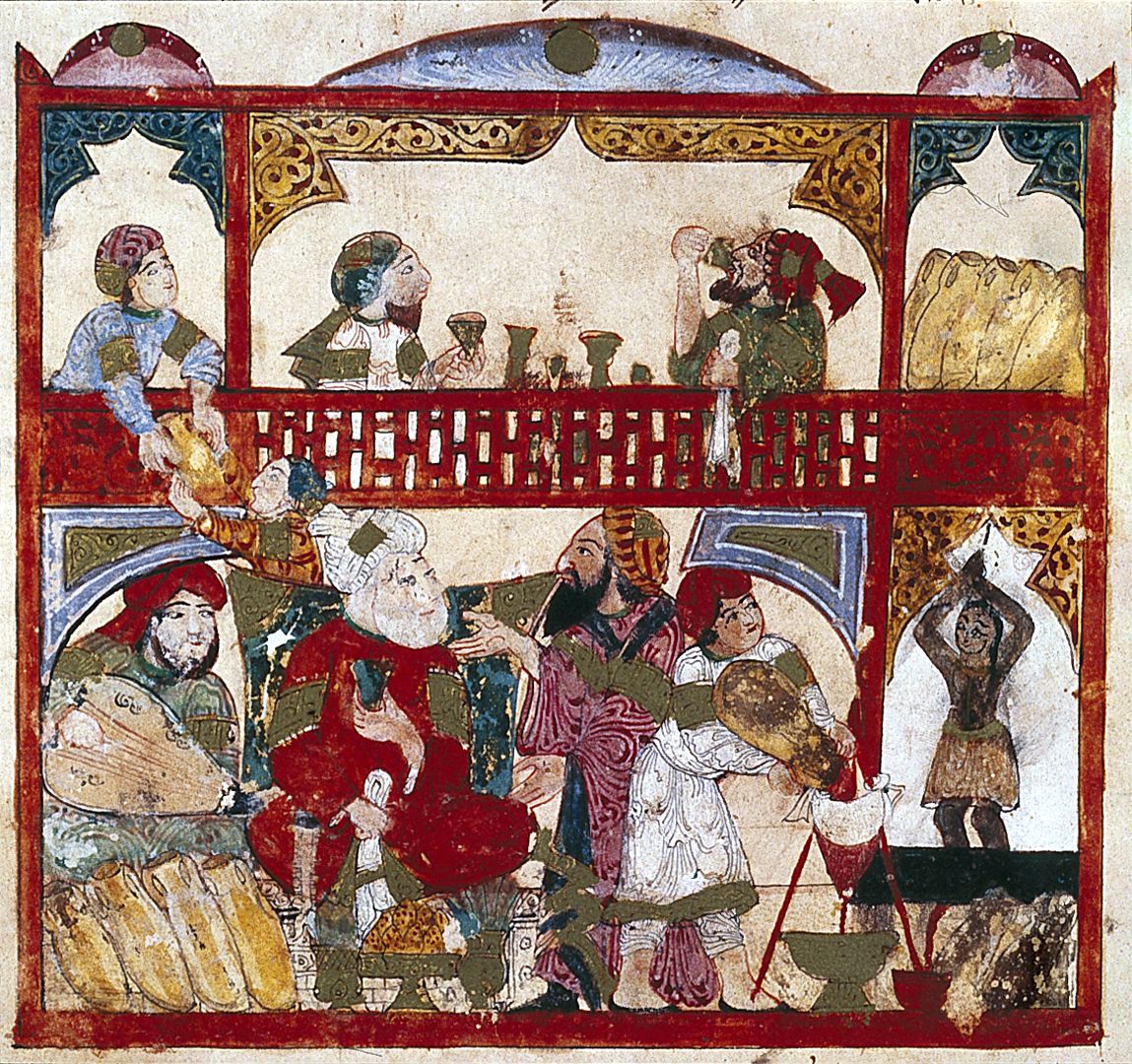
The "holy man" was in fact a con man. And there’s no doubt from the context wine means wine. Certainly the thirteenth century artist who drew this illustration of the scene for an illuminated manuscript thought so. The guy in the lower right stomping the grapes clinches it.

The characters in the Maqamat were practically teetotalers compared to those in the most famous collection of stories from the medieval Muslim world, The Thousand and One Nights. I ran a search on the Richard Burton translation and found 783 instances of the word wine (okay, that includes the footnotes, but I think I made my point). While the narrator of the The Maqamat considered the consumption of alcohol to be “foulness,” the drinking parties in the Nights are presented very matter-of-factly, as if they were a perfectly normal part of life. You’d be surprised at who would show up:

Now the warmth of wine having mounted to their heads they called for musical instruments; and the portress brought them a tambourine of Mosul, and a lute of Irak, and a Persian harp; and each mendicant took one and tuned it; this the tambourine and those the lute and the harp, and struck up a merry tune while the ladies sang so lustily that there was a great noise. And whilst they were carrying on, behold, some one knocked at the gate, and the portress went to see what was the matter there. Now the cause of that knocking, O King (quoth Shahrazad) was this, the Caliph, Harun al-Rashid, had gone forth from the palace, as was his wont now and then, to solace himself in the city that night, and to see and hear what new thing was stirring; he was in merchant’s gear [i.e. traveling in disguise], and he was attended by Ja’afar [the Barmakid], his Wazir [prime minister], and by Masrur his Sworder of Vengeance. As they walked about the city, their way led them towards the house of the three ladies; where they heard the loud noise of musical instruments and singing and merriment; so quoth the Caliph to Ja’afar, “I long to enter this house and hear those songs and see who sing them.” Quoth Ja’afar, “O Prince of the Faithful; these folk are surely drunken with wine, and I fear some mischief betide us if we get amongst them.” “There is no help but that I go in there,” replied the Caliph.

Harun al-Rashid is considered by many to be the greatest caliph of all time. And although he didn’t drink on this occasion—he excused himself on the grounds of “vows of pilgrimage”—he sure didn’t mind that everyone around him partook, especially considering that he was the leader of the Muslim world, responsible for the enforcement of shari’ah. As for Ja’afar, he’s presented as somewhat more strict, attempting to keep himself and the caliph away from a place where wine was being served. But the Thousand and One Nights is a work of fiction. Harun al-Rashid and Ja’afar ibn Barmak’s real-life carousing was considerably more wild. I’ll tell you about that in the next installment.

Michael Isenberg drinks bourbon and writes novels. His latest book, The Thread of Reason, is a murder mystery that takes place in Baghdad in the year 1092, and tells the story of the conflict between science and shari’ah in medieval Islam. It is available on Amazon.com
[1] Palmer Translation. [2] Sahih Muslim, trans. Abd al-Hamid Siddiqui (2009), book 17, Hadith numbers 4226–31. [3] Tirmidhi 43:3031 https://sunnah.com/tirmidhi/43. [4] Ouseley MS #140, Verse 81, Heron Allen translation. [5] Maqamat, #12, Thomas Chenery translation.