Showing posts with label Omar Khayyam. Show all posts

Monday, May 18, 2020

Turn a Goblet Upside Down

Omar Khayyam, born on this day in 1048, was a brilliant scientist and a talented poet. But was he a good Muslim?

It sometimes feels like the phrase “Golden Age of Muslim Science” is a misnomer. Yes, there may have been cutting edge scientific research in the lands ruled by the caliphs during the Middle Ages. But those great scientists you hear about weren’t such great Muslims. Not to mention that they were often persecuted by their co-religionists. It almost seems like their accomplishments were in spite of Islam, and not because of it.

I exaggerate, of course. Still, there’s some truth to it. Avicenna violated the shari’ah nightly by drinking wine while he wrote, his spectacular productivity fueled by the fruit of the vine. Ibn Haytham's books were burned in Baghdad. In a stunning act of impiousness, Rhazes took on the Quran itself, “a work which recounts ancient myths,” he wrote, “and which at the same time is full of contradictions and does not contain any useful information or explanation.”1

Then there’s Omar Khayyam. Today’s his birthday, May 18.2 Born in 1048 in the city of Nishapur, in what’s now Iran, Omar had become one of the leading scientists of his time by age 26, when the sultan Malik-shah tapped him to head up the royal observatory and reform the calendar. Thanks to Edward Fitzgerald’s bestselling English translation of his verses, The Rubiayat, he is also one of the leading poets of all time.

So Omar Khayyam was a brilliant scientist and a gifted poet. But was he a good Muslim?

Well, it's complicated.

His contemporaries and near-contemporaries were divided. Ali ibn Yusuf al-Qifti (d. 1248) said The Rubaiyat may have been pious on the surface, but “inside it are serpents to the shari’ah and shackles on the mosques.”3 The Sufi Najm ad-Din ar-Razi (d. 1256) counted Omar among “the philosophers, materialists, and naturalists.” To a pious 13th century Muslim, them’s fightin’ words. Omar was a “perplexed lost man,” he wrote, who “expressed his blindness” in poems written “in the extremity of wonder and ignorance.”4

Omar’s reputation fared better among people who actually knew him. One of the great Sufi poets, Sanai (d. ca. 1135), wrote, “Omar is attentive to guard the substance of honor of prophecy.”5. The historian Muhammad ibn al-Husayin al-Bayhaqi (d. 1169) wrote that “Sultan Malik Shah treated him as he did his companions, and the sovereign, Shams al-Muluk in Bukhara respected him more than anyone and sat with him on the same throne.” I believe the Shams al-Muluk mentioned here is Shams al-Muluk Nasr (d. 1080), brother of Terken Khatun, who was the wife of Malik-shah and a fascinating and powerful individual in her own right; readers of my novel The Thread of Reason will be familiar with her. In any case, had Omar really been the serpent that al-Qifti would have us believe, it would have been impossible for these respectable monarchs, who had to at least make a show of defending the faith, to honor him so.6

From the same source we learn that Abu Hamid Ghazali (d. 1111), the most influential religious scholar of Omar’s time, couldn’t make up his mind. On one occasion, he was so impressed by Omar’s explanation of some Quranic verses that he exclaimed, “May God increase such learned ones as you; consider me as one of your followers and be amicable with me!” But on other topics, Ghazali was less impressed. Once, when Omar was engaged in a “lengthy elaboration” of how a God who is One can create a universe which is diverse (this problem of “unity and multiplicity” was of great concern to the scientists and philosophers of the day), Ghazali was relieved to have the lecture cut short by the cry of the muezzin, calling the faithful to prayer. “Truth came and falsehood vanished,” he said tartly.

There is no doubt there are aspects of Omar’s life and works that are irredeemably un-Islamic. I’ve written previously about his irreverent humor and obssession with wine. Like all true scientists, he was a skeptic, reluctant to pretend to know things he didn’t, regardless of what was written in scripture or what the powers that be wanted to hear. This got him in trouble on more than one occasion. Al-Qifti again: “When the people of his time censured his faith and his secrets became visible, he feared for his life and stopped his tongue and his pen and arguing impiously, and disclosing impious secrets of secrets.”

Al-Qifti doesn’t tell us exactly what “impious secrets of secrets” put Omar’s life in such danger, but they were serious enough that he had to skip town and go on the Hajj to Mecca to prove his Muslim bona fides.

[After] he returned from his Hajj to his country, he went to the place of worship in the morning, and hid his secrets, and didn’t reveal revelations. And he had no peer in the science of the stars and in wisdom. And in [his heart] beat the example of the type that makes a life of purity. And from fear, he hid his secrets in his soaring poetry. And he muddied his dark, secret meaning with his poetic verses.”7

So what “secrets” did Omar conceal in his “soaring poetry” and what do they tell us about his relationship to Islam?

The author of The Rubaiyat was clearly, at the very least, what we would today call a “cultural Muslim.” His verses teem with mosques, the five daily prayers, and the Fast of Ramadan, not to mention expletives like “By Allah!” and “Muhammad’s Tomb!” These, of course, were the things of daily life in the time and place that he lived, so perhaps we shouldn't read too much into them.

But we can definitely read something into some verses which are unapologetically un-Islamic. IMHO, there’s nothing “muddied” about them. The heresy is right there on the surface.

Where Islam demands a strict regimen of prayer and fasting, and adherence to a code of upright behavior, Omar writes,

So far as in thee lies, follow the example of the profligate,
destroy the foundations of prayer and fasting:
     hear thou the Word of Truth from Omar Khayyam,
“Drink wine, rob on the highway, and be benevolent.”8

Where Islam promises life beyond the grave, Omar is skeptical. Islam is all about eternal life, far more so than Judaism or Christianity. “Threats of Hell and Hopes of Paradise”9 appear in the Quran hundreds of times. The essence of Islam is to not become too attached to this material, temporary, and wicked world, but to secure one’s place in the World to Come. And yet, Omar anticipated Hamlet’s “undiscover'd country from whose bourn no traveller returns” by five hundred years:

Strange, is it not? that of the myriads who
Before us pass'd the door of Darkness through
     Not one returns to tell us of the Road,
Which to discover we must travel too.10

Whatever awaits us beyond the grave, Omar can’t believe it is the Quran’s threat of eternal hellfire. Allah is omnipotent, He predestined our every move (and that’s a very Muslim idea). He would never be so unjust as to punish us for what we cannot control.

Oh Thou, who didst with pitfall and with gin
Beset the Road I was to wander in,
     Thou wilt not with Predestin’d Evil round
Enmesh, and then impute my Fall to Sin?11

Said one—“Folks of a surly Master tell,
“And daub his Visage with the Smoke of Hell;
     “They talk of some sharp Trial of us—Pish!
“He’s a Good Fellow, and ‘twill all be well.”12

Where Islam has a long and proud tradition of religious scholarship, Omar questions its value. The great Doctors of Theology and Shari’ah, like his sometime friend Ghazali, are, at best, wasting their lives on these mysteries. Despite all their ijma (consensus), qiyas (analogy), and ijtihad (interpretation), they are going to die, like all of us.

Myself when young did eagerly frequent
Doctor and Saint, and heard great argument
     About it and about: but evermore
Came out by the same door as in I went.13

At worst, they’re full of it:

To drink wine and consort with a company of the beautiful
is better than practising the hypocrisy of the zealot;14
In the face of such doubts, Omar recommends the very un-Islamic idea of carpe diem:

Some for the Glories of This World; and some
Sigh for the Prophet’s Paradise to come;
     Ah, take the Cash, and let the Credit go,
Nor heed the rumble of a distant Drum!15

Yet despite all his skepticism, heresy, and sin, Omar would only go so far in challenging the doctrines of Islam, and no farther. He never doubted the most fundamental precept—the Oneness of Allah. The oldest collection we have of The Rubaiyat is the Ouseley Manuscript in the Bodleian Library at Oxford. In the very first verse, Omar writes,

IF I have never threaded the pearl of Thy service,
and if I have never wiped the dust of sin from my face
     nevertheless, I am not hopeless of Thy mercy,
for the reason that I have never said that One was Two.16

I think it’s fair to say that Omar Khayyam was a complex figure. The respected scholar, honored by kings, who was nevertheless skeptical of the scholarly enterprise. The freethinker who winked at wine-drinking and other violations of the shari'ah, who nevertheless knew the Quran well enough to earn Ghazali’s praise. The heretic, literally run out of town, who nevertheless never waivered on the fundamental monotheism of Islam. It is this combination of the sacred and the profane which makes him such a compelling character.

If I’m drunk on forbidden wine, so I am!
And if I’m an unbeliever, a pagan or idolator, so I am!
     Every sect has its own suspicions of me,
I myself am just what I am.17

Omar continued to be just what he was well into old age. On what was literally the last day of his life, at age 83, Omar was still delving into the mysteries of the physical universe, still a practicing Muslim, and still aware that the tension between the two put him in need of some forgiveness. His son-in-law (whose name I won't give—that would be a spoiler for the upcoming Thread of Reason sequel) recounted Omar's final hours to the historian Bayhaqi:

He was studying the Shifa [by Avicenna] while he was using a golden toothpick until he reached the section on the “unity and multiplicity.” He marked this section with his toothpick, closed the book and asked his companions to gather so he could state his will of testament. When his companions gathered, they stood up and prayed and Khayyam refused to eat or drink until he performed the night prayer. He prostrated by putting his forehead on the ground and said, “O Lord, I know you as much as it is possible for me, forgive me, for my knowledge of you is my way of reaching you” and then he died.18

Omar asked us to remember him after he was gone—in a way that was true to how he lived:

Friends, when ye hold a meeting together,
it behoves ye warmly to remember your friend;
     when ye drink wholesome wine together,
and my turn comes, turn a goblet upside down.19

In that spirit, here is a toast to Omar Khayyam. Happy 972nd!

Michael Isenberg drinks bourbon and writes novels. His latest book, The Thread of Reason, is a murder mystery featuring Omar Khayyam, and tells the story of the conflict between science and shari’ah in medieval Islam. It is available on Amazon.com

Please follow Mike on Facebook and Twitter.

Subscribe to Islam: the Good, the Bad, and the Everyday

1Starr, S. Frederick, Lost Enlightenment: Central Asia’s Golden Age from the Arab Conquest to Tamerlane, Princeton: Princeton University Press (2013), pp. 181-182. 2Really it should be May 24, since we now use the Gregorian calendar, but the convention among historians is that what happens in the Julian calendar stays in the Julian calendar. 3Qifti, Ali ibn Yusuf al-, Tarih al-Hukama (History of the Scholars), Leipzig: Dieterich’sche Verlagsbuchhandlung (1903), Aug Müller, Julius Lippert, ed, p. 244. Translation mine. 4Abu Bakr Razi, Mirsad al-ibad min al-mabda’ ila’l-ma’ad, Tehran: 1366, p. 31, quoted in Aminrazavi, Mehdi, The Wine of Wisdom: The Life, Poetry and Philosophy of Omar Khayyam, Oxford: Oneworld Publications (2005, 2007), p.53. 5Sana’i Ghaznavi, “Letter to Khayyam,” Danish-namah-yi Khayyami, ed. R. R. Malik, pp. 13-16, quoted in Aminirazavi, op. cit., p. 41. 6Bayhaqi, Z.A. Muhammad ibn al-Husayin al-, Tatimah siwan al-hikmah, Lahore (1351) pp. 116-17. Quoted in Aminrazavi, op. cit., pp. 46-47. 7Al-Qifti, op. cit. 8The Ruba’iyat of Omar Khayyam, Boston: L.C. Page & Co. (1898), Edward Heron-Allen, tr. No. 123. 9Rubaiyat of Omar Khayyam, 2nd Ed., London: Bernard Quaritch (1868), Edward Fitzgerald, tr., No. LXVI. Though Fitzgerald’s translations are beautiful and spark the imagination, they may generously be described as loose. Many quatrains are composites of multiple verses in the original manuscripts, and a handful don’t seem to map to anything Khayyam wrote at all. Where used here, I’ve checked his sources to ensure that, even if the translations don’t capture Omar’s actual words, they accurately capture his thinking. 10Ibid, No. LXVII. 11Ibid, No. LXXXVII. 12Ibid, No. XCV. 13Ibid, No. XXX. 14Rubaiyat, Herron-Allen tr., op. cit., No. 127. 15Ibid, 3d Ed., No. XIII. 16Rubaiyat, Heron-Allen tr., op. cit., No. 1. 17 Khayyam, Omar, The Ruba’iyat of Omar Khayyam, Middlesex, England: Penguin Books (1981), Peter Avery & John Heath-Stubbs, tr. No. 74. 18Bayhaqi, op. cit., 19Rubaiyat, Heron-Allen tr., op. cit., No. 83.

Tuesday, April 28, 2020

Running from what Allah had ordained...

...to what Allah has ordained.
Islam and Plague Part 1: The Theologians.

When one thinks of the relationship between science and religion, the great historical conflicts between the two typically come to mind: the persecution of Galileo by the Roman Catholic Church, for example, or the trial of John Scopes for teaching evolution. Science makes some claim and Religion replies, “That’s heresy!”

But there’s another phenomenon that I've observed over the years. It's kind of the opposite: Science makes some claim, and Religion replies, “We knew it all along!”

Christian writers claim to find conservation of energy, the Big Bang Theory, and dinosaurs in the Bible. Hindus see Heisenberg Uncertainty in Vedic wisdom about the ultimate unknowability of reality. While I was growing up, I often heard my Jewish co-religionists express great pride that our Bronze Age ancestors were millennia ahead of the curve in their insight into the trichinella worm.

One example of this that is particularly timely, thanks to the coronavirus crisis, is that Islam had unique insight into infectious diseases and quarantine centuries before the advent of modern medicine. One hadith in particular (a hadith is a saying of Muhammad or one of his Companions) has been quoted in numerous articles, including this one in The New Yorker: “If you hear of an outbreak of plague in a land, do not enter it; but if the plague breaks out in a place while you are in it, do not leave that place (Sahih Bukhari, Volume 7, Book 71, Number 624).”

Or as today's Koronavirus Karens put it, "Stay the f--k home!"

As I shall show, the alleged foresight of medieval Islam regarding modern germ theory has been greatly exaggerated. Nevertheless, what Muslims did believe—though often contradictory—is interesting in its own right, caught up as it was with fundamental questions about God's power and human destiny. In this post I’ll explore what scripture and theology had to say on the subject. The views of Avicenna and other scientists will be the topic of a future post.

It is impossible to separate any discussion of Islam and plague from the faith’s core tenets, in particular the belief that Allah is all-powerful and everything that happens in Heaven and on Earth unfolds according to His Will. Muslim theologians, especially those of the Ashari school, argued that Will and omnipotence are in fact Allah’s primary attributes. He is not bound by any laws of nature or justice. Miracles are not a departure from the natural order because there is no natural order, no causation, only Allah’s Will. As for the will of human beings—so-called "free" will—there's no such thing as that either. That fantasy is pure blasphemy; it limits Allah's power.

The writings of the towering eleventh century scholar, Abu Hamid Ghazali, is representative of medieval theologians in general and the Ashari school in particular. He delves into the topic at length in his Revival of the Science of Religion in the chapter “Tawhid wa Tawakkal (Monotheism and Reliance on God)”: “Man's will and strength are guided by another,” he writes. “A man is the object or intermediary of God's will and power flow…He who attributes everything to anything other than God is misguided…Everything was written.” The last part echoes verses 54:52-53 of the Quran: "Everything they do is in the writings. And everything small and great is written down."

Such theology inevitably leads to fatalism, a reluctance to act in the face of the impossibility of changing Allah’s decrees. The best we can do is resign ourselves patiently to them, and rely on the benevolence of Allah to ensure that all will turn out well for those who believe. In modern times, Edward Said railed against this characterization of Muslims, which he saw as a racist stereotype: the passive “Oriental.”

But stereotype or not, there is no doubt fatalism is deeply rooted in Muslim scripture. A search on Quran.com for the word patient (صبر) turned up eighty-seven hits. Verse 29:58-60 is typical: “Excellent the reward of the workers, who are patient and on their Lord they rely! And how many a living creature carries not its sustenance! Allah sustains it and yourselves.”

Or as another religion put it, "Consider the lilies of the field; they toil not, neither do they spin."

In another work, The Book of Counsel for Kings, Ghazali told a rather poignant story about the impossibility of taking action to thwart what Allah has written for us. A companion of King Solomon saw Death eyeing him. Fearful that his end was imminent, he asked Solomon to use his magic to teleport him to India in order to escape Death's clutches. Once there, he died that very day. The story ends with Death telling Solomon that the reason he was staring at the man was that he was surprised that someone whose soul was destined to be collected in India could possibly be so far from there.

Even among those Muslims who were inclined toward a more scientific view of the universe, there was a fatalistic streak. It permeates the Rubaiyyat of Omar Khayyam for example. We are

Impotent Pieces of the Game He plays
Upon this Chequer-board of Nights and Days;

If you’ve read my novel The Thread of Reason, you know that despite their on-again off-again friendship, Khayyam and Ghazali were polar opposites, in both personality and in philosophy. When they agreed on something, it must have been deeply ingrained in the culture indeed.

And yet, Muslims are not entirely passive in the face of a deterministic universe. Like all of us, they plan, and work, and fight, as if doing so will have some effect on the world. They lock their doors to prevent thieves from stealing their property and repair their houses to prevent the walls from collapsing. They pray in the hopes of modifying heaven’s terrible decrees. The even eat.

With his characteristic disdain for those who disagree with him, Ghazali explains,

Some think that the meaning of God-reliance is to give up earnings, to give up efforts, and to lie upon the ground like [a] thrown plank or like meat on a [skewer of] wood. This is the conjecture of the fools, it is unlawful in Shari’ah which praises God-reliant men.
For example,

When you are hungry and food is placed before you it is not God-reliance to give it up. This is against law of nature. Similarly if you do not cultivate land and hope for crops or if you do not cohabit with [your] wife but still hope to have a child, it will be madness and not God-reliance.
He then provides a dozen anecdotes about saints who didn’t cultivate the land, or otherwise provide for themselves, and Allah provided for them anyway.

It’s a paradox. Ghazali quotes a hadith which captures it nicely: “The Prophet said to a desert Arab: Why have you let loose your camel? He said: I let it loose depending on God. He said: Tie it and depend on God.”

Or as another religion put it, “Put your faith in God, my boys, and keep your powder dry.”

Any discussion of Islam and medicine in general, and plague in particular, has to be understood in the context of this somewhat dual view of Allah’s omnipotence and man’s agency.

As with other things, Islam teaches that health and disease are entirely controlled by the Will of Allah. And even when there appear to be natural forces at play, such as contagion from one individual to another, it is in fact Allah who is pulling the strings. Thus, we read in the Hadith:

Allah's Apostle said, “There is no contagion, nor jaundice, nor vermin [without Allah’s permission]” A Bedouin stood up and said, "Then what about my camels? They are [as healthy as] deer on the sand, but when a mangy camel comes and mixes with them, they all get infected with mange." The Prophet said, "Then who conveyed the (mange) disease to the first one?" (Sahih Bukhari, Volume 7, Book 71, Number 615)

Disease strikes according to Allah’s plan, which, although it may not seem like it, is benevolent, and should not, therefore, be opposed:

Narrated 'Aisha: (the wife of the Prophet) that she asked Allah's Apostle about plague, and Allah's Apostle informed her saying, "Plague was a punishment which Allah used to send on whom He wished, but Allah made it a blessing for the believers. None (among the believers) remains patient in a land in which plague has broken out and considers that nothing will befall him except what Allah has ordained for him, but that Allah will grant him a reward similar to that of a martyr." (Sahih Bukhari, Volume 7, Book 71, Number 630)

There are two aspects of this I want to emphasize: the seemingly odd notion that plague can be a "blessing," and the last part, the part that says “Allah will grant him a reward similar to that of a martyr,” I can’t underscore its significance enough. It puts a believer who is killed by plague in the same category as a jihadi who is killed in a holy war: they both automatically go to heaven. Another hadith makes this explicit:

The martyrs are of five kinds: one who dies of plague; one who dies of diarrhea (or cholera) ; one who is drowned; one who is buried under debris and one who dies fighting in the way of Allah (Sahih Muslim Book 020, Number 4705).

The insistence that health and disease are entirely a matter of the Will of Allah doesn't preclude doing something about it. The same paradox that exists about other areas of life applies here as well. The book on medicine in Bukhari’s collection of Hadith contains accounts of Muhammad recommending all sorts of antidotes and treatments: dates, cupping, caraway seeds, camel urine, honey (for stomach ailments), talbina (a porridge of barley, milk, and honey), truffle water (for diseases of the eye), incense (inhaled like snuff for tonsillitis and pleurisy), and ruqya (exorcism—for snakebite and scorpion sting). The only treatments he explicitly opposes are cauterization and relieving tonsil pain in children by pressing on the palate with your fingers.

In one hadith, quoted by Ghazali, Muhammad is challenged point blank about the apparent contradiction: “The Prophet was asked about medicines and spells and enchantments: Can they annul the decree God?” Muhammad’s way out: “It is also God's decree.”

We have an early case study on how this paradoxical view of destiny and agency plays out in practice during the reign of the caliph Omar (634-644). Omar had been a Companion of Muhammad and it was during his caliphate that Muslim armies fanned out across the Middle East on a campaign of conquest. In the year 638 or 639, the Plague of Amwas (Emmaus) broke out. Readers of the New Testament will recognize the locale: it’s the village near Jerusalem where Jesus appeared to his disciples after the resurrection. The uncertainty in the date of the plague might indicate there were two waves of infection, as was the case with the Spanish Flu of 1918 and, as some fear, may be the case with coronavirus. As for what kind of disease it was, the sources don’t say, but historians believe it was Bubonic Plague, an aftershock of the Plague of Justinian that ravaged the Byzantine Empire starting in 541.

Omar's dilemma was whether to leave his troops where they were or to withdraw them to safer ground. After travelling about the country, consulting various advisors, and suffering some miscommunications with the commander, Abu 'Ubaida bin Al-Jarrah—there was a whole rigmarole that I won't bore you with—he finally settled on withdrawal. A hadith tells us the decision subjected him to considerable criticism:

Abu 'Ubaida bin Al-Jarrah said (to 'Umar), "Are you running away from what Allah had ordained?" Omar said, "Would that someone else had said such a thing, O Abu 'Ubaida! Yes, we are running from what Allah had ordained to what Allah has ordained.

No matter which choice Omar made, what Allah ordained would prevail. Indeed, his decision to move the troops to safety did not prevent the plague from decimating the army. Twenty five thousand Muslims died, including Abu ‘Ubaida.

The hadith continues,

At that time 'Abdur-Rahman bin 'Auf, who had been absent because of some job, came and said, "I have some knowledge about this. I have heard Allah's Apostle saying, 'If you hear about it (an outbreak of plague) in a land, do not go to it; but if plague breaks out in a country where you are staying, do not run away from it.'” Omar thanked Allah and returned to Medina. (Sahih Bukhari, Volume 7, Book 71, Number 625)

Which brings us full circle to the hadith with which I started this post, and we can now revisit it within the framework of medieval Muslim theology. The reiteration of the hadith inside a broader narrative about Allah’s Will being carried out at Emmaus, regardless of what we impotent humans do, is a smoking gun, giving us context that wasn’t available in the shorter version I cited above. Other variations (Sahih Muslim Book 026 Number 5493-5499) are equally enlightening; they say explicitly that the reason one should neither go to a place that is plague-stricken, nor flee from one, is “It is a calamity or a disease which Allah sent to a group of the Children of Israel, or to the people who were before you.”

Clearly, as it was understood by the theologians of the time, the hadith is not about anticipating modern quarantine methods to prevent the spread of disease. Rather it is a command to be patient and acquiescent in the face of Allah’s plan. If Allah's plan is to punish you with plague for your sins, you cannot escape death by fleeing from it. If His plan is not to "bless" you with plague for your faith, you cannot achieve martyrdom by chasing after it. Either way, do not try to change the outcome. You cannot succeed.

NEXT UP—What the medieval Muslim scientists had to say. As we will see, it is equally rife with contradictions.

Michael Isenberg drinks bourbon and writes novels. His latest book, The Thread of Reason, is a murder mystery that takes place in Baghdad in the year 1092, and tells the story of the conflict between science and shari’ah in medieval Islam. It is available on Amazon.com

Please follow Mike on Facebook and Twitter.

Subscribe to Islam: the Good, the Bad, and the Everyday

Tuesday, December 3, 2019

A Thousand Years of Aptitude

Lost Enlightenment: Central Asia’s Golden Age by S. Frederick Starr.
Book Review by Michael Isenberg.

The title of S. Frederick Starr’s 2013 book, Lost Enlightenment: Central Asia’s Golden Age incorporates two controversial ideas: first, that Central Asia ever had a Golden Age, and second, that it was lost. Granted, these are controversial with two distinct group of people. More about that in a moment.

In his sprawling tour de force, Starr, the founding chairman of John Hopkins’s Central Asia-Caucasus Institute and Silk Road Studies Program, covers some thousand years of the history of Central Asia, a region roughly corresponding to modern Afghanistan, Turkmenistan, Uzbekistan, Kyrgyzstan, and eastern Iran (Khorasan). Starr argues that for the first five hundred years or so, starting with the time of the Muslim conquests (although the roots go back further), the region experienced a cultural flowering that led the world in astronomy, medicine, philosophy, poetry, architecture, craftsmanship, and a host of other fields. But around the year 1100, the Muslim world turned its back on the sciences, and Central Asia went into a long decline.

My Right-of-Center friends find controversy in the claim that there ever was a Golden Age in Central Asia or any other part of the Muslim world (For a discussion of whether there was a Golden Age in Muslim Spain, see my series Did the Islamic Golden Age in Spain really happen? A Debate). On this point, Starr presents abundant evidence that they’re wrong. We meet a colorful cast of thinkers, writers, builders, and experimenters. They were far too numerous to do justice to here, but a few names stand out, Renaissance men centuries before the European Renaissance.

Of course, first and foremost is my personal favorite, Omar Khayyam (1048-1131)—astronomer, mathematician, poet, scholar of shari'ah, and lover of wine. But since I’ve already written a few words about him elsewhere, I’ll use this space to talk about some of the other lamps of the Central Asian Enlightenment instead.

Muhammad ar-Razi (854-925), for example, known in the West as Rhazes. A dedicated physician, his influence extended far beyond the Muslim world—his book on measles and smallpox (he was the first ever to distinguish the two) saw forty European editions from 1475 to 1866. I previously shared an amusing story about his ingenious but risky cure for an emir’s arthritis.

Rhazes also indulged in some theological speculations, and my Right-of-Center friends will find some vindication in the fact that he wasn’t a very good Muslim in this department. The Quran, in a number of places (e.g. 11:13, 17:88), challenges anyone who is skeptical that it is really the word of Allah to write a book like it. Rhazes went on a tirade about that. “By God, what you say astonishes us! You are talking about a work which recounts ancient myths, and which at the same time is full of contradictions and does not contain any useful information or explanations. Then you say: ‘Produce something like it?’”

Then there was Abu Rayhan Biruni (973-1050), who during a less than stellar career as a diplomat managed to become the leading astronomer of his time. He invented specific gravity, wrote an encyclopedia of India, and calculated the circumference of the earth to within eleven miles of the modern value. Given its size, and that only two-fifths of it had been accounted for, he didn’t believe that all the rest could be ocean. He hypothesized that there must be another continent somewhere in the Western Hemisphere. Granted, Starr probably went too far in subtitling that discussion “Biruni Discovers America.”

At a time when most scientists believed that the earth was the immovable center of the universe, Biruni made considerable strides in developing a theory of a sun-centered solar system with a rotating earth. On that point, he engaged in a heated and occasionally insulting correspondence with the granddaddy of the Central Asian Enlightenment, Abu Ali ibn Sina (980-1037), better known in the West as Avicenna.

Avicenna spent his days as a physician and a government official, and his nights writing books and drinking wine (another not very good Muslim). His encyclopedic Canon of Medicine was the handbook of the physician’s art in both Europe and Asia for centuries. But his life wasn’t all bureaucracy and scholarship. He had declined the invitation of the thuggish Sultan Mahmud of Ghazna to join his court, and therefore had to spend some years on the lam, during which he had many narrow escapes.

While he kept his distance from Mahmud, Avicenna did accept the patronage of numerous other rulers. Indeed, all of these monster minds benefited from the generosity of sultans and viziers, who built glittering courts where they collected intellectuals and craftsmen the way squirrels collect nuts. They provided the instruments and books needed—some of their libraries stretched into the tens of thousands of volumes. Perhaps more important, they provided the company of like-minded people, to supply the back and forth that’s so crucial to scientific discovery.

If the Right is dubious that there was ever a Central Asian Enlightenment, the Left is dubious that it was ever “lost.” Indeed, some critics—Sonja Brentjes, for example, from the Max Planck Institute for the History of Sciences—drag out the tired old accusation that the claim is racist. Well, history is what it is, and it's not racist to establish the truth about it. Nevertheless, it is definitely much harder to establish the absence of something than its presence. Which is what Starr sets out to do in the last hundred pages or so of Lost Enlightenment.

The turning point, he argues (as have many others, including me), was the publication of The Incoherence of the Philosophers by the religious hardliner Abu Hamid Ghazali around 1095. In it, Ghazali argued that scientists and philosophers were at best useless—they couldn’t prove the great truths of the Muslim religion—and at worst heretical, deserving of execution. But then, how could it be otherwise? The whole scientific enterprise was based on the earlier ideas of Greeks and Indians—unbelievers in Islam.

Ghazali’s book was hugely influential. After it came out, kings still built glittering courts and stocked them with craftsmen, poets, and scholars of shari’ah (Muslim law). The buildings were more spectacular than ever. “No art surpasses architecture in its appeal to dictators.” But philosophers and scientists were noticeably absent. And when they did appear—the astronomers Nasir ad-Din Tusi and Ulugh Beg, for example—it just wasn’t the same. “Something important has been lost.” Starr hypothesizes it was the Greek and Indian ideas, the grains of sand that produced the pearls of culture, now anathema, thanks to Ghazali. Whatever the reason, the spark was gone. The Muslim world had so little interest in spreading new ideas that the first book printed by a Muslim using movable type would not be published until 300 years after Gutenberg.

I did have one criticism of Lost Enlightenment. I noticed several errors in Starr’s discussion of the Seljuq period (1037-1153)—the period with which I’m most familiar because of my own writing. They were minor in nature—names and dates that were incorrect—and never detracted from the main points. But still.

To his credit, in addition to laying out his arguments that the Central Asian Enlightenment became lost after flourishing for so many centuries, and the reasons that happened, Starr systematically addresses the arguments against his hypothesis. But in the end, he admits it’s not worth spending too much time on. “We feel little need to discover the cause of a nonagenarian’s death.” We can learn far more that it useful for own times by discovering how it lasted so long.

Michael Isenberg drinks bourbon and writes novels. His latest book, The Thread of Reason, is a murder mystery that takes place in Baghdad in the year 1092, and tells the story of the conflict between science and shari’ah in medieval Islam. Starring Omar Khayyam and Abu Hamid Ghazali, it is available on Amazon.com

Please follow Mike on Facebook and Twitter.

Photo credit(s): Princeton University Press

Tuesday, November 19, 2019

If I do not drink wine, God’s knowledge was ignorance

The humor of Omar Khayyam.

by Michael Isenberg.

When we think of the great figures of history, one trait that we tend not to think of is humor. After all, they were busy waging war, handing down laws, writing philosophical tomes, and making world-altering scientific discoveries. Surely these things are no laughing matter.

But of course that’s not true. They were human beings, and like all human beings, some are stiffs, others will have you rolling on the floor laughing. Abraham Lincoln was constantly telling jokes (There was a good one in the 2012 movie about him, starring Daniel Day Lewis, although I don't know if it's one of the jokes Lincoln told in real life. It involved Ethan Allen and a picture of George Washington in an English privy.). Churchill’s rejoinders against various antagonists, mostly female, are world-famous (“Winston, you’re drunk.” “Bessie, you’re ugly. And tomorrow morning, I’ll be sober.”) Ronald Reagan made the age issue in his re-election campaign completely go away with a well-timed zinger (“I am not going to exploit, for political purposes, my opponent’s youth and inexperience”). Even his opponent was laughing.

Certainly humor is not the first thing that comes to mind when one thinks of Omar Khayyam (1048-1131). For westerners, that would be his poetry, The Rubaiyat. Omar was a scientist at a time when the Muslim world was in the throes of turning its back on science. So it’s no surprise that The Rubaiyat is a world-weary collection of verses. Among the themes are the futility of knowledge and the inevitability of death:

Myself when young did eagerly frequent
Doctor and Saint, and heard great argument
          About it and about: but evermore
Came out by the same door as in I went.

With them the seed of Wisdom did I sow,
And with my own hand wrought to make it grow:
          And this was all the Harvest that I reap'd—
“I came like Water, and like Wind I go.” (1)

And yet, amid these grim sentiments, there are flashes of humor, no doubt Omar's way of dealing. Omar generally marshalled it in the service of rationalizing his wine-drinking, another way of dealing. Wine, of course, is prohibited in Islam.

I drink Wine; my Enemies, high and low,
Say—“Do not drink it; ’tis Religion’s Foe.”
          When I learned wine was a Foe, I answered—
“’Tis permitted to drink the Foe’s Blood, though.” (2)

In another bit of twisted logic, Omar argues that God doesn’t mind, and anyway, if Omar doesn’t imbibe, God would be diminished:

I drink wine, and every one drinks who like me is worthy of it;
My wine-drinking is but a small thing to Him;
          God knew, on the Day of Creation, that I should drink wine;
If I do not drink wine, God’s knowledge was ignorance. (3)

Besides, how can wine be a sin? God created it. It’s blasphemous to say it’s sinful! And if it is a sin, well, it’s God’s fault if we drink. He put temptation in our path.

Why, be this Juice the growth of God, who dare
Blaspheme the twisted tendril as a Snare?
          A Blessing, we should use it, should we not?
And if a Curse—why, then, Who set it there? (4)

In any case, Omar has no intention of repenting:

They say to me, “May God give thee repentance!”
He himself will not give it; I will none of it; let it be far off! (5)

For more about Omar and wine, see my recent post, “A Loaf of Bread, a Jug of Wine, and Thou.”

Omar’s humor spilled over from his poetry into his real life. He perpetrated the only practical joke I’ve come across in my studies of the medieval Muslim world (which, as I’m sure you’ve figured out by now, are extensive). According to Zakariya Qazwini, who lived about a century and a half after Omar,

It was reported that a jurist went to him every day before sunrise, and he studied philosophy with him, but then if he mentioned Omar to other people, he spoke evil of him. Then Omar asked two drummers and the two trumpeters to come and he hid them in his house. Then when the jurist came as normal to read his lessons, Omar commanded them to beat the drums and blow the trumpets. Then the people came from every direction. Then Omar said, “O people of Nishapur, this scholar of yours comes to me every day at this time, and he takes lessons from me. He takes my knowledge when I’m there, and speaks of me as evil when I’m not.” (6)

In another, slightly earlier version of the story (7), the jurist was none other than Abu Hamid Ghazali, the era’s foremost scholar of shari’a, and a key figure in the eradication of science in the Muslim world. As we have other stories about Ghazali studying with Omar, and treating him dismissively, this is plausible. Ghazali’s sense of humor, BTW, tended toward insults.

This last story is from a somewhat later source, the Tarikh-i-Alfi, History of the Millennium, written in the 1580s to commemorate the year one thousand in the Muslim calendar.

It is related that there was in Nishapur an old College, for the repairing of which donkeys were bringing bricks. One day, while the Sage (i.e. Omar) was walking with a group of students, one of the donkeys would on no account enter the College. When Omar saw this, he smiled, went up to the donkey, and extemporized:

“O lost and now returned ‘yet more astray,’
They name from men’s remembrance passed away,
          Thy nails have now combined to form thy hoofs,
Thy tail’s a beard turned round the other way!”

The donkey then entered, and they asked Omar the reason of this. He replied, “The spirit which has now attached itself to the body of the ass formerly inhabited the body of a lecturer in this college, therefore it would not come in until now, when, perceiving that its colleagues had recognised it, it was obliged to step inside (8).

The author Tarikh-i-Alfi, Ahmad Tatavi, cited the story as evidence that Omar believed in reincarnation. This was a rather serious accusation, since most Muslims consider reincarnation to be heresy.

Sounds like Tatavi needed to get a sense of humor.

Michael Isenberg drinks bourbon and writes novels. His latest book, The Thread of Reason, featuring Omar Khayyam, is a murder mystery that takes place in Baghdad in the year 1092, and tells the story of the conflict between science and shari’ah in medieval Islam. It is available on Amazon.com

Please follow Mike on Facebook and Twitter.

Photo credit(s): Pinterest

(1) Rubaiyat of Omar Khayyam, 2nd Edition, London: Bernard Quaritch (1868), translated by Edward Fitzgerald, verses xxx-xxxi.

(2) The Ruba’iyat of Omar Khayyam, Boston: L.C. Page and Company (1898), translated by Edward Heron-Allen, verse 38, adapted by me for rhyme and meter.

(3) Ibid, verse 75.

(4) Fitzgerald, op. cit., verse lxiii.

(5) Heron-Allen, op. cit., verse 64.

(6) Shams Tabrizi, Maqalat (Discourses), Tehran (1377 S.H.), 2nd ed., pp. 301-302.

(7) Qazwini, Zakariya ibn Muhammad, Athar al-bilad wa-akhbar al-‘ibad (Monument of Places and History of God’s Bondmen), Beirut:Dar Sadur, 1960, p. 475. Translation mine.

(8) Zhukovski, V., "Al-Musaffariyé: Containing a Recent Contribution to the Study of 'Omar Khayyām" (a translation of "Umar Khayyam and his 'Wandering' Quatrains"), Journal of the Royal Asiatic Society, Vol. 30 (April, 1898), pp. 349-366.

Monday, October 14, 2019

The Story of the Three Students

How three friends grew up to become the most famous scientist, ruler, and terrorist of their age. But is it true? And what does it mean?

By Michael Isenberg.

CONTAINS SPOILERS FOR THE THREAD OF REASON.

(L to R) Omar Khayyam, Nizam al-Mulk, Hasan-i Sabbah

One of my favorite moments in my novel The Thread of Reason is when the hero, astronomer and poet Omar Khayyam, finally comes face-to-face with the terrorist leader, the mysterious Sheikh of the Mountain, and it turns out to be his long-lost school friend Hasan-i Sabbah.

Recently a reader emailed me to ask, “Is Omar's prior relationship with the Sheikh your invention or based on history?”

The answer is history. Sort of.

It’s called The Story of the Three Students. The third, after Omar Khayyam and Hassan-i Sabbah, was the sultan’s vizier (prime minister) Nizam al-Mulk, who ruled an empire for thirty years, and wielded more power than the sultans he served, Alp Arslan and Malik Shah of the House of Seljuq. Every serious fan of Omar Khayyam knows the story because Edward Fitzgerald, who introduced Omar to the English-speaking world, included it in the preface to his translation of Omar’s poetry, The Rubaiyat.

As far as I know, the oldest version of the story we have is from a biography of Hasan-i Sabbah, The Story of our Lord (Sarguzasht-e Sayyidna), which is believed to be based on his own autobiography. The translation from the Persian here is mine, which was a good trick, because I don’t actually know any Persian, modern or medieval, and Google Translate isn’t very good at it. It was a process.

And the cause of the hatred and terror [between Nizam al-Mulk and Hasan-i Sabbah] was this:

Omar Khayyam, Nizam al-Mulk, and our Lord studied together in a school in Nishapur. And they agreed in principle, according to the strictest rules of honesty and right conduct, to make a pact—sealed by drinking each other’s blood, that whichever of them became the greatest would strengthen and reinforce the other two.

And so it happened, as told in the annals of the Seljuqs, that Nizam al-Mulk came into the vizierate. Omar Khayyam came to pay court to him and reminisce about their childhood together. Remembering the old pact, Nizam al-Mulk said, “I will make you the governor of Nishapur and the surrounding territories.”

But Omar replied that the life of a great man is one of wisdom, virtue, and learning. “You have aspirations to rule an empire,” he said. “But to hand down prohibitions to the common people? I have no such ambitions. Set me on the road to fame and give me an annual stipend.”

And Nizam al-Mulk bestowed upon him ten thousand dinars from the tax revenue of Nishapur, and this stream has flowed every year since then without decrease or obligation.

And our Lord also came, from the city of Ray [near Tehran], to pay court to the Nizam. He reminded him, “Your eminence made me a promise.”

Nizam al-Mulk replied, “You shall have authority from Ray to Isfahan.”

Our Lord was an excellent choice for the job, but he wasn’t satisfied with the offer and turned it down. What he was expecting was a high-ranking position in the ministry. Nizam al-Mulk (who was backed into a corner) said, “Then you shall attend the Sahib al-Jalal, the Sultan.”

But because he knew that our Lord aspired to the same dignity and level in the ministry that he held himself, Nizam al-Mulk kept a close eye on him.

The story goes on to tell how Hasan-i Sabbah attempted to undermine Nizam al-Mulk by preparing a budget faster than Nizam al-Mulk could, how Nizam al-Mulk turned the tables on him by arranging to have a page filched from the account books so that the numbers didn’t add up, and how Hasan-i Sabbah was thereby driven out of the ministry. After a number of other adventures, including imprisonment and shipwreck, Hasan-i Sabbah took over the castle of Alamut, near the Caspian Sea, and became the first Sheikh of the Mountain, founder of the terrorist group known to history as the Assassins. The first person they assassinated: Nizam al-Mulk.

Assassination of Nizam al-Mulk

A fascinating story, but how much is true?

To address that, I start with what we know about its origin.

The assassination of Nizam al-Mulk really did occur, 927 years ago today, October 15, 1092.* It was near the beginning of the Assassins’ century-and-a-half long reign of terror. The discovery of The Story of our Lord came at its end. Alamut surrendered to Mongol forces under Hulegu, grandson to Genghis Khan, in 1256.

Siege of Alamut

Before they razed the place, the Mongols let the Persian historian Ata-Malik Juvaini (1226-1283), who traveled with them, loose in the library, and it was there that he found The Story of our Lord. Juvaini’s partly first-hand account of Genghis Khan and the Mongol invasions, History of the World Conquerer (Tarikh-i Jahan-gusha), is one of our primary sources on the Assassins in general and Hasan-i Sabbah in particular.

Yet, for whatever reason, it does not contain The Story of the Three Students. For that we have to wait several more decades, for the The Compendium of History (Jami at-Tawarikh) by Rashid ad-Din Hamadani (1247-1318), the Jewish-born vizier to Hulegu’s great grandsons. This book is very famous. When you see illustrations of Muslim historical events from some old manuscript, including the two on this post, chances are The Compendium is where they came from; there are a number of beautifully illuminated copies from the 14th & 15th centuries still extant. And The Compendium also incorporates The Story of our Lord in its entirety.

So there are problems with the provenance of the story. We don’t have a version of it until a good 300 years after it took place, and there’s an unexplained gap between Juvaini and Rashid ad-Din.

But those aren’t the only problems. More seriously, the chronology doesn’t work out. In all probability, Nizam al-Mulk was thirty years older than the other two, and couldn’t possibly have been at school with them. Or as Omar exclaims to his assistant upon coming across Hasan-i Sabbah’s original manuscript in The Thread of Reason, “How old do you think I am?”

Granted, in some ways, it’s even more interesting if The Story of the Three Students is not true. Because that means someone made it up, which raises the question, “Why?” And whether true or not, people took the trouble to record and transmit it, which against begs the question, “Why?”

Omid Safi, Professor of Islamic Studies at Duke University, offers an answer in his 2006 book The Politics of Knowledge in Premodern Islam: Negotiating Ideology and Religious Inquiry. The Politics of Knowledge was a groundbreaking work in deconstructing what has been called The Great Seljuq Myth, the notion that the Seljuq sultans, and their vizier Nizam al-Mulk, were the defenders of the faith: the guardians of Islamic orthodoxy and the protectors of the nominal head of the religion, the caliph.

Professor Safi’s thesis is that the myth of orthodoxy was a narrative crafted for the purpose of propaganda, to confer legitimacy on the Seljuqs. Legitimacy is important for any government, but especially in the Muslim world, where there has been bitter warfare over who is the true successor to the Messenger Muhammad, almost from the moment that he breathed his last. And especially for the Seljuqs, who had only comparatively recently ridden in from the steppes of Central Asia and usurped power.

In Safi’s view, The Story of the Three Students is such an outstanding example of the Great Seljuq Myth in action that he saves it for his concluding chapter, to summarize his thesis. Nizam al-Mulk symbolizes True Religion in this analysis. Omar Khayyam was somewhat less orthodox, a practitioner of the profane sciences. I’ve written previously about the controversy over his consumption of alcohol—something forbidden in Islam. But he cut a deal with the orthodox Nizam al-Mulk, so he’s okay, set on the road to fame. But Hasan-i Sabbah, who set himself up as a rival of Nizam al-Mulk, is anathema, outcast, the very embodiment of wickedness.

This view of history as narrative is postmodernist in origin; Dr. Safi explicitly acknowledges debts to Edward Said and Michel Foucault. I’ve written in the past why I think Said and Foucault's work is bulls--t, but in this (very rare) case, the postmodern approach seems to be on to something. It will come as no surprise to readers of The Thread of Reason that Nizam al-Mulk, both as portrayed in the book and in real-life, was not very orthodox at times, and the sultan Malik-Shah even less so. One is left wondering how the Great Seljuq Myth became so widely accepted.

Of course as a novelist, I have a somewhat different job than a historian: to entertain. And The Story of the Three Students is definitely entertaining. Not to mention that, thanks to Fitzgerald, it’s too famous to ignore in a book about Omar Khayyam. As for how I get around the chronology problem, I explicitly acknowledge a debt to Dr. Safi and his ideas about narrative in Islamic history. For the specifics, you’ll just have to read my book.

Michael Isenberg drinks bourbon and writes novels. His latest book, The Thread of Reason, is a murder mystery that takes place in Baghdad in the year 1092, and tells the story of the conflict between science and shari’ah in medieval Islam. It is available on Amazon.com.

Please follow Mike on Facebook and Twitter.

*-Sort of. The Julian Calendar was in effect at the time, and the world has since switched to the Gregorian calendar, under which it would have been the 21st of October.

About the illustrations:
- Statue of Omar Khayyam by Hossein Fakhimi at the University of Oklahoma.
- Bust of Nizam al-Mulk, Mashhad, Iran.
- Engraving of the Elder of the Mountain, 19th century, unknown source, CC BY-SA 4.0.
- “The Assassination of Nizam al-Mulk” in Rashid ad-Din Hamadani, Jami at-Tawarikh, Topkapi Museum, Istanbul, Hazine Library Manuscript #1653, folio 360b (14th/15th century).
- "The Siege of Alamut" in Rashid ad-Din Hamadani, Jami at-Tawarikh Bibliothèque Nationale de France, Département des Manuscrits, Division Orientale, Supplément persan 1113, ca. 1430-1434. Public Domain.

Tuesday, September 24, 2019

A Loaf of Bread, a Jug of Wine, and Thou

Did Muslims drink wine in the Middle Ages?
Part IV—Omar Khayyam.
by Michael Isenberg.

Omar Khayyam was a towering figure in the Muslim World at the turn of the 12th century. We in the West know him mainly as a poet, author of the Rubaiyat, but he was also a scientist, a philosopher, a mathematician, the physician of princes, and the companion of sultans.

As the Royal Astronomer, he developed the Jalali calendar, which, with modifications, is still in use in Iran today, and is accurate to one day in 5,000 years. To put that in perspective, the Gregorian calendar we use in the West is accurate to only one day in 3,000 years.

But Omar’s learning was not limited to the physical sciences. His insights into the Quran and the Hadith were well-respected by scholars of Shari’ah such as Abu Hamid Ghazali. To this day, Ghazali is one of the most influential thinkers in Islam. We have a story about him and Omar from the historian Abu’l-Hasan Bayhaqi (d. 1169). Bayhaqi knew Omar; while still a teenager, his dad took him to visit the aging polymath in his hometown of Nishapur, Iran. According to Bayhaqi, Omar once explained some point “concerning a certain verse” (presumably of the Quran) to a group of people, including Ghazali. Ghazali was not an easy man to please, and didn’t always get along with Omar, but on this occasion he exclaimed, “May God increase such learned ones as you; consider me as one of your followers!” Granted, being something of dick, Ghazali then felt compelled to add that he did not expect such a stellar analysis from a scientist [1].

Needless to say, Muslims in general, and Iranians in particular, are proud to have such a brilliant and pious scholar and poet among their numbers. Omar’s beautiful mausoleum in Nishapur was rebuilt in the last century. It is set amid tall pine trees and colorful gardens in what is otherwise a brown and dusty town surrounded by brown and dusty farmland. The park rather stands out on the satellite image. Nearby are the Khayyam Planetarium and Khayyam Boulevard.

And yet, there’s a fly in the ointment: Wine. The oldest collection of Omar’s poems we have is the Ouseley Manuscript in the Bodleian Library at Oxford, transcribed in 1460. Out of the 158 verses that appear there, 90 of them, by my count, or 57%, are about wine—something prohibited in Islam.

I began this series on Islam and wine by citing some of the verses in the Muslim scripture that prohibit the use of alcohol, but I also observed that the literature of the Middle Ages suggests that the prohibition was not very well enforced. In Part II, I backed that up with examples from the history books. Religious hardliners like Ghazali were not happy with wine shops all over town and drinking parties in the palaces. In Part III I wrote about how they struck back, with some success. Since I appropriated Omar Khayyam as the hero of my latest novel, The Thread of Reason, it seems fitting to wrap up the series with a question that has occupied biographers and historians for centuries: Did he drink?

For such an esteemed personage as Omar Khayyam to be as obsessed with wine as his poetry shows him to be is something of an embarrassment to Muslims.

Some condemned his verses. The historian Abu’l-Hasan al-Qifti (d. 1248) wrote that Omar’s poems “are inwardly like snakes who bite the Shari’ah.” [2]

But others attempted to explain them away, and these attempts began almost the moment Omar drew his final breath. The wine in the Rubaiyat, they said, should be interpreted symbolically. Numerous theories have been proposed as to what exactly it symbolizes, but the most common is that it symbolizes the joy of mystic communion with Allah. According to this theory, Omar was an adherent of the Islamic esoteric movement known as Sufism, and the wine in his poetry should be understood in that light, as it is for other prominent Sufi poets such as Rumi and Hafiz. Thus, the question of what wine symbolizes in the Rubaiyat cannot be separated from the question of whether Omar Khayyam was a Sufi.

The theory is not entirely without merit. There are certainly many verses in the Rubaiyat where this interpretation would make sense. Consider one of the most famous:

A Book of Verses underneath the Bough,
A Jug of Wine, a Loaf of Bread—and Thou
          Beside me singing in the Wilderness—
Oh, Wilderness were Paradise enow! [3]

It’s certainly plausible, but by no means certain, that all the elements of Sufism are there. The wilderness is the dwelling of the holy man. Ishmael, Moses, Jesus—they all found Allah in the desert. The loaf of bread is the simple diet of the Sufi. The book of verses is his song. As for the jug of wine, it’s the ecstasy of communion with Allah, the ‘Thou,’ singing beside the ‘me.’

Further, Ahmad Ghazali (d. ca. 1123), who probably knew Omar, included some of Omar's verses in his Treatise on Preaching, a collection of Sufic verses and commentary [4]. Ahmad was the brother of the aforementioned Abu Hamid Ghazali and a prominent Sufi himself. That he included Omar's verses in such a collection suggests that he viewed Omar as a Sufi himself.

But there is no corroboration of that from Omar himself, or any of his contemporaries or near-contemporaries, unless you count Abbas Kayvan Qazwini’s claim that the ghost of Omar Khayyam visited him in a dream and told him it was so [5]. Indeed, it is unusual for someone who has dedicated his life to rational pursuits such as astronomy and mathematics to go in for mysticism. In the same passage where he compares the Rubaiyat to snakes, al-Qifti also tells us that even though “Sufis understood his poems outwardly and considered them to be part of their tradition,” when Omar “arrived in Baghdad, members of [a Sufi] tradition and believers in primary science came to him and began to socialize with him. He did not accept them.”

The debate continues into our own time. Robert Graves, better known as the author of I, Claudius, threw his hat into the ring when he agreed to collaborate with Omar Ali-Shah to publish The Original Rubaiyat of Omar Khayyam (1968), based on a manuscript that had allegedly been in the Shah family for many generations and supported the Sufic interpretation. Alas, Shah never produced the original manuscript, and it is now widely believed that the whole thing was a hoax—of which Graves himself was the greatest victim.

Mehdi Aminrazavi of the University of Mary Washington took on the question in The Wine of Wisdom (2005), unquestionably the best Khayyam biography out there, and an indispensable help to me in writing both The Thread of Reason and this article. On the question of Omar Khayyam and Sufism, Dr. Aminrazavi concludes, “None of his biographers have alluded to his Sufi affiliation, and the one exception I have mentioned previously asserts that Sufis misunderstood his Ruba’iyyat and interpreted them as they wished,” i.e., the al-Qifti passage, cited above. Further, “For all we know, Khayyam neither had a Sufi master nor was he initiated into a Sufi tradition.” Both transmission of knowledge from a master and the initiation ritual are of great importance in Sufism, so their absence in Omar’s case is highly significant.

Although he doesn’t accept that Omar was a Sufi, and therefore the notion that wine in the Rubaiyat represents Sufic communion, Dr. Aminrazavi nevertheless argues for a symbolic interpretation, and indeed he took the title of his book from it: “Khayyam’s use of the concept of wine is as the ‘wine of wisdom,’ a philosophical image which enables one to come to terms with the merciless forces of nature through an all-too-human-wisdom.” Aminrazavi cites a number of verses in support of the wine of wisdom symbolism, including this one:

The mystery is great and the answers are rare
Wise men have searched but you should not care
          Make thy own heaven here with this moment and wine
For the heaven is a fairy tale, nothing but Air.

With all due respect to Dr. Aminrazavi, I disagree with the wine of wisdom metaphor, along with the Sufic metaphor. I believe that when Omar talks about wine in the Rubaiyat, what it symbolizes is…wine. I have two reasons for that. Regarding the first, consider the following, somewhat humorous verses from the Ouseley manuscript: #38,

I drink wine; my Enemies, high and low,
Say—“Do not drink it; ‘tis Religion’s Foe.’
          When I learned wine was a Foe, I answered—
“’Tis permitted to drink the Foe’s Blood, you know.” [6]

And #75,

I drink wine, and every one drinks who like me is worthy of it;
my wine-drinking is but a small thing to Him;
          God knew, on the Day of Creation, that I should drink wine;
if I do not drink wine, God’s knowledge was ignorance. [7]

In these verses, we see that Omar clearly views wine drinking as a sin. He knows it’s prohibited, but he drinks it anyway. He can’t help it. It’s foreordained. Fortunately, Allah is a loving god, and won’t judge him too harshly.

This notion that wine is weakness and sin recurs in seven other verses (#45, 62, 64, 78, 99, 104, and 118). It’s not consistent with the view that wine symbolizes mystic communion—which is not a sin (or at least a Sufi wouldn't say it was). I haven’t run across this angle in the poetry of known Sufis like Rumi. Nor is it consistent with the wine of wisdom—also not a sin in a religion which puts as high a premium on scholarship as Islam does. But wine equals sin makes perfect sense if it’s to be understood as simply plain old tavern-variety fermented grape juice.

The second reason I believe that wine means wine is not based on quite so scholarly an analysis. I’m rather fond of wine myself, and have some experience with it. Reading the Rubaiyat, I just get the gut feeling that Omar knows what he’s talking about.

Michael Isenberg drinks bourbon (and wine) and writes novels. His latest book, The Thread of Reason, featuring Omar Khayyam, is a murder mystery that takes place in Baghdad in the year 1092, and tells the story of the conflict between science and shari’ah in medieval Islam. It is available on Amazon.com

Photo credit(s): touriar.com, Google Maps


[1] Bayhaqi, Abu’l-Hasan, Tatimah siwan al-Hikmah, Lahore (1351 AH), pp. 116-17 [2] Qifti, Abu’l-Hasan al-, Tarikh al-Qifti (History of the Scholars), Leipzig (1903), pp. 243-44. [3] Rubaiyat of Omar Khayyam, 3rd ed. (1872), Edward Fitzgerald, tr., xii. Fitzgerald’s translations tend to be a little loose, and this is actually a composite of #149 and 155 in the Ouseley manuscript, but the Sufic elements I allude to are all there in the original. [4] Ghazzali, Ahmad, Risalah maw’izah, Tehran (1371 AH) Nourbakhsh, ed. [5] Qazwini, A.K. Sharh-i ruba’iyyat-i Khayyam, Tehran (1379 AH), M.R.M. Chahardehi, ed., p. 19. [6] Adapted by me from the translation in The Ruba’iyat of Omar Khayyam, Boston: L.C. Page & Co. (1898), Edward Heron-Allen, tr. [7] Heron-Allen translation, loc. cit.

Tuesday, December 11, 2018

A Juice that Frees thy Heart from a Hundred Pains

Did Muslims drink wine in the Middle Ages?
by Michael Isenberg.

Readers of my novel The Thread of Reason, set in the world of medieval Islam, often tell me how surprised they are to find widespread wine drinking in the book. “Isn’t wine prohibited in Islam?” they ask me.

It certainly is. The Quran bans it in numerous places, for example Chapter 5, Verse 90: “O ye who believe! verily, wine, and [games of chance], and statues, and divining arrows are only an abomination of Satan's work; avoid them then that haply ye may prosper [1].”

The Hadith, the collected sayings of Muhammad and his Companions, which together with the Quran form the basis of Muslim law, is even more strict. It tells us that the penalty for drinking was set by Muhammad and his successor, the caliph Abu Bakr, to forty lashes. But Abu Bakr’s successor, the caliph Omar, raised it to eighty [2]. And it wasn’t merely drinking that was forbidden: also buying it, selling it, transporting it, serving it, and sitting at a table where it is served [3].

Despite these prohibitions, wine was widely enjoyed in the Muslim world during the Middle Ages. We know this from numerous sources. In this post, I’ll share what some of the literature of the time had to say. The poems and stories handed down to us through the centuries may be fictional, but they reflect the attitudes of the writers, and in my opinion they're far better sources for details about daily life than a formal history, which, in the words of Jean Henri Fabre, "records the names of royal bastards, but cannot tell us the origin of wheat." So I'll cover the literature here and, in the next installment, get into more traditional types of historical evidence.

Wine was a favorite topic of poets, especially those in the Sufi tradition such as Rumi and Hafiz. Omar Khayyam, the astronomer and author of The Rubaiyat (and the hero of The Thread of Reason), was obsessed with wine. The oldest collection of his poems we have is the Ouseley Manuscript in the Bodleian Library at Oxford, transcribed in 1460. Out of the 158 verses that appear there, 90 of them, by my count, or 57%, are about wine, including the one from which I took the title of this post:

Every draught that the Cup-bearer scatters upon the earth
quenches the fire of anguish in some afflicted eye.
Praise be to God! thou realizest that wine
is a juice that frees thy heart from a hundred pains [4].

There is some debate as to whether the wine that is so highly praised in Muslim poetry is supposed to be taken literally, or whether it is a symbol for something more spiritual—wisdom, or mystic communion with Allah, for example. The debate is especially controversial in Omar Khayyam’s case; I’ll discuss that in detail in a future post.

While the symbolism of poetry can be hard to interpret, there is no room for interpretation concerning the wine that pours so freely in the prose stories of the time. It symbolizes wine. For instance, liberal imbibing appears in the Maqamat, by Qasim Hariri of Basra. Hariri will be familiar to readers of The Thread of Reason as the spy sent to “take care of” Omar Khayyam during his travels. One story in the Maqamat, for example, concerns a party of travelers who wish to journey from Damascus to Anah, in western Iraq. They are reluctant to set out, however, because they do not have a guard to travel with them and protect them from bandits as they cross the Syrian desert. The problem is solved when a holy man presents himself and promises to keep them safe by means of magic incantations. This unlikely expedient works like, well, like magic, and the party arrives in Anah without incident. They pay the holy man generously, and he scampers off, leaving them wondering where he went:

And we ceased not to seek him in every assembly, and to ask news of him from each that might mislead or guide.—Until it was said, "Since he entered 'Anah he has not quitted the tavern."—Then the foulness of this report set me on to test it, and to walk in a path to which I belonged not.— So I went by night to the wine-hall in disguised habit; and there was the old man in a gay-coloured dress amid casks and wine vats;—And about him were cupbearers surpassing in beauty, and lights that glittered, and the myrtle and the jasmine, and the pipe and the lute.—And at one time he bade broach the wine casks, and at another he called the lutes to give utterance; and now he inhaled the perfumes, and now he courted the gazelles [5].

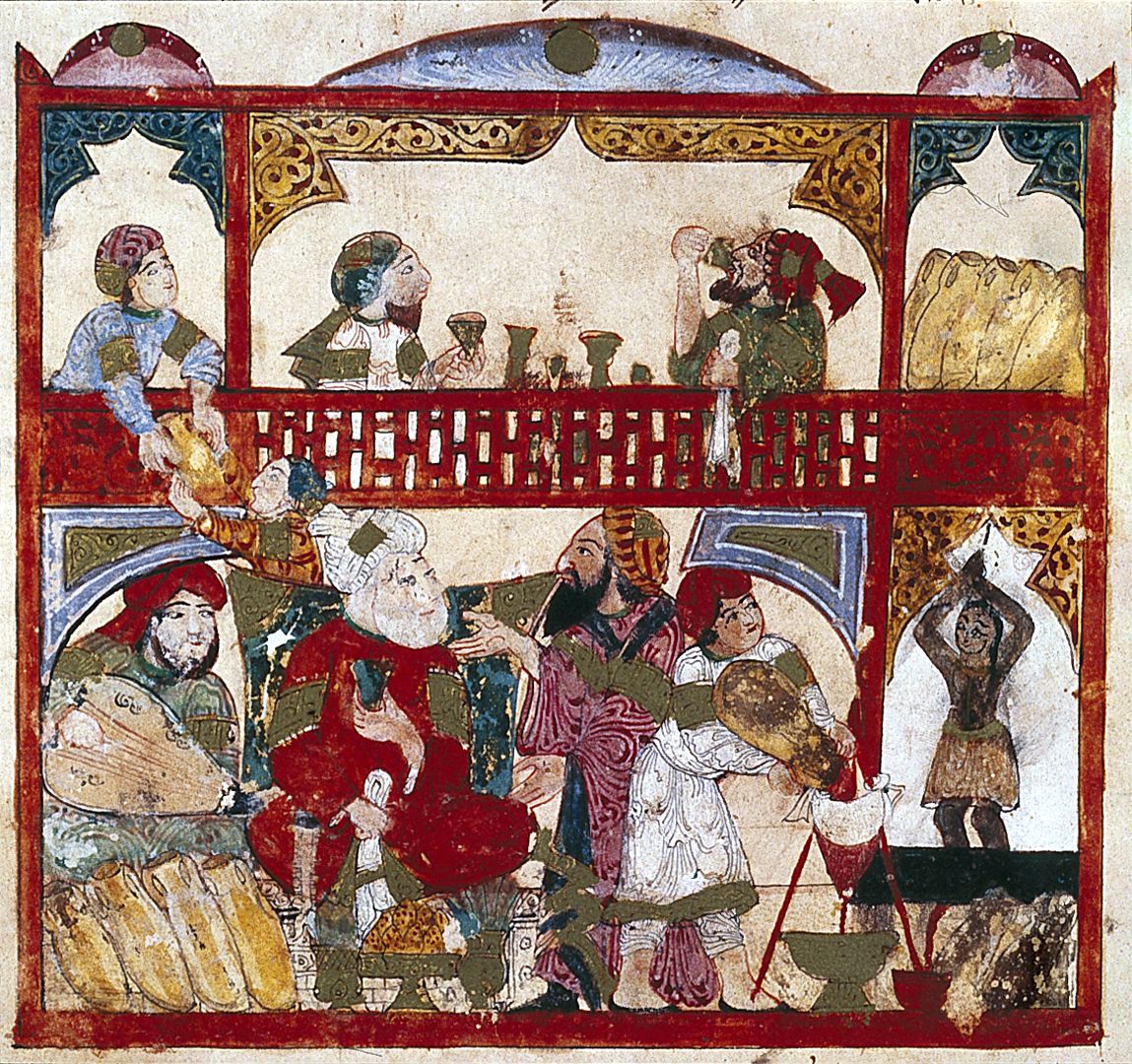
The "holy man" was in fact a con man. And there’s no doubt from the context wine means wine. Certainly the thirteenth century artist who drew this illustration of the scene for an illuminated manuscript thought so. The guy in the lower right stomping the grapes clinches it.

The characters in the Maqamat were practically teetotalers compared to those in the most famous collection of stories from the medieval Muslim world, The Thousand and One Nights. I ran a search on the Richard Burton translation and found 783 instances of the word wine (okay, that includes the footnotes, but I think I made my point). While the narrator of the The Maqamat considered the consumption of alcohol to be “foulness,” the drinking parties in the Nights are presented very matter-of-factly, as if they were a perfectly normal part of life. You’d be surprised at who would show up:

Now the warmth of wine having mounted to their heads they called for musical instruments; and the portress brought them a tambourine of Mosul, and a lute of Irak, and a Persian harp; and each mendicant took one and tuned it; this the tambourine and those the lute and the harp, and struck up a merry tune while the ladies sang so lustily that there was a great noise. And whilst they were carrying on, behold, some one knocked at the gate, and the portress went to see what was the matter there. Now the cause of that knocking, O King (quoth Shahrazad) was this, the Caliph, Harun al-Rashid, had gone forth from the palace, as was his wont now and then, to solace himself in the city that night, and to see and hear what new thing was stirring; he was in merchant’s gear [i.e. traveling in disguise], and he was attended by Ja’afar [the Barmakid], his Wazir [prime minister], and by Masrur his Sworder of Vengeance. As they walked about the city, their way led them towards the house of the three ladies; where they heard the loud noise of musical instruments and singing and merriment; so quoth the Caliph to Ja’afar, “I long to enter this house and hear those songs and see who sing them.” Quoth Ja’afar, “O Prince of the Faithful; these folk are surely drunken with wine, and I fear some mischief betide us if we get amongst them.” “There is no help but that I go in there,” replied the Caliph.

Harun al-Rashid is considered by many to be the greatest caliph of all time. And although he didn’t drink on this occasion—he excused himself on the grounds of “vows of pilgrimage”—he sure didn’t mind that everyone around him partook, especially considering that he was the leader of the Muslim world, responsible for the enforcement of shari’ah. As for Ja’afar, he’s presented as somewhat more strict, attempting to keep himself and the caliph away from a place where wine was being served. But the Thousand and One Nights is a work of fiction. Harun al-Rashid and Ja’afar ibn Barmak’s real-life carousing was considerably more wild. I’ll tell you about that in the next installment.

Michael Isenberg drinks bourbon and writes novels. His latest book, The Thread of Reason, is a murder mystery that takes place in Baghdad in the year 1092, and tells the story of the conflict between science and shari’ah in medieval Islam. It is available on Amazon.com
[1] Palmer Translation. [2] Sahih Muslim, trans. Abd al-Hamid Siddiqui (2009), book 17, Hadith numbers 4226–31. [3] Tirmidhi 43:3031 https://sunnah.com/tirmidhi/43. [4] Ouseley MS #140, Verse 81, Heron Allen translation. [5] Maqamat, #12, Thomas Chenery translation.

Tuesday, October 2, 2018

Conan the Barbarian and The Thread of Reason

Tales of Medieval Islam.
By Michael Isenberg.

“The power of ideas—Allah’s ideas—was all I ever needed.”

Thus spake the Sheikh of the Mountain, the leader of the medieval Assassin cult in real life, and one of the principal villains in my novel The Thread of Reason. In the book, the sheikh captures and imprisons the hero, Omar Khayyam, along with Omar’s assistant, Muhammad Baghdadi. At a confrontation in the sheikh’s study, Omar was characteristically skeptical about the sheikh’s grandiose claims of his power—basically it was the scene from every James Bond movie where 007 confronts the bad guy bent on world domination. But unlike Omar, Baghdadi was intrigued. He wanted to know how the sheikh commanded such unwavering loyalty from his Assassins, who were all too eager to die for their master on a suicide mission. In response, the sheikh offered Baghdadi a demonstration. “Let me prove how powerful an idea can be,” he said. “When it comes from Allah.”

He rose from his cushion and gestured for Baghdadi to follow him to the window. Putting one arm around Baghdadi’s shoulders, he pointed out to the courtyard, where dozens of men were working by torchlight. “Every one of my Assassins is completely dedicated to our cause,” [he] said. “Pick one of them out—any one—and I’ll show you how much.”

Still at the table, Omar was absorbed in extracting the pit from a date when suddenly he jerked his head upward. He had just remembered something: a story from the history books. It gave him a bad feeling about where this was going. He scrambled to get to his feet and join the others at the window.

Baghdadi had made his selection. “That one,” he said. He pointed to a young man stripped to the waist who was hustling across the courtyard at a good clip despite the two baskets of bricks hanging from a pole across his shoulders.

“You there,” the Sheikh of the Mountain shouted. The porter dropped his burden and prostrated himself in the dust. “What is your bidding, O Sheikh of the Mountain?” he shouted back.

“I want you to climb the ramparts and—”

“Stop this right now,” Omar said firmly…

“Why do you say stop? You don’t even know what I’m going to tell him.”

“You mean you’re not planning to order him to jump off the castle wall?”

“Now you spoiled the surprise.”

If the scene seems familiar, it’s probably because you saw something similar in the 1982 sword and sorcery flick Conan the Barbarian. In explaining how he made the transition from warlord to cult leader, the villain Thulsa Doom (James Earl Jones) tells Conan (Arnold Schwarzenegger), “There was a time, boy, when I searched for steel, when steel meant more to me than gold or jewels.”

“The riddle...of steel,” Conan replies.

“Yes! You know what it is, don't you, boy? Shall I tell you? It's the least I can do. Steel isn't strong, boy, flesh is stronger! Look around you. There, on the rocks.” He beckons to one of his followers standing above them on a ridge. “A beautiful girl. Come to me, my child...” The girl calmly steps off the edge of the cliff and plummets to her death.

“That is strength, boy!” says Thulsa. “That is power! What is steel compared to the hand that wields it?”

But lest you think the Sheikh of the Mountain plagiarized Thulsa Doom, it was in fact the other way around. The story has been associated with the Assassin cult ever since the Crusaders returned to Europe with tales of their adventures. Bernard Lewis, in The Assassins: a Radical Sect in Islam, relates “a somewhat questionable story” of one of the later Assassin leaders:

Count Henry of Champagne, returning from Armenia in 1198, was entertained in his castle by the Old Man, who ordered a number of his henchmen to leap to their deaths from the ramparts for the edification of his guest, and then hospitably offered to provide others for his requirements: and if there was any man who had done him an injury, he should let him know, and he would have him killed.

(From the “continuation” of William of Tyre’s History of Deeds Done Beyond the Sea.)

But even in 1198, the story was already old. An earlier version occurred during the Qarmatian Rebellion. The Qarmatians were one of the strangest sects in the history of Islam. They were communists. A dissident Shiite offshoot, dedicated to the brotherhood of mankind, they threw off the authority of the caliphs and established their own egalitarian utopia in the early 900s, with their capital at Lahsa, near Bahrain. Naser-e Khosraw, who visited the Qarmatians around the year 1050, described what he found:

They neither pray nor fast, but they do believe in Mohammad and his mission…They take no tax from the peasantry, and whenever anyone is stricken by poverty or contracts a debt they take care of his needs until the debtor’s affairs should be cleared up. And if anyone is in debt to another, the creditor cannot claim more than the amount of the debt. Any stranger to the city who possesses a craft by which to earn his livelihood is given enough money to buy the tools of his trade and establish himself. If anyone’s property or implements suffer loss and the owner is unable to undertake necessary repairs, they appoint their own slaves to make the repairs and charge the owner nothing. The rulers have several gristmills in Lahsa where the citizenry can have their meal ground into flour for free, and the maintenance of the buildings and the wages of the miller are paid by the rulers.

[From Naser-e Khosraw, Book of Travels (Safarnama), W. M Thackston, Jr., tr. (1986)]

You may wonder how a communist state can afford to be so generous and survive, let alone prosper for 150 years, when every other experiment in communism that litters the pages of history collapsed under the weight of its own poverty. The answer is buried in the passage above: slavery. “At the time I was there,” Khosraw writes, “they had thirty thousand Zanzibar and Abyssinian slaves working in the fields and gardens.”

The Qarmatians supplemented the stolen product of their slaves' labor with plunder from neighboring communities. In 930, for example, under the command of Abu Tahir Suleiman Janabi, they sacked Mecca, killed several pilgrims in the holy precincts of the Kaaba, stole the sacred Black Stone that was kept there, and brought it back to their capital. According to Khosraw, “They said that the stone was a ‘human magnet’ that attracted people, not knowing that it was the nobility and magnificence of Mohammad that drew people [to Mecca].” After Janabi’s death his successors returned it for a ransom. At some point during its theft and captivity it got shattered—to this day a silver frame is used to hold the pieces together.

The raid on Mecca was not the Qarmatians’ only attack on Muslim cities. Two years earlier, Abu Tahir Suleiman Janabi and his men had marched on Baghdad, capital of the Commander of the Faithful, the Caliph al-Muqtadir. Edward Gibbon, in The Decline and Fall of the Roman Empire, tells us what happened next:

Baghdad was filled with consternation; and the caliph trembled behind the veils of his palace. In a daring inroad beyond the Tigris, Abu Tahir advanced to the gates of the capital with no more than five hundred horse. By the special order of Muqtadir the bridges had been broken down, and the person or head of the rebels was expected every hour by the commander of the faithful. His lieutenant, from a motive of fear or pity, apprised Abu Tahir of his danger, and recommended speedy escape. “Your master,” said the intrepid Qarmatian to the messenger, “is at the head of thirty thousand soldiers: three such men as these are wanting in his host:” at the same instant, turning to three of his companions, he commanded the first to plunge a dagger into his breast, the second to leap into the Tigris, and the third to cast himself headlong from down a precipice. They obeyed without a murmur. “Relate,” continued the imam, “what you have seen: before the evening your general shall be chained among my dogs.”

[Spelling updated for consistency with modern use]

Abu Tahir Suleiman Janabi's boastful prediction was not to be. The Qarmatians were driven away from Baghdad and al-Muqtadir, despite a turbulent reign, remained unchained.

I put the “Riddle of Steel” scene in The Thread of Reason because I wanted to make a serious point about the power of ideas and because the book is about the Assassins and the scene is a timed-honored part of Assassin lore. But I couldn't resist poking fun a little at how often it has appeared, not only in Conan the Barbarian and The Thread of Reason, but in many other works as well (1964’s The Long Ships and 2005’s The Keeper: The Legend of Omar Khayyam come to mind). And so, when the Sheikh of the Mountain accuses Omar of ruining his surprise, I have Omar reply, “When Suleiman Janabi performed that demonstration—a century and a half ago—it was a surprise. Now it’s just a cliché.”

As for whether the porter actually jumps, you’ll just have to read the book.

Michael Isenberg drinks bourbon and writes novels. His latest book, The Thread of Reason, is a murder mystery that takes place in Baghdad in the year 1092, and tells the story of the conflict between science and shari’ah in medieval Islam. It is available on Amazon.com

Photo credit(s): You Tube, Crystalinks