Showing posts with label Kurdish independence. Show all posts

Sunday, October 8, 2017

Mideast Week in Review

by Michael Isenberg.

  • ISIS nearly eradicated in Iraq.
  • Kurdistan: Baghdad strikes back.

    ISIS nearly eradicated in Iraq: The Iraqi government announced on Wednesday that it had driven ISIS forces from the town of Hawija, in the north of the country.

    As the map shows, Hawija was the last ISIS stronghold in Iraq, other than a small band along the Euphrates River between the Syrian border and town of Ana. Meanwhile, in Syria, operations continue against ISIS forces around Deir al-Zour. Clearly, ISIS’s days as a “state” with territory are numbered.

    Sadly, I do not expect ISIS to go away. Rather, I predict it will evolve into something that looks more like al-Qaeda, claiming responsibility for terrorist attacks around the world, some which it actually committed, and others, like the tragic shooting in Las Vegas last weekend, which it apparently had nothing to do with.

    Read more—

  • Iraq forces retake town of Hawija from IS (BBC)


    Kurdistan: Baghdad strikes back. As I reported previously, Iraq’s Kurdish Autonomous Region held a referendum last week and chose to secede from Iraq by a mind-boggling 92% of the vote. The referendum is non-binding; most pundits consider it merely an instrument to give the Kurds leverage in negotiating their eventual departure.

    Nevertheless, the Iraqi government has now struck back. Last Friday it announced that it was lowering the ban hammer on international flights to the Kurdish region.

    The Kurds voted for secession because they thought the central government persecutes them. So the government responded by proving them right.

    Read more—

  • Iraq halts international flights to Kurdistan Region (BBC)

    Michael Isenberg writes about the Muslim world, medieval and modern. His forthcoming novel, The Thread of Reason, is a murder mystery that takes place in Baghdad in the year 1092. It depicts the war for the Muslim soul between those who seek to enforce shari’a strictly, persecute Jews and Christians, and stamp out "un-Islamic" science, and those who wink at a few sins, tolerate their non-Muslim neighbors, and write books about science instead of burning them.

  • Monday, September 25, 2017

    Now trending: Kurdistan

    Today is referendum day in Kurdish northern Iraq. Some four million voters turned out to weigh in on whether to secede from the country and establish an independent nation. The Kurds are the fourth largest ethnic group in the Middle East (after Arabs, Persians, and Turks) and the only one out of the four without a state of their own. The referendum is non-binding and will not lead immediately to independence, but if it passes, it should give the Kurds considerable leverage to negotiate with Baghdad for their departure.

    In many parts of the region, a festive atmosphere has reigned for days:

    On Twitter, #Kurdistan is trending.

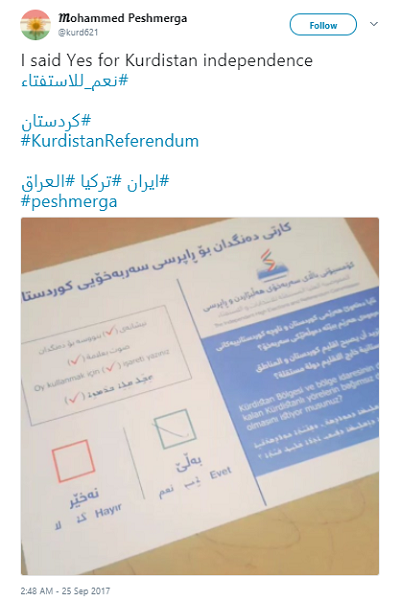
    Just as in the west, many want to broadcast their votes:

    I couldn’t tell if this voter was giving the finger to independence or to someone who voted against it. The caption wasn’t much help, but it’s nice to know that some gestures are universal.

    Many wish the Kurds well:

    Nevertheless, the bid for Kurdish independence has almost no support among the governments of the world, especially Turkey and Iran, who worry that their own Kurdish populations will get ideas.

    Some find significance in the decision of the Turkish and Iraqi armies to begin joint exercises near the Kurdish border today:

    Israel is one of the few nations that have announced support for Kurdish independence. Many welcome this,

    But others see something sinister, as in this loathsome anti-Semitic cartoon:

    Incidentally, despite being depicted as sitting next to Israel at the feast, the US government opposes independence.

    Julian Assange, of Wikileaks fame, posted this cartoon:

    It depicts the Kurdish nation, pierced by the arrows of Iraq, Turkey, ISIS, Iran, and a few others I don’t recognize. Nevertheless, the Kurds persist and climb the ladder of freedom out of the abyss and into the sunlight.

    As we await the results of the vote, I hope that proves prophetic.

    Michael Isenberg writes about the Muslim world, medieval and modern. His forthcoming novel, The Thread of Reason, is a murder mystery that takes place in Baghdad in the year 1092. It depicts the war for the Muslim soul between those who seek to enforce shari’a strictly, persecute Jews and Christians, and stamp out "un-Islamic" science, and those who wink at a few sins, tolerate their non-Muslim neighbors, and write science books instead of burning them.

    Sunday, September 17, 2017

    Mideast Week in Review

    by Michael Isenberg.

  • Kurdish independence.
  • Syria de-escalation.
  • Anti-woman Tunisian marriage law abolished.

    Kurdish Independence: The Iraqi Kurdish Parliament voted this week to proceed with a September 25 referendum on independence from Iraq. The move is opposed by the Iraqi government of course, as well as the governments of Iran and Turkey, which seek to discourage Kurdish separatism in their own countries. The United States also opposes it, on the grounds that it will bring instability to Iraq. But as Masoud Barzani, president of the Kurdistan Regional Government correctly points out, “When have we ever had stability or security that we should be worried about losing it?”

    In light of the significant contributions the Kurds have made to the fight against ISIS, it is my humble opinion that they have earned independence. However, a yes-vote on the referendum will not necessarily lead to that outcome. Some pundits think the intent is merely to strengthen the Kurds’ hand in their negotiations with Baghdad.

    Read more—

  • Kurdish MPs say yes to independence referendum (BBC)


    Syria de-escalation: Turkey, Russia, and Iran have agreed to establish a “de-escalation zone” in Idlib province, Syria, the last major enclave of non-ISIS opposition to the Assad regime. The agreement is significant for two reasons, neither of them good: First, it helps Assad enormously. As I’ve written previously, these escalation zones free him to move his troops around the country and pick off his enemies one at a time. His opponents, pinned down in isolated enclaves, enjoy no such freedom. Second, it shows that the US, who isn’t a party to deal, has nearly completely lost influence in Syria.

    Read more—

  • Syria war: Turkey, Russia, Iran agree Idlib 'ceasefire' zone (BBC)


    Anti-woman Tunisian marriage law abolished: The government of Tunisia abolished a law which prohibits Muslim women from marrying non-Muslims. The new law raises the status of women in the country, putting them on a more equal footing with men as to who they can marry.

    Tunisia is pretty much the only country in the region that has seen positive change come out of the Arab Spring.

    Read more—

  • Tunisian women free to marry non-Muslims (BBC)

    Michael Isenberg writes about the Muslim world, medieval and modern. His forthcoming novel, The Thread of Reason, is a murder mystery that takes place in Baghdad in the year 1092. It depicts the war for the Muslim soul between those who seek to enforce shari’a strictly, persecute Jews and Christians, and stamp out "un-Islamic" science, and those who wink at a few sins, tolerate their non-Muslim neighbors, and write science books instead of burning them.