Showing posts with label Iran. Show all posts

Tuesday, November 5, 2019

The Other Mideast Story

Protests are raging in Lebanon and Iraq. Here are the basics.

By Michael Isenberg.

The gruesome suicide of ISIS “caliph” Abu Bakr Baghdadi as he fled US forces and detonated his suicide vest was a richly deserved and I hope painful end for the bastard. The world is a better place without him, and the story has rightly dominated the headlines from the Middle East during the past week.

But Baghdadi’s death has overshadowed another story, unnoticed by many in the West. Massive protests have virtually shut down two Middle Eastern countries: Lebanon and Iraq. The story is still unfolding, but as with any unrest in that part of the world, there is the potential for the consequences to echo across the globe. (There are other reasons that this story has received so little attention. I’ll come to that later).

The protest in Iraq had been planned for some months. But a couple events in the days leading up to the scheduled October 1 demonstration gave new urgency to it. On September 25 there was a protest outside the office of Prime Minister Adil Abd’ al-Mahdi to highlight the plight of the many Iraqis with advanced degrees who are unable to get jobs. The protest was brutally broken up by authorities. Then on the 27th, al-Mahdi announced his intention to transfer Lieutenant General Abd’ al-Waheb as-Saedi from the Iraqi Counter Terrorism Force to the defense ministry. As-Saedi is a hero of the liberation of Mosul from ISIS terrorists; the decision sparked a firestorm of backlash on social media.

In the wake of these events, the planned demonstration mushroomed beyond all expectation, with demonstrators in Baghdad’s Tahrir Square numbering in the hundreds of thousands and protests spreading to eleven other cities.

Government forces have hit back hard with an arsenal of water cannons, tear gas, and bullets (not the rubber kind). Internet service has been shut down to prevent protesters from learning the harshness of the measures and from using social media to coordinate their activities. The Green Zone, home to parliament, government offices, and foreign embassies, has been barricaded; the government has no intention of allowing a repeat of the 2016 storming of the Iraqi parliament. Unidentifed “security forces” raided the NRT and Tigris satellite channels and the Saudi al-Hadath channel, destroyed and confiscated equipment, and attacked employees, wounding at least one. The cost of the government crackdown has been high. According to The Economist, 250 people have been killed, as of the end of October,

Like the French Revolution, the protests in Lebanon were sparked by a government funding crisis. The Lebanese pound is officially pegged to US currency—1507 pounds to the dollar—and like many countries that interfere with the free market for currency, the result is disastrous. As a poor economy put downward pressure on the pound, the government drained its reserve of dollars in an effort to prop it up. Desperate for cash, the Lebanese government sought to borrow from the World Bank and other international agencies, which demanded harsh austerity measures in return. The resulting package of spending cuts and tax increases proved extremely unpopular—especially the tax imposed on VoIP telephone calls which became known as the “WhatsApp Tax.”

Although sporadic protests were held as early as September, things began in earnest following an October 17 cabinet meeting to discuss the proposals. The protests swelled. According to some estimates, a quarter of the country’s population has participated. Key roadways were blocked. A human chain stretched along the Mediterranean Coast for 100 miles, from Tripoli to Tyre. Although the violence in Lebanon has not come up to the level in Iraq, there have been some fatalities, and things have been getting worse in the last few days, as I discuss below.

Events came to a head October 29, when Prime Minster Saad Hariri declared himself at a “dead end” and resigned. He’ll stay on as a caretaker until a replacement is found. Protests, in the meantime, have shown no sign of slowing.

Commentators are at a loss to figure out what to make of it all. The BBC’s Jeremy Bowen asks, “Is the region slipping into a new Arab spring?” While hedging on the answer, he notes that the issues which led to those 2011 protests are largely unresolved. The Economist noted that Iraq and Lebanon are only two out of numerous countries that have been deluged with mass protests recently, both inside the Muslim world (Algeria, Pakistan) and beyond (Hong Kong, France, and many others). Their writers were at a loss to find common elements in all these protests. After considering and rejecting numerous theories—rising inequality, shifting demographics, foreign conspiracies—they threw up their hands and subtitled their article “Something in the Air.”

Still, there are three grievances that permeate all the reporting from Iraq and Lebanon: corruption, unemployment, and pitiful public services.

Both nations have rigid governmental structures, with certain positions set aside for Sunnis, Shiites, and in the case of Lebanon, Christians. This sectarian spoils system is laid out in agreements that the various parties made to put an end to political violence—the Taif Agreement in Lebanon near the end of its civil war in 1989, and the political settlement reached in Iraq as the Sunni insurgency wound down in 2016/2017. In practice it has yielded a system of patronage jobs under the control of political leaders, who fill them with their relatives and supporters. The protesters demand a “technocratic” government, in which job assignments are made based on skills rather than political connections. Indeed, that is what Prime Minister al-Mahdi in Iraq promised upon taking office, but failed to deliver. This is why the resignation of Prime Minister Hariri in Lebanon hasn’t satisfied the protesters there: they want the whole system replaced.

Unemployment is high in both countries, especially for the young. As of September 2019, the International Labour Organization model estimates that the overall unemployment rate is 7.9% in Iraq and 6.2% in Lebanon. For young people, ages 15-24, the news is significantly worse: 16.5% and 17.6% respectively. These numbers have been consistent for a decade or so. Unofficial numbers are even higher. Last year, Lebanese President Michel Aoun claimed a whopping 46% of the Lebanese labor force is unemployed. The Iraqi economy is burdened by the destruction of infrastructure during fifteen years of war, while Lebanon, a country of some six million people, has had to absorb a million or more refugees from the civil war in Syria.

Both countries are plagued by unreliable infrastructure, and cannot depend on services that we take for granted in the West: trash pickup, electricity, clean water.

As much as I hear my left-of-center friends blame the United States for the travails of the Middle East, that is one thing I haven’t heard from the protesters. The US just doesn’t seem to be on their radar right now. No mention of America in any of interviews I’ve read, and I haven’t seen anything along those lines from the protesters on Twitter either (usual caveat: I’m sure it can be found, but it’s clearly rare).

But there is a country who the protesters do blame for their problems. This aspect of the demonstrations has been largely overlooked in what little press coverage there has been. But it became impossible to ignore Friday night, when rioters in Karbala, Iraq attacked a foreign consulate, threw burning objects over the wall, and replaced its flag with an Iraqi one. The consulate belonged to the Islamic Republic of Iran.

Iran has its Islamist tentacles deep in both Iraq and Lebanon. Iranian-backed militias operate in both countries and Iranian puppets are influential in their governments. As the American Islamic Forum for Democracy’s Zuhdi Jasser pointed out in his podcast yesterday, “The demonstrations in Baghdad this week, as they grow, are a rejection of Iranian colonization of Iraq. They’re a rejection of the corruption of the radical Shia supremacism, of their Shari’a state that they brought from Iran, into Iraq and into Lebanon as Hezbollah has been controlling Lebanon and the same demonstrations are happening.”

Dr. Jasser also opined on why the demonstrations have received so little press coverage, especially compared to the murder of Jamal Khashoggi by agents of the Saudi government a year ago. “Those demonstrations do not fit the narrative. Remember the Obama Administration was knee deep, butts and elbows as they say (there’s another term for it but I won’t say it on my podcast), knee deep with the Iranian regime. Everything at the altar of that nuclear deal. Everything. So the narrative that Iran is not as bad as we think is something that the traditional legacy media is stuck in.”

Iran is clearly feeling the heat in Iraq and Lebanon, and is seeking to deflect it. Unlike the protesters, Iranian leaders are talking about the United States. In a speech to graduating army cadets October 30, Supreme Leader Ali Khamenei said, “The U.S. and Western intelligence services, with the financial backing of reactionary countries in the region, are spreading turmoil,” and recommended that Iraq and Lebanon follow the example of his own country during similar protests in 2017 and 2018: unleash the rent-a-mobs and the military. “They (U.S. and Saudi Arabia) had similar plans for our dear country, but fortunately the people... came out in time and the armed forces were ready and that plot was neutralized.”

In Lebanon, Khamanei’s lap dog, Hassan Nasrallah, leader of Hezbollah, apparently received his barking points. In a speech on October 25, he urged his followers to stop protesting and go home, warning darkly that they were being manipulated by American and Israeli conspiracies. Since then, Hezbollah supporters have attacked and driven away other protesters, smashing chairs, pulling down tents, and violently prying phones out of the hands of anyone who tries to video them.

It appears that Iranian supporters are engaging in similar violent tactics in Iraq. Some of “security forces” firing on the protesters wear black clothing and masks, their affiliations unclear. It’s widely believed that they are members of Iran-backed militias.

I wish the protesters every success in eliminating Iranian influence in their countries and restoring their economies. It will be an uphill battle however. The political settlements that are responsible for so much corruption were hammered out with great difficulty among enemies who had until then been at each other’s throats. They wouldn’t be easy to re-negotiate under the best of circumstances, and certainly not with powerful interests vested in the status quo. And if Iraq and Lebanon really want their economies to flourish, they need to unleash the power of free markets, rather than relying on government controls like pegged currencies. Sadly, capitalism is not popular in that part of the world. The real tragedy is that in two centuries of reforms and dashed hopes, the nations of the Middle East have tried everything but freedom.

Michael Isenberg drinks bourbon and writes novels. His latest book, The Thread of Reason, is a murder mystery that takes place in Baghdad in the year 1092, and tells the story of the conflict between science and shari’ah in medieval Islam. It is available on Amazon.com

Please follow Mike on Facebook and Twitter.

Photo credit(s): Wikipedia/FPP under Creative Commons License CC BY-SA 4.0

For further reading—

  • 2019 Iraqi protests (Wikipedia). Many people look down on Wikipedia, but frankly, I thought in this case, they had some of the best coverage out there for giving the big picture.
  • 2019 Lebanese protests (Wikipedia)
  • Why are so many countries witnessing mass protests? - Something in the air (The Economist, Nov 4)
  • Iraq unrest: Protesters attack Iranian consulate in Karbala (BBC, Nov 4)
  • Protests in Iraq are met with violence (The Economist, Oct 31)
  • Pointing to Iraq, Lebanon, Khamenei recalls how Iran put down unrest (Reuters, Oct 30)
  • Amal and Hezbollah supporters overrun Beirut protesters (The National, Oct 29)
  • Is a new Arab Spring unfolding in the Middle East? (BBC, Oct 29)
  • Iraq protests: What's behind the anger? (BBC, Oct 7)
  • قوات أمنية تداهم قناتين فضائيتين في بغداد (Security forces raided two satellite channels in Baghdad, al-Hurra, Oct 5)
  • Reform This! with Dr. Zuhdi Jasser, Ep 43 | The Long War against Jihadists (Blaze Radio Network, Nov 4)
  • Tuesday, September 17, 2019

    The Saudi Oil Facility Attacks: What the US Should Do Now

    It will take more than tweets for President Trump to show the Iranians that they will not benefit from attacking the world’s energy supply.

    by Michael Isenberg.

    The video was quite dramatic. Mountains of white-orange flame dwarfing the buildings and lighting up the sky. Billows of red smoke trailing off into the night.

    The attacks on the Saudi oil facilities, believed to be from a combination of cruise missiles and drones, struck the Abqaiq processing plant and the Khurais oil field at 4 AM Saturday morning. The Saudi government reported that there were no fatalities or injuries, fortunately, but the Abqaiq facility will be offline for an undetermined period of time. The facility removes sulfur from some 5 to 7 million barrels of oil a day, about half of Saudi Arabia’s production, and around 5% of the world’s oil supply.

    Now that the fires are, if not exactly out, at least “under control,” the question for those of us in the US is what, if anything should we do about it? And that question can’t be separated from the questions of who was responsible for the attacks and what were their motives.

    Who did it?

    Within hours of the attacks, a spokesman for the Houthi rebels in Yemen appeared on their al-Masirah news channel and claimed responsibility. The Houthi, based in the country's western hills, have been at war with their government since March of 2015, in what has been called “the world’s worst humanitarian crisis.” The war has been a stalemate, with little change in the territories subject to government and Houthi control. Almost from the beginning, the Saudi military intervened on the government side, conducting a massive air campaign, but with little effect. In retaliation, the Houthis have launched drone and missile attacks against defense and oil facilities within Saudi Arabia, but none of these earlier attacks were as damaging as Abqaiq and Khurais.

    It’s about 550 miles from Abqaiq to Houthi-held territories in Yemen, within the 930 mile range of the most advanced Houthi drone, the UAV-X. Nevertheless, there is some reason for skepticism whether the Houthis were actually responsible. An anonymous US military source has claimed that the damage to the facilities were on the west-north-west sides, suggesting a direction of attack from Iran, or possibly Iraq, where there are many Iran-backed militias. Indeed, as the map shows, both Iran and Iraq are much closer to the targets.

    In a tweet on Saturday, Secretary of State Mike Pompeo called out Iran explicitly for the “unprecedented attack on the world’s energy supply,” adding, “There is no evidence the attacks came from Yemen.”

    Iran’s Foreign Minister, Javad Zarif, in turn, accused Pompeo of lying. “Having failed at ‘max pressure,’” he tweeted, “@SecPompeo's turning to ‘max deceit.’”

    In my mind, the bottom line as to whether the Abqaiq and Khurais attacks came from the Houthis or the Iranians is: I don’t care. The Houthis are Iranian clients. We know this because of the various Iranian arms shipments to the Houthis, sometimes accompanied by trainers, that have been observed over the years, and sometimes intercepted, most notably the capture of the Jihan One by the Yemeni government in 2013. As far as I’m concerned, Iran is responsible, regardless of where the drones took off from.

    What was their motive?

    Iran’s defenders insist that the Islamic Republic has no motive for carrying out such an attack. I disagree. When it comes to motive, there are numerous possibilities; an embarrassment of riches. Any one of them could fill a blog post by itself. In the interest of space (and not boring you), I will merely list some here, without going into their details and relative merits:

  • Start with Iran’s domestic politics. We often talk about the country as if it’s a single entity with a single motive. But Iran and its government are deeply fractured. In particular, there is conflict between the religious hardliners on the one hand, led by Ayatollah Khamenei and the Revolutionary Guard, and the civilian government on the other, led by President Rouhani. The biggest area of disagreement is engagement with the West. Rouhani got re-elected promising that such engagement would grow the country’s economy, while the hardliners still view the West as the Great Satan. By stirring up conflict with the West, the Revolutionary Guard is causing Rouhani’s policies to fail, thereby undermining him. An all out war would give them a pretext to remove Rouhani from power all together.
  • Iran has other domestic problems. Contrary to Rouhani’s plans, the economy is tanking, thanks to President Trump’s decision to pull out of the 2015 nuclear deal and re-impose economic sanctions. Iran is desperate to get the sanctions lifted, and by threatening the world’s oil supplies, it hopes to pressure the US to give in.
  • In addition to economic disaster, the government of Iran faces a population that is sick and tired of living under shari’ah, and is fighting back. An unending series of foreign policy crises can distract the population from these issues (I actually did fill a blog post about this. From last July: “Rouhani Wags the Dog: Behind the Trump/Rouhani war of words”).
  • Then there’s US domestic politics. The 2020 election, unfortunately, will touch on every major event for the next 14 months (An aside: when the presidential election touches every major event, the presidency has too much damn power). Even if Trump doesn’t lift the sanctions, by dragging him into an unpopular Middle Eastern quagmire, Iran hopes to cost him enough votes for him to lose what promises to be a close election. A Democrat in the White House will be far easier for them to hoodwink, as they learned from their experience with Mr. Obama.
  • As for regional politics, Iran is locked in a battle with Saudi Arabia to dominate the Middle East. Shutting down half of Saudi oil production harms its rival substantially.
  • Finally, the Iranian government is run by Islamists, who are inspired by the Quran and the Hadith--which say that Allah has commanded them to wage jihad against the unbeliever (the West) and bring death to the apostate (Saudi Arabia).

    What should the United States do?

    First of all, here’s what I don’t think we should do just now: attack Iran militarily. Abqaiq and Khurais were not directed against the United States and none of our citizens were hurt. A military response would be disproportionate. Not to mention, as I noted above, the Revolutionary Guard wants a confrontation with the US, so we shouldn’t give them one.

    But just because I don't want a military confrontation with Iran doesn't mean I think we should sit on our collective ass and do nothing. That’s what we’ve been doing and it’s not working.

    A lot of the discussion about Iran revolves around the false alternative, "Go to war" or "Do nothing." In fact, there are numerous lesser measures we could take. Indeed, if history teaches us anything, it's that the best way to create a situation where we have to go to war someday is to do nothing, rather than take those lesser measures while we still can.

    It would be irresponsible to do nothing. The Iranians have threatened to shut down shipping in the Straits of Hormuz and have taken numerous steps to make good on that threat. Yes, they deny mining the MT Front Altair and the Kokuka Courageous oil tankers and the evidence against them is sketchy. But there's no doubt they shot down a US drone and seized the Stena Impero oil tanker and its crew (which they’re still holding). Furthermore, they delivered the cargo of the Grace One tanker to Assad’s Syria, in violation of EU sanctions and their own promises, and they’ve imprisoned some dozen or so western citizens, mostly on dubious spying accusations. No responsible government can sit idly by in the face of this many attacks on the liberty and property of its citizens.

    And yet, the response of the US and its allies has been virtually non-existent. President Trump posted some threatening tweets and added Ayatollah Khamanei and Foreign Minister Zarif to the list of sanctioned individuals, thereby freezing any assets they have in the United States. This did nothing but prompt mockery from Mr. Zarif who tweeted, “It has no effect on me or my family, as I have no property or interests outside of Iran. Thank you for considering me such a huge threat to your agenda.”

    Clearly, Iran is not impressed, and, like all bullies, it has merely been emboldened by the weak response to engage in ever more aggressive provocation. It will continue destroying property and kidnapping people until the West puts some measures with real teeth in place, on top of the US sanctions already in existence.

    As I’ve argued previously, US policy should not be based on knee-jerk reactions to the latest event. Rather, the US should act according to an overarching strategy for Saudi Arabia and Iran, neither of whom is a friend to the US or US values. Specifically the US should learn from the successes of the Nixon Administration during the Cold War and follow a two-prong strategy based on (1) linkage—tying the things Iran and Saudi Arabia want to their good behavior, and (2) triangular diplomacy—playing them off against each other.

    There is not much we can do right now by way of triangular diplomacy. Ideally we would expand military and diplomatic aid to the Kingdom of Saudi Arabia, and thereby show the Iranians that this kind of attack only benefits its rival. But there’s not much opportunity, given that President Trump—despite Congressional opposition—is already giving them everything they want. Might want to rethink that policy.

    There’s a clear path on the linkage side, however. We already know the US sanctions are hurting. If President Trump persuaded our European allies to join the US, it would make a big difference in showing Iran that aggression will not get the sanctions lifted, but instead will have the opposite effect. We've heard about President Trump's spectacular negotiating skills often enough. It’s time for him to put them to work.

    UPDATE 9/18--Since I posted this, there have been reports that US officials claim the reason Saudi air defenses were ineffective is that the radars were all pointed to the south, toward Yemen, where an attack was expected from, rather than the north, toward Iran. If true, then this is evidence that the attack actually was launched from Iran. It also suggests that there's something we can do for the Saudis at this point, and thereby send the message to Iran that bad behavior will only benefit its rival: sell them some more Patriot missile batteries for their northern perimeter.

    Michael Isenberg drinks bourbon and writes novels. His latest book, The Thread of Reason, is a murder mystery that takes place in Baghdad in the year 1092, and tells the story of the conflict between science and shari’ah in medieval Islam. It is available on Amazon.com

    Photo credit(s): BBC, WhatsNew2Day.com, twitter

  • Thursday, June 13, 2019

    I’ll Have Grounds More Relative than This

    The Gulf of Oman Tanker Attacks: Avoid a rush to judgment.
    By Michael Isenberg.

    America awoke this morning to horrifying images of a funnel of black smoke billowing from a tanker ship. The news was not good. Two ships—the MT Front Altair and the Kokuka Courageous—had been attacked in the Gulf of Oman, just outside the Straits of Hormuz. The only good news was that the crews had been safely evacuated.

    The seriousness of the attacks was obvious to anyone who pays attention to what goes on in the world. 20% of world oil trade—35% of oil shipped by sea—passes through the Straits. The attacks caused the price of oil to jump 4% almost immediately. They come in the wake of similar attacks against four ships last month, which left far less damage, and in an environment of tension between Iran and the United States, due to the Trump Administration’s withdrawal from the 2015 nuclear agreement and the subsequent sanctions re-imposed on Iran. As I wrote last July, just the prospect of sanctions had done considerable damage to the Iranian economy: “The Iranian rial has collapsed against the dollar. Prices of foreign goods have skyrocketed. In Teheran last month, shopkeepers in the Grand Bazaar closed their doors in protest, and thousands of demonstrators attempted to march to Parliament until they were dispersed by riot police.” Things have only gone downhill since then.

    The Trump Administration has been quick to blame Iran for the Gulf of Oman attacks. In a press briefing this afternoon, Secretary of State Mike Pompeo said,

    The assessment of the United States government is that the Islamic Republic of Iran is responsible for the attacks that occurred in the gulf of Oman today. This assessment is based on intelligence, the weapons used, the level of expertise needed to execute the operation, recent similar Iranian attacks on shipping and the fact that no proxy group operating in the area has the resources and proficiency to act with such a high degree of sophistication…Iran is lashing out, because the regime wants our successful, maximum pressure campaign lifted.

    Secretary Pompeo spoke mainly in terms of a diplomatic response. “Today I’ve instructed our UN Ambassador Jonathan Cohen to raise Iran’s attacks in the UN Security Council meeting, later this afternoon. Our policy remains an economic and diplomatic effort to bring Iran back to the negotiating table.”

    But there were also these ominous words: “The United States will defend its forces, interests, and stand with our partners and allies to safeguard global commerce and regional stability.” Whether that refers to a US military strike against Iran is unclear, but military action would certainly be consistent with some of President Trump’s threats on the subject, such as last year’s all-caps “Mother of all Tweets,” “NEVER, EVER THREATEN THE UNITED STATES AGAIN OR YOU WILL SUFFER CONSEQUENCES THE LIKES OF WHICH FEW THROUGHOUT HISTORY HAVE EVER SUFFERED BEFORE.”

    I hope my fellow citizens will have less of a knee-jerk reaction to the attacks than the Trump Administration did, and will urge their elected officials to put off any military response until the case against Iran is considerably stronger than it stands now.

    Twice in my lifetime, the US became entangled in foreign wars, at considerable financial expense to American taxpayers, and tragic loss of life to American soldiers, based on accusations from our government which turned out afterward to be not quite true: the escalation of the Vietnam War after the Gulf of Tonkin incident in 1964, and the launch of the Iraq War amid accusations of Iraqi chemical, biological, and nuclear weapons programs in 2003. In light of those experiences, it behooves all of us as citizens to treat any such claims by government officials with extreme skepticism.

    Indeed there are plenty of reasons to be skeptical of the current accusations against Iran. Contrary to what Secretary Pompeo said in his statement, there is no shortage of suspects in the area with “the level of expertise needed to execute the operation.” Saudi Arabia, Russia, and Israel all have considerable capabilities, and would benefit from escalating conflict between Iran and the United States.

    Nor should we rule out non-state actors like ISIS and al-Qaeda. Because also contrary to Secretary Pompeo’s statement, the attacks were not particularly sophisticated. Although the details are still forthcoming, and there has been one claim of a torpedo involved, most reports are that limpet mines were used, World War II technology which requires little more than a man with SCUBA equipment to attach them to the ships. Limpet mines have been used in other attacks by non-state actors. Radical conservationists were believed to have used them to sink the whaling vessel Sierra in 1980, after it survived being rammed by the Sea Shepherd. They were also used by the Mujahidin in Afghanistan during their war to expel the Soviets.

    Then there is Iran’s motive for the attack. Secretary Pompeo says that it is to scare the Trump Administration into backing off on sanctions. I find it hard to believe that the government of Iran would think that could possibly work. If anything, it would harden the Administration’s—and America’s—resolve. The leaders of Iran are evil. Not stupid. Also, they denied their involvement. Foreign Minister Javad Zarif tweeted “Suspicious doesn't begin to describe what likely transpired this morning.” I don’t for one minute think that the Islamic Republic of Iran is truthful. But it will tell the truth when it perceives that’s in its own interest to do so. And if its goal really is to put the fear of Allah into the United States, then it would want the US to know, in no uncertain terms, that it had committed these atrocities. In the immortal words of Dr. Strangelove, the whole point is lost if you keep it a secret! Why didn't you tell the world, eh?!

    So something doesn't add up. If, after further investigation, the US government is forthcoming with solid evidence against Iran, I’ll be the first to say bomb the f—kers back into the Stone Age. But so far all we have is assertions from Secretary Pompeo which don’t quite ring true, and have nothing to back them up. As Hamlet said, “I’ll have grounds more relative than this.” Until then, I urge restraint.

    UPDATE 6/14/19: Since my original post, the US released grainy video of an unmarked boat of the type used by Iran removing an unexploded mine from the Kokuka Courageous. The Trump Administration alleges that it proves Iran put it there, although that doesn't necessarily follow. So I still advise skepticism. Remember the Gulf of Tonkin. Remember Iraq.

    Michael Isenberg drinks bourbon and writes novels. His latest book, The Thread of Reason, is a murder mystery that takes place in Iran and Iraq in the year 1092, and tells the story of the conflict between science and shari’ah in medieval Islam. It is available on Amazon.com

    Photo credit(s): CBS News

    Thursday, December 6, 2018

    The US-Saudi-Iran Triangle

    by Michael Isenberg.

    In my previous post, I argued that practically everybody in Washington has the wrong approach to responding to the murder of Washington Post journalist Jamal Khashoggi.

    The media demands a knee-jerk reaction, divorced from any overall strategy, just because Khashoggi was one of their own.

    As for President Trump, he does have an overall strategy. At least as far as his public statements and actions are concerned, that strategy is to shamelessly suck up to the Saudis, one of the most repressive regimes on the face of the planet, and a leader in both funding terrorism and spreading the jihadist philosophy that underlies it (I concede the possibility that President Trump may take a harder line with the Saudis in private).

    So if both the media and President Trump are pursuing the wrong approach, what is the right one?

    Any US reaction needs to be part of a larger, coherent strategy toward the Middle East in general and Saudi Arabia in particular. It needs to be a strategy we adhere to consistently, not just when the latest victim of Saudi repression happens to be a media darling. It also needs to be a strategy which supports the interests of the United States. And our primary interest in that part of the world is to defend ourselves against Islamic terror.

    For guidance we can look to the lessons of the Cold War in general, and in particular, two policies of the Nixon Administration which were extremely effective in making the Soviet Union less aggressive: linkage and triangular diplomacy.

    Mr. Nixon explained the first policy in his 1980 book, The Real War:

    It was during the transition period between my election in 1968 and my first inauguration in 1969 that Henry Kissinger and I developed what is now widely called the concept of linkage. We determined that those things the Soviets wanted—the good public relations that summits provided, economic cooperation, and strategic arms limitations agreements—would not be gained by them without a quid pro quo. At that time the principal quid pro quos we wanted were some assistance in getting a settlement in Vietnam, restraint by them in the Middle East, and a resolution of the recurring problems in Berlin…We “linked” our goals to theirs, and though it took two years for the Kremlin to accept this policy in the SALT I negotiations, it finally did [pp. 267-8].

    As for triangular diplomacy, the triangle was Soviet Russia, the People’s Republic of China, and the United States of America. The idea was that, going forward, the US would engage both Russia and China diplomatically, rather than engaging Russia and isolating China, as it had been doing for decades. The strategy leveraged the Russian-Chinese split that existed at that time. Historically, the two peoples had looked down on each other as barbarians. The communist takeover of China in 1949 brought a temporary thaw to the relationship, but the rivalry soon reasserted itself. In Nixon’s words, “As competition between the two communist giants developed, it was increasingly directed toward leadership of the communist world, with each accusing the other of deviation from ‘true’ communist orthodoxy [The Real War p. 135].” By the early months of the Nixon Administration, the “competition” had degenerated into an all-out border war.

    “Promoting Sino-Soviet rivalry cannot, in and of itself, be a U.S. policy,” Nixon wrote. “But the rivalry is there, and it provides an opportunity, an environment, in which to design a policy [The Real War, pp. 302-3].”

    Ken Hughes, of the University of Virginia’s Miller Center, described how Nixon put that design into practice: “He would play China against the Soviet Union, the Soviet Union against China, and both against North Vietnam [Richard Nixon: Foreign Affairs].”

    For example, as we learn from his 1978 autobiography, RN:The Memoirs of Richard Nixon, Nixon told the Soviets, “The only beneficiaries of US-Soviet disagreement over Vietnam is China [p. 406]. Then he told the Chinese, “The only gainer in having the war continue is the Soviet Union. [p. 568].” He really was “Tricky Dick.”

    There are many similarities between the Soviet Union during the Cold War and Saudi Arabia during the War on Islamic Terror that make the latter a perfect candidate for Nixonian policies.

    Like the Soviet Union, Saudi Arabia wants—in fact needs—things from the United States: arms deals, investment funds to make its economy less dependent on oil revenue, and summits to give their leaders stature and legitimacy in the eyes of their own people and the world. A perfect opportunity for the US to insist on linkage to things the United States wants: intelligence on jihadist groups, an end to Saudi funding of them, and most important, an end to spreading the Wahhabi doctrine of political Islam around the world. A perfect opportunity for linkage, and a far better policy for the US than first bowing to Iran under the Obama Administration and then toeing the line for Saudi Arabia under Trump.

    Also like the Soviet Union, the Saudis have a rival for the leadership of its respective world. Shiite Iran has locked horns with Sunni Saudi Arabia over which nation best represents the “true” Islam. This rivalry colors every aspect of Iranian/Saudi activity, from constant Iranian sniping at any mishaps during the annual pilgrimage or haj (Saudi Arabia’s role as Custodian of the Two Holy Sanctuaries is a source of great prestige in the Muslim world), to vicious proxy wars in Syria and Yemen.

    There is one complication in any hardline US policy toward Saudi Arabia: Russia and its president Vladimir Putin. If Saudi Arabia fears losing the United States as an ally, it may turn to them. Indeed, some Middle Eastern countries, the United Arab Emirates, for example, are already doing this. Their leaders may be thugs, but they’re not stupid. They saw how the Obama Administration threw Egyptian president Hosni Mubarak under the bus during 2011’s Arab Spring. They also saw how steadfast an ally Putin has been to Syria’s Bashar Assad during the civil war in that country. Any US Middle East policy must be accompanied by a complementary Russia policy. While a comprehensive Russia strategy is beyond the scope of a blog about Islam, the annals of the Nixon administration contain many examples of how to keep the Russians from meddling the Middle East. We can also learn some lessons from Turkish president Recep Erdogan, who recently succeeded at halting the Russian/Syrian advance on Idlib.

    This week offers a perfect opportunity to take linkage and triangular diplomacy on their maiden voyage: negotiations between the parties in the Yemen civil war began today in Stockholm. I would love to see Trump tell the Saudis, “The only beneficiaries of US-Saudi disagreement over Yemen is Iran,” and then turn around and tell Iran, “The only gainer in having the war continue is Saudi Arabia.” If that could hasten a settlement, the Yemeni people would be free of the starvation and disease that the war has inflicted on them, and the world would be free of a breeding ground for jihadists, who flourish wherever instability reigns.

    Michael Isenberg drinks bourbon and writes novels. His latest book, The Thread of Reason, is a murder mystery that takes place in Baghdad in the year 1092, and tells the story of the conflict between science and shari’ah in medieval Islam. It is available on Amazon.com

    Photo credit(s): iuvmpress.com, A Cartoon History of US Foreign Policy

    Friday, August 3, 2018

    Mideast Week in Review

    by Michael Isenberg.

  • Saudi “Hajj Hackathon” sets world record.
  • Massive protests break out across Iran.
  • Israel sentences Palestinian poet Dareen Tatour to five months in prison.

    Saudi “Hajj Hackathon” sets world record: Nearly 3,000 software professionals have gathered in Jeddah, Saudi Arabia this week for a “Hajj Hackathon.”

    Wikipedia defines a hackathon as “a design sprint-like event in which computer programmers and others involved in software development, including graphic designers, interface designers, project managers, and others, often including subject-matter-experts, collaborate intensively on software projects. The goal of a hackathon is to create usable software. Hackathons tend to have a specific focus.”

    In the case of the Jeddah event, the specific focus is to generate apps to modernize the annual Muslim pilgrimage to Mecca known as the hajj. According to The National, “The competition will focus on improving Hajj services in food sanitation, finance, transportation, accommodation, communications and crowd management for the estimated two million pilgrims who travel to Saudi Arabia each year…The event is offering cash prizes to the top three participants, amounting to two million Saudi riyals [$533k US] to transform their ideas into application-based solutions.”

    The hackathon is supported by some of the giants of the tech industry. It is sponsored by Google, and Wikipedia founder Jimmy Wales and Apple co-founder Steve Wozniak delivered addresses during the opening ceremony.

    The event is aligned with Vision 2030, an initiative by Saudi Crown Prince Muhammad bin Salman to modernize the nation’s economy and reduce its dependence on oil exports.

    It is the largest gathering of its kind ever, scoring a Guinness World Record for “The most participants in a hackathon.”

    The Hajj Hackathon is also notable because of the extensive collaboration of men and women programmers in a country with a reputation for strict segregation of the sexes. Albeit whether it is a harbinger of genuine technological and social reform in the Kingdom, or merely a public relations stunt, remains to be seen.

    Read more—

  • What you need to know about Saudi Arabia's record-breaking hackathon (Stepfeed)
  • Hackathon (Wikipedia)
  • Hajj Hackathon to modernise the holy pilgrimage (The National)


    Massive protests break out across Iran: Thousands of Iranians took to the streets this week to protest against their government a day after Iranian officials rejected US President Donald Trump’s offer to begin negotiations with that country.

    The demonstrations started on Tuesday afternoon and spread to multiple cities, including Karaj, Isfahan, and Mashhad.

    Video footage from Shiraz shows demonstrators chanting “Death to the Dictator.”

    In some cities, security forces have clashed with demonstrators and fired tear gas in their midst.

    Demonstrators are protesting deteriorating economic conditions in Iran. The Trump Administration’s withdrawal of the United States from the 2015 Iran nuclear agreement, known as the Joint Comprehensive Plan of Action or JCPOA, and the resulting renewal of sanctions against Iran, scheduled to go into effect August 7, has resulted in a significant drop in the value of Iran’s currency on world markets. This in turn has led to high prices, falling wages, and shortages of water and electricity in the country.

    Although Mr. Trump has offered to open negotiations with Iran, the Iranian government has rejected the offer. Hamid Aboutalebi, who describes himself in his Twitter profile as “Sociologist Advisor” to Iran’s President Hasan Rouhani, tweeted on Monday that Iran would not come to the negotiating table unless the US gives in ahead of time on the main point of contention by returning to the JCPOA.

    The Express reported that “In a comment provided to Express.co.uk, [Maryam Rajavi, President-elect of the National Council of Resistance of Iran] said the source of all the miseries of the Iranian nation is the religious dictatorship, which has wasted the wealth and human resources of our homeland."

    I salute the courage of the protesters in standing up to one of the world’s most repressive dictatorships and international bad actors.

    Read more—

  • Iran in FLAMES: Protestors attacked with TEAR GAS as they cry - 'Down with the DICTATOR' (Express)
  • Iranians criticise Trump's offer of talks (BBC)
  • Rouhani Wags the Dog: Behind the Trump/Rouhani war of words (Michael Isenberg)


    Israel sentences Palestinian poet Dareen Tatour to five months in prison. Ms. Tatour was initially arrested in 2015. The BBC reports that she was charged with “inciting violence and supporting a group banned as a terrorist organization…in connection with three social media posts that appeared at the start of the wave of mainly ‘lone-wolf’ attacks on Israelis. The first was a video featuring her reciting a poem and footage appearing to show Palestinian protesters using slingshots and throwing stones at Israeli security forces. The poem includes the lines: ‘Resist, my people, resist them. / Resist the settler's robbery / And follow the caravan of martyrs.’”

    According to Reuters, Ms. Tatour says in her defense that Israeli authorities “didn't understand my poem. There is no call for violence. There is a struggle, they cast it as violent."

    As always, I support freedom of speech. So while I disagree with what Ms. Tatour says, I will defend to the death her right to say it. In my humble opinion the Israeli government got this one wrong. Nevertheless, Ms. Tatour isn't fooling anybody with her claim that "There is no call for violence" in her posts.

    Read more—

  • Dareen Tatour: Israeli Arab poet sentenced for incitement (BBC)


    Michael Isenberg drinks bourbon and writes novels. His latest book, The Thread of Reason, is a murder mystery that takes place in Baghdad in the year 1092, and tells the story of the conflict between science and shari’ah in medieval Islam. It is available on Amazon.com

    Photo credit(s): Twitter, PMOI - NCRI

  • Monday, July 23, 2018

    Rouhani Wags the Dog

    Behind the Trump/Rouhani war of words.
    by Michael Isenberg.

    "NEVER, EVER THREATEN THE UNITED STATES AGAIN OR YOU WILL SUFFER CONSEQUENCES THE LIKES OF WHICH FEW THROUGHOUT HISTORY HAVE EVER SUFFERED BEFORE."

    So declared President Trump last night in what the interwebz has dubbed "The Mother of all Tweets." His words, rendered in all caps, were in response to a speech that Iranian President Hassan Rouhani delivered earlier in the day to a gathering of Iranian diplomats. Rouhani’s remark that “Americans must [understand] that peace with Iran [is] the mother of all peace, war with Iran the mother of all wars” was the most widely reported excerpt from the speech, but it was just the tip of the iceberg. More extensive quotes, appearing on President Rouhani’s website (sadly, there isn’t a full transcript) reveal a bellicose and paranoid rant against the United States, President Trump, and the State of Israel. In addition to outlining five “conspiracies” by the United States against the Iranian people, President Rouhani said,

    "The current US administration is fighting the world and its own national interests at the same time."

    "What [the] US always does is conspiracy against Iran and the great Iranian nation."

    "Iran acted wisely against Trump's inexperience."

    "They have been saying that Israel is the model of democracy in the region; today, it was proved that it is the centre of apartheid."

    "Iran's strategic depth stretches in east to the subcontinent, in the west to the Mediterranean, in the south to the Red Sea, and in the north to the Caucasus."

    "Anybody who knows a little politics doesn't say he will stop Iran's oil export. We have a lot of straits; Hormuz is just one of them."

    "Today, speaking with [the] US has no meaning except surrender and end of people's achievements. Mr. Trump! We are the people of dignity and guarantor of security of the waterway of the region throughout the history. Don't play with the lion's tail; you will regret it."

    The last three quotes are particularly troubling because they express Iran’s ambitions to be the dominant power in the region and they repeat a threat that President Rouhani made earlier this month to close the Straits of Hormuz to international shipping if the Trump administration proceeds with its plans to re-impose nuclear sanctions on Iran. That threat was seconded by Supreme Leader Ayatollah Khamanei at the gathering of diplomats this weekend.

    Rouhani’s speech was not delivered in a vacuum. The Iranian regime faces serious domestic problems, specifically a weakening economy and popular protest against the regime’s hardline enforcement of Islamic law, especially its restrictions on women’s dress and behavior.

    The economy was a major issue in the May 2017 Iranian presidential election. Iran had suffered many years of economic stagnation—the BBC reported “Iran’s economy had been close to collapse”—thanks to western sanctions. But with the signing of the nuclear deal in 2015, formally known as the Joint Comprehensive Plan of Action or JCPOA, sanctions were lifted, and by the time of the election the economy was enjoying 7% growth. However, despite an expanding GDP, double digit unemployment lingered. President Rouhani’s election opponent, Ibrahim Raisi, hammered the incumbent for relying too heavily on foreign investment, especially western investment.

    The Iranian people decided they were satisfied with President Rouhani—they handed him a 57%-39% victory over Raisi—but their satisfaction did not last long. Protests over high prices in Mashhad during the New Year’s weekend received international attention and spread to several other cities before they were violently stamped out by authorities. Since then the economic situation has deteriorated considerably. In anticipation of President Trump’s withdrawal from the JCPOA and the re-imposition of US sanctions, which he formally announced May 8, the Iranian rial has collapsed against the dollar. Prices of foreign goods have skyrocketed. In Teheran last month, shopkeepers in the Grand Bazaar closed their doors in protest, and thousands of demonstrators attempted to march to Parliament until they were dispersed by riot police.

    But not all protests in Iran are economic. When Vida Movahedi removed her hijab at a demonstration on Revolution Street in Teheran in December, she inspired women all over Iran to defy the country’s strict dress code. But she is merely the most visible symbol that Iranian women are fed up with theocracy. In recent months, they have proven themselves ingenious at devising a thousand small acts of defiance. Whether by going out hijab-less, dancing in public (sometimes with men, sometimes by themselves), or disguising themselves as men to sneak into soccer games, they have, little by little, cracked the façade of fundamentalism.

    There is no doubt that the economic and social protests were on President Rouhani’s mind when he addressed the gathering of diplomats yesterday. He alluded to the government’s responsibility “to pave the way for private sector's activity in the country.” And he attempted to discredit the protests by blaming them on the United States. “You can't incite Iranian people against Iran's security and interests.” I find it likely that this is the real motive for Rouhani’s attacks—to distract the Iranian people from domestic problems by drawing their attention to international ones. To wag the dog.

    If that is the case, then President Trump—who has domestic problems of his own—played into President Rouhani’s hands by responding the way he did. Still, I’m not sure he had a lot of choice. The threats to the Straits of Hormuz need to be taken seriously and couldn’t go unanswered. It will be interesting to see, in the weeks ahead, whether the hard line he has taken will cause Iran, like most bullies, to back down. As a number of commentators have pointed out, a similar tack brought North Korea to the negotiating table—albeit how those negotiations will play out is anybody’s guess at this point. When it comes to Twitter diplomacy, we’re all still learning.

    Michael Isenberg drinks bourbon and writes novels. His latest book, The Thread of Reason, is a murder mystery that takes place in Baghdad in the year 1092, and tells the story of the conflict between science and shari’ah in medieval Islam. It is available on Amazon.com

    Photo Credits: NPR, Twitter

    Friday, July 13, 2018

    Mideast Week in Review

    by Michael Isenberg.

  • In sad milestone, Syrian government forces have nearly completed recapturing the south of the country.
  • Espionage coup: Mossad filches Israeli spy's watch from Syria.
  • Iranians continue to find ingenious ways to defy their Isamo-fascist rulers—by dancing.

    In sad milestone, Syrian government forces have nearly completed recapturing the south of the country

    The BBC reported on Thursday that troops loyal to Syrian President Bashar Assad entered rebel-held areas in the city of Deraa, near the border with Jordan. As in other places recaptured by the government, opposition forces have reportedly agreed to surrender in exchange for safe passage to other rebel-held areas.

    With the fall of Deraa, the government has nearly completed its recapture of the southern part of the country. It is a sad milestone: Deraa is where the rebellion began in 2011 with great hopes for throwing off the repressive Assad regime.

    I expect military operations will soon shift back to the north, especially to the rebel-held areas in Idlib province, near Aleppo. Also in the north, large sections of land are controlled by the Kurds. It will be interesting to see whether the Assad regime turns its attention to regaining control over these provinces, and whether the Trump administration will permit US ground troops positioned there to stand by our Kurdish allies, who fought in the front lines in the battle against ISIS.

    Read more—

  • Deraa, birthplace of Syria uprising, retaken by government forces (BBC)


    Espionage coup: Mossad filches Israeli spy's watch from Syria

    The Israeli government announced last week that the Mossad had recovered the watch of martyred agent Eli Cohen. In the years leading up to the Six Day War, Cohen infiltrated the top levels of the Syrian government, obtaining crucial military data for Israel, before he was captured and hanged in 1965. Despite repeated requests from the Israeli government, the Syrian regime has refused to return Cohen’s remains to the Jewish state.

    Israel does not reveal Mossad operations frivolously. My speculation is that the decision to go public with Cohen’s watch was made in order to send a message to the Assad regime: we can operate freely in your country.

    Read more—

  • Israel recovers hanged spy Eli Cohen's watch from Syria (BBC)
  • Eli Ben-Hanan, Our Man in Damascus


    Iranians continue to find ingenious ways to defy their Isamo-fascist rulers—by dancing

    Nineteen year old Maedeh Hojabri was arrested last week after she posted video of herself dancing on Instagram, without a hijab, in defiance of Iran’s strict Islamic code.

    In response of her arrest, thousands have tweeted their support for Hojabri with hashtags like برقص_تا_برقصیم# (Dance to dance) and رقص_جرم_نیست# (Dancing is not a crime)—many with their own videos in which they bust some moves.

    Read more—

  • Iran women dance in support of arrested Instagram teen (BBC)


    Michael Isenberg drinks bourbon and writes novels. His latest book, The Thread of Reason, is a murder mystery that takes place in Baghdad in the year 1092, and tells the story of the conflict between science and shari’ah in medieval Islam. It is available on Amazon.com
  • Monday, September 25, 2017

    Now trending: Kurdistan

    Today is referendum day in Kurdish northern Iraq. Some four million voters turned out to weigh in on whether to secede from the country and establish an independent nation. The Kurds are the fourth largest ethnic group in the Middle East (after Arabs, Persians, and Turks) and the only one out of the four without a state of their own. The referendum is non-binding and will not lead immediately to independence, but if it passes, it should give the Kurds considerable leverage to negotiate with Baghdad for their departure.

    In many parts of the region, a festive atmosphere has reigned for days:

    On Twitter, #Kurdistan is trending.

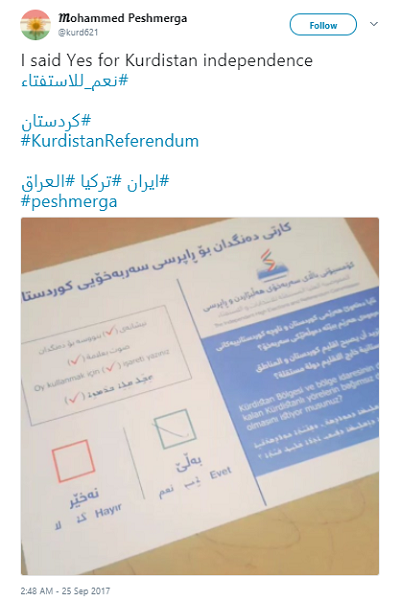
    Just as in the west, many want to broadcast their votes:

    I couldn’t tell if this voter was giving the finger to independence or to someone who voted against it. The caption wasn’t much help, but it’s nice to know that some gestures are universal.

    Many wish the Kurds well:

    Nevertheless, the bid for Kurdish independence has almost no support among the governments of the world, especially Turkey and Iran, who worry that their own Kurdish populations will get ideas.

    Some find significance in the decision of the Turkish and Iraqi armies to begin joint exercises near the Kurdish border today:

    Israel is one of the few nations that have announced support for Kurdish independence. Many welcome this,

    But others see something sinister, as in this loathsome anti-Semitic cartoon:

    Incidentally, despite being depicted as sitting next to Israel at the feast, the US government opposes independence.

    Julian Assange, of Wikileaks fame, posted this cartoon:

    It depicts the Kurdish nation, pierced by the arrows of Iraq, Turkey, ISIS, Iran, and a few others I don’t recognize. Nevertheless, the Kurds persist and climb the ladder of freedom out of the abyss and into the sunlight.

    As we await the results of the vote, I hope that proves prophetic.

    Michael Isenberg writes about the Muslim world, medieval and modern. His forthcoming novel, The Thread of Reason, is a murder mystery that takes place in Baghdad in the year 1092. It depicts the war for the Muslim soul between those who seek to enforce shari’a strictly, persecute Jews and Christians, and stamp out "un-Islamic" science, and those who wink at a few sins, tolerate their non-Muslim neighbors, and write science books instead of burning them.

    Thursday, September 21, 2017

    The UN General Assembly: Hypocrites on Parade

    We all saw highlights of President Trump’s speech. But what did other world leaders have to say?

    Sure, Donald Trump got all the publicity. That’s par for the course when you threaten to “totally destroy North Korea.”

    But this is a blog about Islam, so rather than North Korea, the focus here is the Muslim world. What did the various world leaders have to say about that?

    I'll start with President Trump: he called out the “vile and sinister ideology” of “radical Islamic terrorism.” In particular, he singled out Iran’s “corrupt dictatorship” and “murderous regime.” Good stuff, noticeably absent from his 9/11 and Afghanistan speeches. Still, it's mostly a rehash of his May 21 address in Riyadh, which I covered previously.

    Prime Minister Netanyahu of Israel shared President Trump’s concern about Iran: “From the Caspian Sea to the Mediterranean,” he said, “from Tehran to Tartus, an Iranian curtain is descending across the Middle East.” (If you don’t follow the reference, look it up. “Iron Curtain speech.” Get it? Iron Curtain/Iranian Curtain).

    Hassan Rouhani of Iran came back swinging. He called the accusations against his country “ignorant, absurd, and hateful rhetoric” from a “rogue newcomer.”

    Overall, President Rouhani wins the award for smarminess. “Our ambassadors are our poets, our mystics, and our philosophers,” he intoned piously. But my favorite part was, “The path of moderation nurtures beauty. Deadly-weapons exports are not beautiful; rather peace is.” He should know; his country is exporting weapons all over the Middle East to fight its proxy wars, including the humanitarian catastrophes in Yemen and Syria.

    Rouhani concluded with a sales pitch for investment in the Iranian economy. He invited “all those who seek peace, security, and progress through partnership and cooperation among nations to visit Iran.” I’d actually like to take him up on that. I discovered in the course of research for my book The Thread of Reason that Iran is a country of spectacular and diverse natural beauty which, to its credit, takes great pride in its wealth of historical monuments, even pre-Islamic ones. Those who seek to destroy the monuments of the Confederate States of America could take a lesson from the Iranians. Still I think I’ll postpone my visit until I can travel in Iran without fear of being arrested and tried behind closed doors on dubious charges of espionage, as has been the fate of other Americans in that country.

    Abdu’l-Fattah as-Sisi of Egypt presides over one of the world’s worst human rights abusers. It’s a place where Giulio Regeni, a Cambridge University student who was researching trade unions in 2016 mysteriously disappeared. His corpse, showing signs of excruciating torture, turned up in a ditch along a highway nine days later. In another story, just this week, an Egyptian court sentenced some 500 people in a mass trial for their role in the 2013 anti-government demonstrations. Amnesty International reported that 330 of them had already been detained for four years or more, and among these, there was evidence against only two of them. So one can only marvel at the irony of President as-Sisi lecturing the world body on “upholding the notion of the modern nation-state, which is based on the principles of citizenship, equality, rule of law, and human rights.” In a less hypocritical vein, he continued that he intended to defeat “any attempts at retracting to doctrinal, sectarian, ethnic, or tribal loyalties.” You read that right. No loyalty to religion, culture, or ideas allowed. One must be loyal only to the State.

    On the subject of terror, President as-Sisi said, “We in the Muslim world need to face our reality and work together to rectify misconstrued notions which have become an ideological pretext for terrorism and their destructive discourse. As you may recall, Egypt has launched an initiative to rectify religious discourse in order to revive the moderate and tolerant values of Islam.” This showed some insight in that the roots of terror are ideological, but as-Sisi is mistaken that Islam has been misconstrued. While the ideology of ISIS and al-Qaeda isn’t the only possible interpretation of Muslim scripture, it’s certainly an interpretation with deep roots in that scripture. As for the prospect of any government “rectifying” religious discourse, or any discourse—that is truly chilling.

    President as-Sisi also called for “global order that can face challenges, such as climate change.”

    Mahmud Abbas, leader of the Palestinians, called Israel a colonial, Apartheid, occupying power, but nevertheless he promised that “upon Israel’s withdrawal from the Palestinian and Arab territories occupied in 1967, the Arab and Islamic States would recognize Israel and normalize relations with it.” One has to wonder about his sincerity, since he then went on to denounce the “historical injustice” of the 1917 Balfour Declaration, the document which laid the foundation for Israel’s right to existence in the first place. In any case, we're unlikely ever to put Mr. Abbas's sincerity to the test. There's only a small chance he'll ever have to follow through on this promise. Territories "occupied" in 1967 include East Jerusalem, which Israel views as part of its eternal, undivided capital.

    As for Abbas’s view of the roots of terror, he claimed that “draining the swamp of colonial occupation of our land and ending its unjust, oppressive, and illegal practices against our people would greatly affect the fight against terrorism, depriving terrorist groups of one of the key rallying cries they exploit to promote their repugnant ideas.” This is an argument that Dr. Zuhdi Jasser, of the American Islamic Forum for Democracy, recently called “pure, unadulterated insanity.”

    Mr. Abbas also said, “We once again affirm our commitment to…the Paris Agreement on Climate Change.”

    Aung San Suu Kyi, First State Counsellor of Myanmar, chose not to attend, due to the anti-Muslim violence engulfing Rakhine State in her country; I wrote about that earlier this week. Instead, Counsellor Suu Kyi sent Vice President U Henry Van Thio, who for the most part parroted the awful speech that the First Counsellor delivered on Tuesday. But not to worry. Despite the atrocities in Rakhine, Mr. Van Thio assured the world that, “Myanmar welcomes the Paris Agreement on Climate Change.”

    Well, that gives you some flavor of the 72nd UN General Assembly. As I read through page after page of self-inflicted grievances and smug hypocrisy, not to mention the pathological obsession with climate change, there was one question that kept nagging at me:

    Why is the United States part of this?

    Michael Isenberg drinks bourbon and writes novels. His latest book, The Thread of Reason, is a murder mystery that takes place in Baghdad in the year 1092, and tells the story of the conflict between science and shari’ah in medieval Islam. It is available on Amazon.com

    Transcripts and video of the speeches from the 72nd UNGA may be found on the UN Website.