Showing posts with label Israel. Show all posts

Thursday, October 4, 2018

Professor Lewis Strikes Back

Bernard Lewis, Edward Said, and why “Orientalism” is Bulls—t.
Part 5: Back to the Pilot.
By Michael Isenberg.

I began this series on Orientalism with the feud between Bernard Lewis and Edward Said. I’ve now come full circle and will wrap it up in the same vein.

Orientalism was a 1978 book by Professor Said, in which he argues that most Western scholarship on the Middle East is tainted: racist and in the service of the Armies of Imperialism. Among Western scholars, he singled out Mr. Lewis in particular. In a book chock full of attacks on the works of Orientalists, and even occasional praise for them, the attack on Lewis stands out as an attack on him personally, and an unusually bitter and abusive one at that:

Lewis is an interesting case to examine further because of his standing in the political world of the Anglo-American Middle Eastern Establishment is that of the learned Orientalist, and everything he writes is steeped in the “authority” of the field. Yet for at least a decade and a half his work in the main has been aggressively ideological, despite his various attempts at subtlety and irony. I mention his recent writing as a perfect exemplification [of an] Establishment Orientalist [whose work] purports to be objective, liberal scholarship, but is, in reality, very close to being propaganda against his subject material.

And,

One would find this kind of procedure objectionable as political propaganda—which is what it is, of course—were it not accompanied by sermons on the objectivity, the fairness, the impartiality of a real historian, the implication always being that Muslims and Arabs cannot be objective but that Orientalists like Lewis writing about Muslims and Arabs are, by definition, by training, by the mere fact of their Westernness. This is the culmination of Orientalism.

And again,

To look for a conscious, fair, and explicit judgment by Lewis of the Islam he has treated as he has treated it is to look in vain.

What are these "aggressively ideological" works of Professor Lewis? This "political propaganda?" Professor Said objects to a series of articles, which I wrote about previously, in which Lewis argues that despite the apparent victory of secular, nationalist dictators in the Middle East, Islamic movements were a rising force, and “Though they have all, so far, been defeated, they have not yet spoken their last word.” In Orientalism, Said dismisses that as “a project to debunk, to whittle down, and to discredit the Arabs and Islam,” and “a charge intended by Lewis to explain to his latest public why it is that the Muslims (or Arabs) still will not settle down and accept Israeli hegemony over the Near East.” The role of Islam in the Arab world was certainly a topic over which reasonable people could disagree without either of them being guilty of trying to "discredit the Arabs." In any case, only a year after Orientalism was published, events in Iran would prove—in a tragic and spectacular fashion—that is was Lewis who was right.

Professor Said’s claim, that what this is really about is the Israeli/Palestinian conflict, tells us more about Said than about Lewis. As I noted in Part 1, Said concedes in his Introduction that the subject was personal, “not for me an exclusively academic matter.” Nowhere does he let his personal feelings get in the way of his scholarly objectivity more than when it comes to the Jewish State. While he maintains a certain amount of academic detachment through most of the book, the final chapter, covering modern scholars, is entirely distorted by his partisanship as a Palestinian. Bernard Lewis is pro-Zionist and therefore must be at the receiving end of ad hominem attacks. But Louis Massignon, who viewed Zionism as “bourgeois colonialism,” possesses “sheer genius” and “overwhelming intelligence.” Said is even willing to give him a pass for equating the East with the ancient and the West with the modern, usually one of Said's top complaints against Orientalists.

Lewis calls Said out on this. In a rebuttal, published in The New York Review of Books, “the culmination of Orientalism” argues that what really bothers Said and other critics about so called-Orientalists is not their view of history, but rather their view of current events:

“Orientalism” has been emptied of its previous content and given an entirely new one—that of unsympathetic or hostile treatment of Oriental peoples. For that matter, even the terms “unsympathetic” and “hostile” have been redefined to mean not supportive of currently fashionable creeds or causes.

Or as we would put it today, the real sin of “Orientalists” is that they aren’t politically correct.

As for his overall assessment of the Orientalism hypothesis, Mr. Lewis sums it up in one word: “Absurd.” He points out that everything that Professor Said had to say about Western scholars of the Middle East could equally apply to scholars of Ancient Greece, until “the very name of classicist must be transformed into a term of abuse.” As ludicrous as that may seem, “if for classicist we substitute ‘Orientalist,’ with the appropriate accompanying changes, this amusing fantasy becomes an alarming reality.”

Or as we would put it today, “Orientalism” is bulls—t.

Michael Isenberg drinks bourbon and writes novels. His latest book, The Thread of Reason, is a murder mystery that takes place in Baghdad in the year 1092, and tells the story of the conflict between science and shari’ah in medieval Islam. It is available on Amazon.com

Photo Credit(s): Haaretz, Bio.com

Friday, September 14, 2018

Mideast Week in Review

by Michael Isenberg.

  • Idlib Offensive.
  • Trump Administration to close PLO Office in DC.

    Idlib Offensive: As is so often the case these days, the big story in the Middle East is Syria, where government forces and their Russian backers have besieged Idlib province.

    Idlib is located in the northwest of the country. It is one of the last major strongholds of rebellion against the regime of dictator Bashar Assad, not counting the Turkish- and Kurdish-controlled regions along the northern border. Some 30,000 rebels from various factions are holed up in Idlib, most notably from the Turkish-backed National Liberation Front and the jihadist Hay'at Tahrir ash-Sham, the group which absorbed the al-Qaeda-backed al-Nusra Front (For the record, Hay'at Tahrir ash-Sham denies al-Qaeda ties).

    Idlib is also home to nearly three million civilians, many of them refugees from fighting in other parts of the country. The presence of such a large population of non-combatants has prompted concern among world leaders and international relief agencies of a looming “humanitarian disaster” including severe shortages of food supplies and medical services.

    A negotiated settlement to avoid the fighting and prevent such a disaster is unlikely. A summit last week in Tehran between Turkey’s Recep Erdogan, Iran’s Hassan Rouhani, and Russia’s Vladimir Putin broke up without reaching agreement on Idlib. The Assad regime has little incentive for negotiations in the wake of its battlefield successes elsewhere in the country. Further, there is the problem of what could be offered to the rebels to convince them to lay down their arms. As government forces cleared out other rebel-held areas over the past year, agreements were reached to evacuate them to other parts of the country, notably Idlib province. But with Idlib as their last stronghold, there are few places they could go now.

    Following the failure of the Tehran conference, Russian forces have resumed pounding opposition targets in airborne attacks.

    The biggest wild cards are how the Trump administration will react, and whether the Assad regime will use chemical weapons.

    President Trump’s policy on Syria has been, to put it nicely, inconsistent—always a mistake when dealing with children, animals, and dictators. Last July, I reported that the president had apparently given up on Syria, in the wake of reports that he planned to end CIA support to the allegedly moderate rebels fighting Assad. The only things that seemed to spur the administration into action were attacks on the US-allied Syrian Democratic Forces—the coalition of Arabs and Kurds that has been in the forefront of the fight against ISIS—and any use of chemical weapons by the Assad regime, such as the chlorine gas attack in Douma this April (The Syrian government denies any use of chemical weapons).

    However, in a tweet last week, Mr. Trump warned that “President Bashar al-Assad of Syria must not recklessly attack Idlib Province,” potentially signaling a more active US role going forward.

    As for whether chemical weapons will be used in Idlib, both the Trump Administration and the Assad regime are staking out their positions in case of that eventuality. According to the BBC, “The US state department warned on Monday that Washington would respond to any new chemical attacks by the Syrian government or its allies.” President Assad, meanwhile, is already preparing his alibi. Virginia state senator Richard Black emerged from a meeting with Assad claiming “British intelligence was working toward a chemical attack in order to blame the Syrian government.”

    As I write this, the situation is uncertain. According to Reuters, “Russian Foreign Minister Sergei Lavrov said on Friday that Moscow would keep bombing militant targets in Syria’s Idlib Province if need be.” However, Fox News reports, “In the previous 24 hours, air strikes from Russian aircraft in rebel-held areas significantly decreased, and lowered in intensity.” The Syria Campaign’s Kenan Rahmani claims, “The offensive is certainly on hold, and that is in large part a result of the renewed commitment from the United States to establish consequences should Russia and the regime continue with reckless bombing of Idlib.” It remains to be seen whether the easing of Russian air strikes is in response to Trump Administration saber rattling, or merely a tactical pause to make way for an imminent ground offensive.

    Read more—

  • The looming fight for Idlib, Syria’s last main rebel stronghold, explained (Vox)
  • Va. state senator who met with Assad says British are planning fake chemical attack (Washington Post)
  • Syria war: How Idlib may be changing Trump's strategy (BBC)
  • Syria war: Idlib rebels targeted by 'fiercest raids in weeks' (BBC)
  • Russia says will keep bombing Syria's Idlib if need be: Ifax (Reuters)


    Trump Administration to close PLO Office in DC: In contrast to its Syria policy, the Trump Administration has shown great consistency toward the Palestinians.

    On Monday, the State Department notified the Palestinian Liberation Organization (PLO) that it was ordering the closure of the PLO’s office in Washington DC. By way of explanation, department spokesperson Heather Nauert said in a statement, “The PLO has not taken steps to advance the start of direct and meaningful negotiations with Israel. To the contrary, PLO leadership has condemned a U.S. peace plan they have not yet seen and refused to engage with the U.S. government with respect to peace efforts and otherwise.”

    The closure comes in the wake of the move of the US Embassy to Jerusalem in May, in the face of Palestinian objections, and the cancellation of $200 million in aid for Palestinian “refugees” in August.

    The move brought outraged protests from Palestinian leaders. Diplomat Saeb Erekat called it a “dangerous escalation” and a “slap by the Trump Administration against peace and justice.” He promised that Palestinians “will not succumb to US threats and bullying.”

    Although the Palestinians so far show no signs of moderating their stance, some observers have noted that the Trump Administration’s policies have had an effect on the rest of the Arab world. Israel’s Ambassador to the US, Ron Dermer, said during an embassy reception last week that “Despite the best efforts of Palestinian leaders to whip up opposition to President Trump’s Jerusalem decision, the response in the Arab world was mostly silence” and “What is new is the behavior of many Arab states. They are no longer reflexively dancing to the Palestinians’ tune.”

    Read more—

  • Trump admin. closing Palestine Liberation Organization D.C. office (CBS)
  • Dermer ‘Confident’ Trump Peace Plan will Incorporate Arab States (Jerusalem Post)
  • Dr. Saeb Erekat on the Announcement to Close the Palestinian Mission in Washington (State of Palestine)
  • Closure of the PLO Office in Washington (Dept. of State)


    Michael Isenberg drinks bourbon and writes novels. His latest book, The Thread of Reason, is a murder mystery that takes place in Baghdad in the year 1092, and tells the story of the conflict between science and shari’ah in medieval Islam. It is available on Amazon.com

    Photo credit(s): Fox News, BBC, Twitter

  • Friday, August 3, 2018

    Mideast Week in Review

    by Michael Isenberg.

  • Saudi “Hajj Hackathon” sets world record.
  • Massive protests break out across Iran.
  • Israel sentences Palestinian poet Dareen Tatour to five months in prison.

    Saudi “Hajj Hackathon” sets world record: Nearly 3,000 software professionals have gathered in Jeddah, Saudi Arabia this week for a “Hajj Hackathon.”

    Wikipedia defines a hackathon as “a design sprint-like event in which computer programmers and others involved in software development, including graphic designers, interface designers, project managers, and others, often including subject-matter-experts, collaborate intensively on software projects. The goal of a hackathon is to create usable software. Hackathons tend to have a specific focus.”

    In the case of the Jeddah event, the specific focus is to generate apps to modernize the annual Muslim pilgrimage to Mecca known as the hajj. According to The National, “The competition will focus on improving Hajj services in food sanitation, finance, transportation, accommodation, communications and crowd management for the estimated two million pilgrims who travel to Saudi Arabia each year…The event is offering cash prizes to the top three participants, amounting to two million Saudi riyals [$533k US] to transform their ideas into application-based solutions.”

    The hackathon is supported by some of the giants of the tech industry. It is sponsored by Google, and Wikipedia founder Jimmy Wales and Apple co-founder Steve Wozniak delivered addresses during the opening ceremony.

    The event is aligned with Vision 2030, an initiative by Saudi Crown Prince Muhammad bin Salman to modernize the nation’s economy and reduce its dependence on oil exports.

    It is the largest gathering of its kind ever, scoring a Guinness World Record for “The most participants in a hackathon.”

    The Hajj Hackathon is also notable because of the extensive collaboration of men and women programmers in a country with a reputation for strict segregation of the sexes. Albeit whether it is a harbinger of genuine technological and social reform in the Kingdom, or merely a public relations stunt, remains to be seen.

    Read more—

  • What you need to know about Saudi Arabia's record-breaking hackathon (Stepfeed)
  • Hackathon (Wikipedia)
  • Hajj Hackathon to modernise the holy pilgrimage (The National)


    Massive protests break out across Iran: Thousands of Iranians took to the streets this week to protest against their government a day after Iranian officials rejected US President Donald Trump’s offer to begin negotiations with that country.

    The demonstrations started on Tuesday afternoon and spread to multiple cities, including Karaj, Isfahan, and Mashhad.

    Video footage from Shiraz shows demonstrators chanting “Death to the Dictator.”

    In some cities, security forces have clashed with demonstrators and fired tear gas in their midst.

    Demonstrators are protesting deteriorating economic conditions in Iran. The Trump Administration’s withdrawal of the United States from the 2015 Iran nuclear agreement, known as the Joint Comprehensive Plan of Action or JCPOA, and the resulting renewal of sanctions against Iran, scheduled to go into effect August 7, has resulted in a significant drop in the value of Iran’s currency on world markets. This in turn has led to high prices, falling wages, and shortages of water and electricity in the country.

    Although Mr. Trump has offered to open negotiations with Iran, the Iranian government has rejected the offer. Hamid Aboutalebi, who describes himself in his Twitter profile as “Sociologist Advisor” to Iran’s President Hasan Rouhani, tweeted on Monday that Iran would not come to the negotiating table unless the US gives in ahead of time on the main point of contention by returning to the JCPOA.

    The Express reported that “In a comment provided to Express.co.uk, [Maryam Rajavi, President-elect of the National Council of Resistance of Iran] said the source of all the miseries of the Iranian nation is the religious dictatorship, which has wasted the wealth and human resources of our homeland."

    I salute the courage of the protesters in standing up to one of the world’s most repressive dictatorships and international bad actors.

    Read more—

  • Iran in FLAMES: Protestors attacked with TEAR GAS as they cry - 'Down with the DICTATOR' (Express)
  • Iranians criticise Trump's offer of talks (BBC)
  • Rouhani Wags the Dog: Behind the Trump/Rouhani war of words (Michael Isenberg)


    Israel sentences Palestinian poet Dareen Tatour to five months in prison. Ms. Tatour was initially arrested in 2015. The BBC reports that she was charged with “inciting violence and supporting a group banned as a terrorist organization…in connection with three social media posts that appeared at the start of the wave of mainly ‘lone-wolf’ attacks on Israelis. The first was a video featuring her reciting a poem and footage appearing to show Palestinian protesters using slingshots and throwing stones at Israeli security forces. The poem includes the lines: ‘Resist, my people, resist them. / Resist the settler's robbery / And follow the caravan of martyrs.’”

    According to Reuters, Ms. Tatour says in her defense that Israeli authorities “didn't understand my poem. There is no call for violence. There is a struggle, they cast it as violent."

    As always, I support freedom of speech. So while I disagree with what Ms. Tatour says, I will defend to the death her right to say it. In my humble opinion the Israeli government got this one wrong. Nevertheless, Ms. Tatour isn't fooling anybody with her claim that "There is no call for violence" in her posts.

    Read more—

  • Dareen Tatour: Israeli Arab poet sentenced for incitement (BBC)


    Michael Isenberg drinks bourbon and writes novels. His latest book, The Thread of Reason, is a murder mystery that takes place in Baghdad in the year 1092, and tells the story of the conflict between science and shari’ah in medieval Islam. It is available on Amazon.com

    Photo credit(s): Twitter, PMOI - NCRI

  • Thursday, August 2, 2018

    Fighting for God

    Bernard Lewis and the Clash of Civilizations.
    By Michael Isenberg.

    Yesterday I posted an obituary for Princeton historian Bernard Lewis, a towering figure in twentieth century Middle East studies who was no stranger to controversy. I noted that two controversies in particular will be forever linked with his name: his “Clash of Civilizations” hypothesis, which is the subject of this post, and “Orientalism,” which I will cover in a future article.

    The Clash of Civilizations theory concerns the origins of Islamic conflict with the West, a topic which Professor Lewis explored in a 1990 essay in The Atlantic, “The Roots of Muslim Rage,” and expanded upon in his 2003 book, The Crisis of Islam: Holy War and Unholy Terror.

    Lewis rejects the idea that Islamic radicalism is a reaction to particular policies of Europe or the United States. In The Crisis of Islam, he points out that one of the founders of modern jihadist theory, the Muslim Brotherhood’s Sayyid Qutb, formed his views about the West during a stay in the United States from 1948 to 1950. At that time, most of the US policies which are supposedly responsible for radical Islam—from the fall of Mossadegh, to the two Gulf Wars, to the invasion of Afghanistan—hadn’t happened yet.

    Admittedly, America was a supporter of Israel at the time, and that did influence Mr. Qutb, but Professor Lewis argues that American support for the Jewish state during its early years was lukewarm at best. Lewis claims that Israel was far closer to the Soviet Union than the US at that time. In fact, during the 1956 Suez crisis, when Israel, France, and Great Britain attempted to wrest control of the Suez Canal from Gamal Nasser’s Egypt, the Eisenhower Administration intervened on the Egyptian side, applying diplomatic pressure that led to the withdrawal of Israel and its allies. And yet, the US’s support of Egypt brought no goodwill for America from the Arab world, whose governments proceeded to build alliances with the Soviets.

    “Clearly,” Professor Lewis writes in the Atlantic article, “something deeper is involved than these specific grievances, numerous and important as they may be—something deeper that turns every disagreement into a problem and makes every problem insoluble.” If nothing the Western nations did can explain Muslim antipathy, one must look elsewhere. “It should by now be clear,” he continues,

    that we are facing a mood and a movement far transcending the level of issues and policies and the governments that pursue them. This is no less than a clash of civilizations—the perhaps irrational but surely historic reaction of an ancient rival against our Judeo-Christian heritage, our secular present, and the worldwide expansion of both [emphasis mine].

    This “clash of civilizations,” a phrase which was subsequently taken up by Samuel Huntington in his eponymous book, has its origins in both ideology and history. Indeed, as early as 1964, Lewis wrote about “The Revolt of Islam” as a force to be reckoned with in Middle Eastern affairs. Its origin is in the absence of a separation between the sacred and the secular in Islamic ideology. There is no rendering unto Caesar that which is Caesar’s and unto God that which is God’s in Islam. It’s all God’s.

    In Islam the struggle of good and evil very soon acquired political and even military dimensions. Muhammad, it will be recalled, was not only a prophet and a teacher, like the founders of other religions; he was also the head of a polity and of a community, a ruler and a soldier. Hence his struggle involved a state and its armed forces. If the fighters in the war for Islam, the holy war "in the path of God," are fighting for God, it follows that their opponents are fighting against God. And since God is in principle the sovereign, the supreme head of the Islamic state—and the Prophet and, after the Prophet, the caliphs are his vicegerents—then God as sovereign commands the army. The army is God's army and the enemy is God's enemy. The duty of God's soldiers is to dispatch God's enemies as quickly as possible to the place where God will chastise them—that is to say, the afterlife.

    Clearly related to this is the basic division of mankind as perceived in Islam...In the classical Islamic view, to which many Muslims are beginning to return, the world and all mankind are divided into two: the House of Islam, where the Muslim law and faith prevail, and the rest, known as the House of Unbelief or the House of War, which it is the duty of Muslims ultimately to bring to Islam. But the greater part of the world is still outside Islam, and even inside the Islamic lands, according to the view of the Muslim radicals, the faith of Islam has been undermined and the law of Islam has been abrogated. The obligation of holy war therefore begins at home and continues abroad, against the same infidel enemy.

    The holy war went well…at first:

    For the first thousand years Islam was advancing, Christendom in retreat and under threat. The new faith conquered the old Christian lands of the Levant and North Africa, and invaded Europe, ruling for a while in Sicily, Spain, Portugal, and even parts of France. The attempt by the Crusaders to recover the lost lands of Christendom in the east was held and thrown back, and even the Muslims' loss of southwestern Europe to the Reconquista was amply compensated by the Islamic advance into southeastern Europe, which twice reached as far as Vienna. For the past three hundred years, since the failure of the second Turkish siege of Vienna in 1683 and the rise of the European colonial empires in Asia and Africa, Islam has been on the defensive, and the Christian and post-Christian civilization of Europe and her daughters has brought the whole world, including Islam, within its orbit.

    For a long time now there has been a rising tide of rebellion against this Western paramountcy, and a desire to reassert Muslim values and restore Muslim greatness. The Muslim has suffered successive stages of defeat. The first was his loss of domination in the world, to the advancing power of Russia and the West. The second was the undermining of his authority in his own country, through an invasion of foreign ideas and laws and ways of life and sometimes even foreign rulers or settlers, and the enfranchisement of native non-Muslim elements. The third—the last straw—was the challenge to his mastery in his own house, from emancipated women and rebellious children. It was too much to endure, and the outbreak of rage against these alien, infidel, and incomprehensible forces that had subverted his dominance, disrupted his society, and finally violated the sanctuary of his home was inevitable. It was also natural that this rage should be directed primarily against the millennial enemy and should draw its strength from ancient beliefs and loyalties.

    Clearly, the “roots of Muslim rage” run deep in Islamic ideology. But fortunately, Islam is not monolithic and Muslims do not have to choose between waging perpetual war against the West or giving up on Islam altogether. There are other, gentler ways to interpret Muslim scripture. Quoted in his New York Times obituary, Professor Lewis says,

    As a specialist on Islam, I find myself disturbed by the nonsense being talked, by both Muslims and non-Muslims. On the one hand, you have people who would have you believe that Islam is a bloodthirsty religion bent on world destruction. On the other hand, you have people telling us that Islam is a religion of love and peace—rather like the Quakers, but less aggressive.

    The truth is in its usual place.

    Michael Isenberg drinks bourbon and writes novels. His latest book, The Thread of Reason, is a murder mystery that takes place in Baghdad in the year 1092, and tells the story of the conflict between science and shari’ah in medieval Islam. It is available on Amazon.com

    Photo source: thirtyfifthcenturyromance.blogspot.com

    Friday, July 13, 2018

    Mideast Week in Review

    by Michael Isenberg.

  • In sad milestone, Syrian government forces have nearly completed recapturing the south of the country.
  • Espionage coup: Mossad filches Israeli spy's watch from Syria.
  • Iranians continue to find ingenious ways to defy their Isamo-fascist rulers—by dancing.

    In sad milestone, Syrian government forces have nearly completed recapturing the south of the country

    The BBC reported on Thursday that troops loyal to Syrian President Bashar Assad entered rebel-held areas in the city of Deraa, near the border with Jordan. As in other places recaptured by the government, opposition forces have reportedly agreed to surrender in exchange for safe passage to other rebel-held areas.

    With the fall of Deraa, the government has nearly completed its recapture of the southern part of the country. It is a sad milestone: Deraa is where the rebellion began in 2011 with great hopes for throwing off the repressive Assad regime.

    I expect military operations will soon shift back to the north, especially to the rebel-held areas in Idlib province, near Aleppo. Also in the north, large sections of land are controlled by the Kurds. It will be interesting to see whether the Assad regime turns its attention to regaining control over these provinces, and whether the Trump administration will permit US ground troops positioned there to stand by our Kurdish allies, who fought in the front lines in the battle against ISIS.

    Read more—

  • Deraa, birthplace of Syria uprising, retaken by government forces (BBC)


    Espionage coup: Mossad filches Israeli spy's watch from Syria

    The Israeli government announced last week that the Mossad had recovered the watch of martyred agent Eli Cohen. In the years leading up to the Six Day War, Cohen infiltrated the top levels of the Syrian government, obtaining crucial military data for Israel, before he was captured and hanged in 1965. Despite repeated requests from the Israeli government, the Syrian regime has refused to return Cohen’s remains to the Jewish state.

    Israel does not reveal Mossad operations frivolously. My speculation is that the decision to go public with Cohen’s watch was made in order to send a message to the Assad regime: we can operate freely in your country.

    Read more—

  • Israel recovers hanged spy Eli Cohen's watch from Syria (BBC)
  • Eli Ben-Hanan, Our Man in Damascus


    Iranians continue to find ingenious ways to defy their Isamo-fascist rulers—by dancing

    Nineteen year old Maedeh Hojabri was arrested last week after she posted video of herself dancing on Instagram, without a hijab, in defiance of Iran’s strict Islamic code.

    In response of her arrest, thousands have tweeted their support for Hojabri with hashtags like برقص_تا_برقصیم# (Dance to dance) and رقص_جرم_نیست# (Dancing is not a crime)—many with their own videos in which they bust some moves.

    Read more—

  • Iran women dance in support of arrested Instagram teen (BBC)


    Michael Isenberg drinks bourbon and writes novels. His latest book, The Thread of Reason, is a murder mystery that takes place in Baghdad in the year 1092, and tells the story of the conflict between science and shari’ah in medieval Islam. It is available on Amazon.com
  • Sunday, March 25, 2018

    Mideast Week in Review

    by Michael Isenberg.

  • Syria war end game.
  • Israel sentences slap video teen to eight months in prison.

    The war in Syria dominated the news from the Middle East this week. Government forces continued to make gains in the Eastern Ghouta region. 70% of the district, on the outskirts of Damascus, has now fallen into the hands of the Assad regime. The area had been under rebel control since 2013.

    The operation by the Assad regime and its Russian ally has been brutal. The BBC reports more than 1,400 civilians have been killed. Among these, fifteen children and two women died in an underground school that was struck by Russian missiles.

    With the capture of Eastern Ghouta, the Syria War is in its end game and, sadly, it's an Assad victory. Not that the other options were great. But at least the destruction will stop soon.

    Separately, in the north of the country, Free Syrian Army forces, backed by Turkey, have taken control the Kurdish town of Afrin. The Turkish government claims that the Kurdish People’s Protection Units (YPG), which controlled the area, is part of the Kurdistan Worker’s Party (PKK), a rebel group within Turkey which the government considers a terrorist organization. The US disputes the claim that the groups are in cahoots. Turkish president Recep Erdogan intends to create a buffer zone in northern Syria along the Turkish border. “The military operation will go on until the terror corridor through Manbij, Ain al-Arab, Tal Abyad, Ras al-Ain, Qamishli has been wiped out,” he said.

    The Trump Administration has done little to protect the Kurds from Turkish aggression. Given that the Kurds allied with the United States in the battle against ISIS, and fought in the front lines, it is shameful that we are not doing more to help them. That may change, however, as American troops are stationed in some of the towns threatened by Erdogan.

    There were reports of looting by the rebel forces. According to the BBC, “AFP news agency journalists in Afrin also saw rebels break into shops, restaurants, and houses, and leave with food, electronic equipment, blankets and other goods.” And we thought the Free Syrian Army were the good guys.

    Also related to Syria, the Israeli government this week declassified video and other documents concerning its bombing of a suspected Syrian nuclear reactor in 2007. This is the first public admission by the Jewish state that it was behind the destruction of the facility. Pundits believe the timing of the release is intended as a warning to Iran that Israel will respond similarly to Iran's nuclear ambitions. Indeed a tweet from Prime Minister Netanyahu, that “Israel's policy was and remains consistent - to prevent our enemies from arming themselves with nuclear weapons,” seems to confirm that interpretation.

    Read more—

  • Syria war: Rebel evacuations from Eastern Ghouta gather pace (BBC)
  • Syria war: Air strike 'kills children in Eastern Ghouta school’
  • Syria war: Turkish-led forces oust Kurdish fighters from heart of Afrin (BBC)
  • Syria war: Afrin looted by Turkish-backed rebels (BBC)
  • Israel admits striking suspected Syrian nuclear reactor in 2007 (BBC)


    In a plea deal, an Israeli military court sentenced 17-year old Ahed Tamimi to eight months in prison. You may recall Ms. Tamimi as the Palestinian teen who was pictured in a viral video slapping an Israel soldier.

    In my humble opinion, Israel made a mistake in prosecuting Tamimi. The video was a propaganda victory for the Jewish state, showing Israeli restraint in the face of Palestinian provocation. By imprisoning Tamimi, Israel is turning victory into defeat by creating a martyr for the Palestinian cause.

    Read more—

  • Ahed Tamimi: Palestinian slap video teen gets eight months in plea deal (BBC)

    Michael Isenberg drinks bourbon and writes novels. His latest book, The Thread of Reason, is a murder mystery that takes place in Baghdad in the year 1092, and tells the story of the conflict between science and shari’ah in medieval Islam. Check it out on Amazon.com.

    Photo credits: IHS Conflict Monitor, Twitter

  • Sunday, February 11, 2018

    Mideast Week in Review

    by Michael Isenberg.

    The news from the Middle East this week was dominated by the war in Syria.

    Fighting raged in the Eastern Ghouta region, in the suburbs of Damascus. The BBC reported over 200 civilians were killed. The Assad regime has kept rebel-occupied Eastern Ghouta under siege, cut off from the outside world, since 2013. Four hundred thousand people are trapped there, starving, freezing, and desperate for medical supplies. Now, with many troops freed up by successes in Aleppo and other parts of the country, the government is attempting to retake the region. In a characteristically impotent gesture, the United States and the United Nations have, according to the BBC, “called for an immediate cessation of hostilities.” Such demands are ultimately fruitless, since Assad has no motive to cut off hostilities while he’s winning, unless it's to provide himself with a temporary tactical advantage.

    Meanwhile, monitors on the ground accuse the Syrian government of conducting six chemical weapon attacks with chlorine gas during the past month. @SyriaCivilDef reported that one of these attacks, in Saraqeb (northwest part of the country), injured nine, including three of their volunteers, called “White Hats.” The BBC reported that in response to the allegations, which the Syrian government denies, Israeli warplanes struck a Scientific Studies and Research Centre site near Damascus. The site is believed to be used for the manufacture of chemical weapons, in violation of the Russian-brokered agreement that Syria concluded with the Obama Administration after a 2013 chemical attack. In my humble opinion, the Syrian government is stupid to engage in these attacks. Crossing that line is one of the few things guaranteed to bring a military response from either the United States or Israel.

    But not the only thing.

    On Wednesday night, US forces launched artillery and airborne attacks against forces allied with the Syrian government near the Euphrates River, killing 100. The US said the attack was in retaliation for a raid by government forces against the headquarters of the Syrian Democratic Forces (SDF)—the coalition of Arabs and Kurds that has been in the forefront of the fight against ISIS. I’m glad to see the US standing by the SDF—we owe them. It is a pleasant change from our weak response to Turkish attacks against the Kurds in the north of the country last week.

    On Saturday an Iranian drone infiltrated Israeli airspace from Syria. An Israeli helicopter shot it down. The Israeli Air Force then retaliated against Syrian military targets. One Israeli jet was hit by antiaircraft fire but was able to crash in Israel. The pilots ejected safely. According to the BBC, Israel then “launched a second wave of strikes” and “inflicted huge damage on Syrian air defences.”

    Read more—

  • Israeli air strikes against Syria 'biggest since 1982' (BBC)
  • Syria war: Assault on besieged Eastern Ghouta kills 200 in four days (BBC)
  • Syria war: Israel 'strikes Damascus military complex' (BBC)
  • Syria war: Assad's government accuses US of massacre (BBC)


    Michael Isenberg writes about the Muslim world, medieval and modern. His forthcoming novel, The Thread of Reason, is a murder mystery that takes place in Baghdad in the year 1092 and will be the first in a series that depicts how the Muslim world committed cultural suicide during the Middle Ages.

    Photo credit: BBC

  • Friday, September 29, 2017

    Mideast Week in Review

    by Michael Isenberg.

  • Baghdadi alive?
  • Iraqi Kurds overwhelmingly vote for secession.
  • Saudi women to be permitted to drive.
  • Palestinian gunman murders three.
  • Egypt arrests seven for displaying rainbow flag.
  • All kneel before Faisal, King of Saudi Arabia, and his little friend Yoda.

    Baghdadi alive? The loathsome ISIS cult may be nearly dead, at least in its present form as a territorial state. However its so-called "caliph," Abu Bakr Baghdadi may still be alive. New audio of a man who sounds like Baghdadi has been posted to an ISIS-affiliated website. In it, the speaker mentions recent events such as North Korean saber-rattling and the Battle for Mosul. Although the US Department of Defense is still analyzing the recording for authenticity, it appears that Russian claims of having killed Baghdadi in a May airstrike are greatly exaggerated.

    Read more—

  • 'New Baghdadi tape' posted by Islamic State group (BBC)


    Iraqi Kurds overwhelmingly vote for secession: The Kurdish Autonomous Region held a referendum on Monday on seceding from Iraq and establishing an independent nation. 3.3 million people—73% of the electorate—turned out at the polls. The referendum passed by a whopping 92% of the vote.

    The Kurds are the fourth largest ethnic group in the Middle East (after Arabs, Persians, and Turks) and the only one out of the four without a state of their own.

    The referendum is non-binding and will not lead immediately to independence, but it should give the Kurds considerable leverage to negotiate with Baghdad for their departure.

    The bid for Kurdish independence has almost no support among the governments of the world, especially Turkey and Iran, who worry that their own Kurdish populations will get ideas. Other nations, including the United States, oppose Kurdish independence on the grounds that it will be destabilizing. One of the few supporters is Israel, which sees in the Kurdish quest for a homeland a reflection of its own cause.

    In a related story, the Turkish and Iraqi armies have begun joint exercises near the Kurdish border.

    Read more—

  • Iraqi Kurds decisively back independence in referendum (BBC)
  • Kexit? Iraqi Kurdistan referendum explained (BBC)
  • Now trending: Kurdistan (Michael Isenberg)


    Saudi women to be permitted to drive: The Kingdom of Saudi Arabia—notorious for its restrictions on the freedom of women—announced a historic reversal of policy on Tuesday: starting next June, the gentle sex will be allowed to drive.

    Around the kingdom, and around the world, women took to social media to celebrate. Many activists tempered their jubilation with caution: women still have a long way to go in the kingdom. In particular, the “guardianship” system still persists. Under this system, women need permission from their male custodians to travel, marry, start businesses, and many other common activities.

    Read more—

  • Saudi Arabia Agrees to Let Women Drive (NYT)
  • Women to drive in Saudi Arabia: Twitter goes bonkers (Michael Isenberg)


    Palestinian gunmen murders three: On a sadder note, a Palestinian man, identified as 37-year-old Nimer Jamal, shot and killed two Israeli security guards and a border policeman at the gate of the Har Adar Jewish settlement in the West Bank. The Information Office of Palestinian President Mahmoud Abbas’s Fatah Party blamed Israel.

    Read more—

  • Palestinian gunman kills three Israelis in West Bank (BBC)


    Egypt arrests seven for displaying rainbow flag: The government of President Abdel Fattah this week continued to pile up its abysmal human rights record. In the latest incident, seven individuals were arrested for “promoting sexual deviancy” after raising the LGBT rainbow flag at a Cairo concert.

    Read more—

  • Seven arrested in Egypt after raising rainbow flag at concert (BBC)


    All kneel before Faisal, King of Saudi Arabia, and his little friend Yoda: In an embarrassment to the Ministry of Education, the Saudi government released a textbook that included a photo of King Faisal signing the UN charter in 1945, while seated next to Jedi Master Yoda, of Star Wars fame. Analysts believe the picture has been photoshopped. The BBC reported that education minister Ahmad al-Isa called it an “unintended mistake.” No word yet on how it happened.

    Read more—

  • Saudi textbook features image of Yoda with King Faisal (BBC)

    Michael Isenberg writes about the Muslim world, medieval and modern. His forthcoming novel, The Thread of Reason, is a murder mystery that takes place in Baghdad in the year 1092. It depicts the war for the Muslim soul between those who seek to enforce shari’a strictly, persecute Jews and Christians, and stamp out "un-Islamic" science, and those who wink at a few sins, tolerate their non-Muslim neighbors, and write books about science instead of burning them.

    Photo credit: BBC/Shaweesh/Gharem Studio

  • Monday, September 25, 2017

    Now trending: Kurdistan

    Today is referendum day in Kurdish northern Iraq. Some four million voters turned out to weigh in on whether to secede from the country and establish an independent nation. The Kurds are the fourth largest ethnic group in the Middle East (after Arabs, Persians, and Turks) and the only one out of the four without a state of their own. The referendum is non-binding and will not lead immediately to independence, but if it passes, it should give the Kurds considerable leverage to negotiate with Baghdad for their departure.

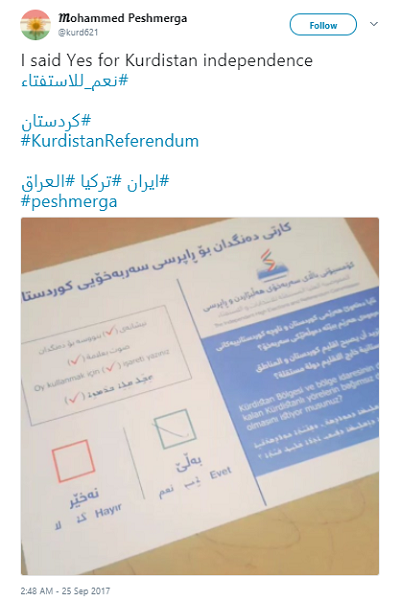
    In many parts of the region, a festive atmosphere has reigned for days:

    On Twitter, #Kurdistan is trending.

    Just as in the west, many want to broadcast their votes:

    I couldn’t tell if this voter was giving the finger to independence or to someone who voted against it. The caption wasn’t much help, but it’s nice to know that some gestures are universal.

    Many wish the Kurds well:

    Nevertheless, the bid for Kurdish independence has almost no support among the governments of the world, especially Turkey and Iran, who worry that their own Kurdish populations will get ideas.

    Some find significance in the decision of the Turkish and Iraqi armies to begin joint exercises near the Kurdish border today:

    Israel is one of the few nations that have announced support for Kurdish independence. Many welcome this,

    But others see something sinister, as in this loathsome anti-Semitic cartoon:

    Incidentally, despite being depicted as sitting next to Israel at the feast, the US government opposes independence.

    Julian Assange, of Wikileaks fame, posted this cartoon:

    It depicts the Kurdish nation, pierced by the arrows of Iraq, Turkey, ISIS, Iran, and a few others I don’t recognize. Nevertheless, the Kurds persist and climb the ladder of freedom out of the abyss and into the sunlight.

    As we await the results of the vote, I hope that proves prophetic.

    Michael Isenberg writes about the Muslim world, medieval and modern. His forthcoming novel, The Thread of Reason, is a murder mystery that takes place in Baghdad in the year 1092. It depicts the war for the Muslim soul between those who seek to enforce shari’a strictly, persecute Jews and Christians, and stamp out "un-Islamic" science, and those who wink at a few sins, tolerate their non-Muslim neighbors, and write science books instead of burning them.

    Thursday, September 21, 2017

    The UN General Assembly: Hypocrites on Parade

    We all saw highlights of President Trump’s speech. But what did other world leaders have to say?

    Sure, Donald Trump got all the publicity. That’s par for the course when you threaten to “totally destroy North Korea.”

    But this is a blog about Islam, so rather than North Korea, the focus here is the Muslim world. What did the various world leaders have to say about that?

    I'll start with President Trump: he called out the “vile and sinister ideology” of “radical Islamic terrorism.” In particular, he singled out Iran’s “corrupt dictatorship” and “murderous regime.” Good stuff, noticeably absent from his 9/11 and Afghanistan speeches. Still, it's mostly a rehash of his May 21 address in Riyadh, which I covered previously.

    Prime Minister Netanyahu of Israel shared President Trump’s concern about Iran: “From the Caspian Sea to the Mediterranean,” he said, “from Tehran to Tartus, an Iranian curtain is descending across the Middle East.” (If you don’t follow the reference, look it up. “Iron Curtain speech.” Get it? Iron Curtain/Iranian Curtain).

    Hassan Rouhani of Iran came back swinging. He called the accusations against his country “ignorant, absurd, and hateful rhetoric” from a “rogue newcomer.”

    Overall, President Rouhani wins the award for smarminess. “Our ambassadors are our poets, our mystics, and our philosophers,” he intoned piously. But my favorite part was, “The path of moderation nurtures beauty. Deadly-weapons exports are not beautiful; rather peace is.” He should know; his country is exporting weapons all over the Middle East to fight its proxy wars, including the humanitarian catastrophes in Yemen and Syria.

    Rouhani concluded with a sales pitch for investment in the Iranian economy. He invited “all those who seek peace, security, and progress through partnership and cooperation among nations to visit Iran.” I’d actually like to take him up on that. I discovered in the course of research for my book The Thread of Reason that Iran is a country of spectacular and diverse natural beauty which, to its credit, takes great pride in its wealth of historical monuments, even pre-Islamic ones. Those who seek to destroy the monuments of the Confederate States of America could take a lesson from the Iranians. Still I think I’ll postpone my visit until I can travel in Iran without fear of being arrested and tried behind closed doors on dubious charges of espionage, as has been the fate of other Americans in that country.

    Abdu’l-Fattah as-Sisi of Egypt presides over one of the world’s worst human rights abusers. It’s a place where Giulio Regeni, a Cambridge University student who was researching trade unions in 2016 mysteriously disappeared. His corpse, showing signs of excruciating torture, turned up in a ditch along a highway nine days later. In another story, just this week, an Egyptian court sentenced some 500 people in a mass trial for their role in the 2013 anti-government demonstrations. Amnesty International reported that 330 of them had already been detained for four years or more, and among these, there was evidence against only two of them. So one can only marvel at the irony of President as-Sisi lecturing the world body on “upholding the notion of the modern nation-state, which is based on the principles of citizenship, equality, rule of law, and human rights.” In a less hypocritical vein, he continued that he intended to defeat “any attempts at retracting to doctrinal, sectarian, ethnic, or tribal loyalties.” You read that right. No loyalty to religion, culture, or ideas allowed. One must be loyal only to the State.

    On the subject of terror, President as-Sisi said, “We in the Muslim world need to face our reality and work together to rectify misconstrued notions which have become an ideological pretext for terrorism and their destructive discourse. As you may recall, Egypt has launched an initiative to rectify religious discourse in order to revive the moderate and tolerant values of Islam.” This showed some insight in that the roots of terror are ideological, but as-Sisi is mistaken that Islam has been misconstrued. While the ideology of ISIS and al-Qaeda isn’t the only possible interpretation of Muslim scripture, it’s certainly an interpretation with deep roots in that scripture. As for the prospect of any government “rectifying” religious discourse, or any discourse—that is truly chilling.

    President as-Sisi also called for “global order that can face challenges, such as climate change.”

    Mahmud Abbas, leader of the Palestinians, called Israel a colonial, Apartheid, occupying power, but nevertheless he promised that “upon Israel’s withdrawal from the Palestinian and Arab territories occupied in 1967, the Arab and Islamic States would recognize Israel and normalize relations with it.” One has to wonder about his sincerity, since he then went on to denounce the “historical injustice” of the 1917 Balfour Declaration, the document which laid the foundation for Israel’s right to existence in the first place. In any case, we're unlikely ever to put Mr. Abbas's sincerity to the test. There's only a small chance he'll ever have to follow through on this promise. Territories "occupied" in 1967 include East Jerusalem, which Israel views as part of its eternal, undivided capital.

    As for Abbas’s view of the roots of terror, he claimed that “draining the swamp of colonial occupation of our land and ending its unjust, oppressive, and illegal practices against our people would greatly affect the fight against terrorism, depriving terrorist groups of one of the key rallying cries they exploit to promote their repugnant ideas.” This is an argument that Dr. Zuhdi Jasser, of the American Islamic Forum for Democracy, recently called “pure, unadulterated insanity.”

    Mr. Abbas also said, “We once again affirm our commitment to…the Paris Agreement on Climate Change.”

    Aung San Suu Kyi, First State Counsellor of Myanmar, chose not to attend, due to the anti-Muslim violence engulfing Rakhine State in her country; I wrote about that earlier this week. Instead, Counsellor Suu Kyi sent Vice President U Henry Van Thio, who for the most part parroted the awful speech that the First Counsellor delivered on Tuesday. But not to worry. Despite the atrocities in Rakhine, Mr. Van Thio assured the world that, “Myanmar welcomes the Paris Agreement on Climate Change.”

    Well, that gives you some flavor of the 72nd UN General Assembly. As I read through page after page of self-inflicted grievances and smug hypocrisy, not to mention the pathological obsession with climate change, there was one question that kept nagging at me:

    Why is the United States part of this?

    Michael Isenberg drinks bourbon and writes novels. His latest book, The Thread of Reason, is a murder mystery that takes place in Baghdad in the year 1092, and tells the story of the conflict between science and shari’ah in medieval Islam. It is available on Amazon.com

    Transcripts and video of the speeches from the 72nd UNGA may be found on the UN Website.

    Sunday, July 23, 2017

    Mideast Week in Review

    By Michael Isenberg.

  • Trump gives up on Syria.
  • Six dead in Temple Mount-related violence.
  • Saudi miniskirt woman.

    Trump gives up on Syria: A couple weeks ago, I wrote that President Trump had gotten “suckered” by President Vladimir Putin of Russia at the G2 summit in Hamburg. They agreed to a partial Syria ceasefire which primarily benefited Putin and his puppet, Syrian president Bashar Assad. The deal made no sense, in light of US Secretary of State Rex Tillerson’s contention at the time that US policy was to topple Assad, as it has been since the Obama Administration.

    It has all become clear now.

    On Wednesday, The Washington Post reported that the Trump Administration planned to end CIA support to the allegedly moderate rebels fighting Assad.

    In other words, the Trump Administration has given up on Syria, which will allow Assad—and Putin—to win.

    This is a huge story, and yet it has gone almost unnoticed, except among those sad and pathetic individuals who still haven’t come to terms with Hillary Clinton’s 2016 electoral loss and think that this latest turn of events proves…something.

    The Post writes that this decision was made a month ago, before the G2 Summit. So apparently Secretary Tillerson was less than completely honest in Hamburg regarding US objectives.

    The end of the US attempt at regime change in Syria is a mixed blessing. It will alleviate the suffering of the Syrian people—somewhat. The daily torture of war will come to an end and with it, the refugee crisis. Syrians will be able to get back to something resembling a normal life. Alas, it will be life under the brutal Assad dictatorship.

    Furthermore, it means that the US will leave its allies among the Syrian rebels in the lurch, just as we did to the South Vietnamese a generation ago. Many will be killed by the Assad regime. “We are really cutting them off at the neck,” said Charles Lister of the Middle East institute. The harm to the credibility of the United States will have consequences, as it did in the post-Vietnam years: no one wants an ally they can't rely on.

    Not a good situation, but in all fairness to Mr. Trump, he didn't have a lot of options. Mr. Obama left him with a mess. It would have been far better if the Obama Administration had not gotten the US involved in the first place. In my humble opinion, that caused the war to drag on far longer than it would have otherwise. The same outcome—an Assad victory—could have been achieved years ago, without the hit to US credibility, possibly before ISIS broke out in 2014, probably before the surge in Syrian refugees to Europe in 2015.

    “Beware of entrance to a quarrel,” Polonius cautioned in Hamlet. “But being in, bear't that the opposed may beware of thee.” Tragically, when it came to Syria, the United States did neither.

    Read more—

  • Trump ends covert CIA program to arm anti-Assad rebels in Syria, a move sought by Moscow (Washington Post)


    Six dead in Temple Mount-related violence: Last week, Palestinian gunmen murdered two Israeli policemen near the Temple Mount, home to the Dome of the Rock and the al-Aqsa Mosque. In the wake of the shooting, the Israeli government closed the area, known to Muslims as the Noble Sanctuary. Two days later it was reopened with new security measures—metal detectors—in place. The Temple Mount is a flashpoint for Palestinian conflict with Israel and as I predicted that wasn't the end of it.

    Here are this week's developments:

  • Muslims continue to refuse to enter the area, instead praying just outside its gates.
  • Palestinian president Mahmud Abbas has cut off relations with the Israeli government until the metal detectors are removed.
  • On Friday, three Palestinian protesters were killed in clashes with police.
  • Also on Friday, a Palestinian man entered a Jewish home in Halamish, in the West Bank, stabbed and killed three Jewish residents and wounded a fourth before being shot by a neighbor. According to the BBC, the assailant, Omar al-Abed, had earlier “posted on Facebook linking his actions to events at Jerusalem's holy site.”

    Read more—

  • East Jerusalem: Palestinians killed as holy site tensions soar (BBC)
  • Three Israelis stabbed to death in West Bank attack (BBC)


    Saudi miniskirt woman: Last weekend, a video appeared on Snapchat of a woman with an exposed midriff and wearing a miniskirt, strolling around an old fortress in Saudi Arabia's Ushayqir Heritage Village. Because her attire was in defiance of Saudi laws requiring women to be covered in public, the video drew the attention of police, who identified and question her. The case has now been referred to prosecutors. Too bad—I had been hoping she would get away with it. Although, given how few details there seem to be about her in news accounts, maybe she did. Official accounts are not always reliable.

    Read more—

  • Saudi police question miniskirt video woman (BBC)

    Michael Isenberg writes about the Muslim world, medieval and modern. His forthcoming novel, The Thread of Reason, is a murder mystery that takes place in Baghdad in the year 1092 and depicts the battle for the Muslim soul between those who embrace science and tolerance, and those who would throw in their lot with mysticism and persecution instead.

  • Sunday, July 16, 2017

    Mideast Week in Review

    by Michael Isenberg.

  • Attack near Temple Mount.
  • Radiohead under fire over Israel gig.
  • “Green Burger” trending in Egypt.


    Attack near Temple Mount: On Friday, Palestinian terrorists gunned down two Israeli policeman, Advanced Staff Sergeant Major Kamil Shanan and Advanced Staff Sergeant Major Hail Sattawi. The murders took place near the Gate of the Tribes, one of the entries to the Temple Mount, where the Jewish Temple stood in ancient times, and now home to al-Aqsa Mosque and the Dome of the Rock. The perpetrators than fled into the holy site, known to Muslims as the Noble Sanctuary, where they were killed by Israeli security forces.

    The attack was unusual in that the victims weren’t Jews—they were Druze. Also unusual: Palestinian President Mahmud Abbas called Israeli Prime Minister Netanyahu to condemn the attack.

    In the wake of the tragedy, Israeli security forces closed the Temple Mount in order to search for weapons. This was the first time the al-Aqsa Mosque was closed for Friday prayers since 1969, when Denis Michael Rohan set fire to the pulpit. Mr. Rohan, who was an Australian Christian, believed that if he destroyed the mosque, it would enable the Jews to rebuild the Temple in its original location, which would hasten the Second Coming of Jesus. When tried, he was found not guilty by reason of insanity.

    As I’ve discussed previously, the status of the Temple Mount is a flashpoint with Palestinians, who fear, somewhat irrationally, that the Israelis partially share Mr. Rohan's objectives, and plan to tear down al-Aqsa to rebuild the Temple. It was inevitable, therefore, that there would be repercussions over the killing of the terrorists on the site and the subsequent closure. Several hundred Jordanians demonstrated in Amman on Saturday to protest the closure.

    This morning the Israeli government reopened the site, with new security measures in place, including metal detectors at the entrances. However, the controversy continues. News accounts differ but either the Jerusalem Islamic Waqf, which oversees the Temple Mount, has advised Muslims not to enter the site, or it has closed the site altogether in protest of the new security measures. In any case, scores of Muslims conducted their prayers outside the gates, a row of vacant metal detectors in front of them. I'm sure we'll see more blowback in the coming days.

    Read more—

  • Israeli police killed in attack near Jerusalem holy site (BBC)
  • Hundreds in Jordan protest Temple Mount closure (Times of Israel)
  • Muslim Authority protests Temple Mount security measures, blocks entrance (Jerualem Post)
  • Israel reopens Aqsa Mosque compound, Muslims refuse to enter in protest (PressTV)
  • Denis Michael Rohan (Wikipedia)


    Radiohead under fire over Israel gig: Speaking of Israel, the band Radiohead has become the last target of the BDS movement (not to be confused with BDSM) over its plans to play a concert there next week. The most recent attack has come from filmmaker Ken Loach. “By playing in Israel,” he wrote in an open letter, “you’ll be playing in a state where, UN rapporteurs say, ‘a system of apartheid has been imposed on the Palestinian people.’” (I never head of Mr. Loach, so I looked him up on IMDB. He has director credits for 51 films, but I never heard of any of them either.)

    Radiohead front man Thom Yorke replied via tweet, “Playing a country isn't the same as endorsing its government.”

    Mr. Yorke may be unwilling to endorse the Israeli government but I am. It has shown admirable restraint in the face of chronic terrorist attacks by Palestinians, and anti-Semitic libels, including that one about apartheid, from Palestinian sympathizers. Radiohead should be proud to play there. As for Mr. Loach, he should acquaint himself with that great saying from the music business, “A gig’s a gig.”

    Read more—

  • An open letter to Radiohead (Artists for Palestine)
  • Radiohead on Israel gig: "Playing a country isn't the same as endorsing its government" (BBC)


    “Green Burger” trending in Egypt: On the lighter side of the news, the hashtag “Green Burger” trended on Twitter this week, as many Egyptians took to using the term to refer to falafel. According to the BBC, others “pointed the finger [of ridicule] at ‘high class’ people, accusing them of inventing English terms for things so as to sound cool.”

    Read more—

  • How Green Burger has provoked online reaction in Egypt (BBC)

    Michael Isenberg writes about the Muslim world, medieval and modern. His forthcoming novel, The Thread of Reason, is a murder mystery that takes place in Baghdad in the year 1092 and depicts the battle for the Muslim soul between those who embrace science and tolerance, and those who would throw in their lot with mysticism and persecution instead.

    Photo credit: al-Jazeera, PressTV

    Correction: An earlier version of this article stated incorrectly that the perpetrator of the 1969 arson at the al-Aqsa mosque was a "Jewish extremist." Serves me right for not fact-checking something I read on al-Jazeera, especially when it appears in the Arabic version of the article, and not the English one.

  • Wednesday, July 5, 2017

    But do Palestinians really think that?

    What the polls say.

    Last week I reviewed Tuvia’s Tenenbom’s book Catch the Jew. In it, he relives his adventures in Israel, especially his conversations with individuals from all walks of life: Israelis, Europeans, Members of the Knesset (MKs), Jewish fundamentalist con men, humorless lefty journalists, lascivious monks, Tel Aviv prostitutes, feral cats—and Palestinians. He found the Palestinians to be warm people with a rich culture. But when it came to Israel, they were absolutely out of their minds. In their view, everything bad in the world is Israel’s fault, regardless of logic. Anything bad about Israel they believe without question, no matter how absurd.

    Ultimately, though, Tuvia’s stories are just that. Stories. Subject to exaggeration, selective editing, and spin. I wondered how widespread the attitudes Tuvia describes are. In order to put some science behind it, I researched some polls that take the pulse of the Palestinian street.

    The most prominent such poll is from the Palestinian Center for Policy and Survey Research (PCPSR) in Ramallah. Its latest survey—Number 63—was conducted in March of this year. To quote some of the major findings:

    On the two-state solution, the public is divided: 47% support and 51% oppose it…

    A minority of 32% supports a one-state solution in which Jews and Arabs enjoy equal rights; 67% oppose the one-state solution...

    The percentage of those who are worried that they would be hurt by Israel or that their land would be confiscated or homes demolished stands at 71%; 29% are not worried. Furthermore, a majority of 52% believes that Israel’s long term aspiration is to annex the lands occupied in 1967 and expel their population and 32% believe that Israel wants to annex the West Bank while denying the Palestinians their rights. 14% believe that Israel’s long term aspiration is to insure its security and withdraw from all or most of the territories occupied in 1967. 50% believe that Israel intends to destroy al-Aqsa Mosque and the Dome of the Rock and replace them with a Jewish temple; 17% believe that it intends to divide the plateau on which the two mosques sit so that Jews would have a synagogue alongside the Muslim holy places.

    In the absence of peace negotiations, 77% support joining more international organizations, 67% support non-violent popular resistance, 51% support a return to an armed intifada, and 49% support the dissolution of the Palestinian Authority.

    The PCPSR poll is typical. Other polls on Palestinian attitudes toward Israel may be found in the Jewish Virtual Library and show similar results.

    By and large, the PCPSR polls bears out the attitudes Tuvia encountered in his one-on-one conversations, especially with regard to distrust regarding Israel’s intentions. The desire to rebuild the ancient Jewish sanctuary on the Temple Mount is held by only a lunatic fringe of Israeli Jews (albeit a loud lunatic fringe). The Israeli government goes to great lengths to prevent Jews from so much as moving their lips in prayer on the Temple Mount, much less take a wrecking ball to sacred historical landmarks. (See also the case of Yehuda Glick, who, according to the Jewish Press, "has been banned repeatedly from the site for having prayed at the Mount, a move police say has sparked unrest.") That 50% of Palestinians believe Israel intends to raze al-Aqsa and the Dome of the Rock shows levels of paranoia bordering on the clinical. (Brace yourself for more controversy on this issue: a few days ago, Netanyahu reversed the ban on MKs visiting the Temple Mount. So now they can visit. But they still can't move their lips in prayer.)

    The poll stops short of asking Palestinians if they believe Israel has a right to exist as a Jewish state, or whether they think the Jews should be driven into the sea. But given that a slight majority opposes a two-state solution and supports an armed intifada "in the absence of peace negotiations", and a large majority opposes a single state where Jews and Arabs enjoy equal rights, I think you can read between the lines. If they don't believe the Jews and Arabs should have separate states, and they don't believe the Jews and Arabs should share a state, there aren't very many other possibilities.

    The poll results are quite disheartening. In light of them, I'm going to go out on a limb here and say prospects for peace between the Israelis and the Palestinians anytime soon are dim indeed.

    Michael Isenberg writes about the Muslim world, medieval and modern. His forthcoming novel, The Thread of Reason, is a murder mystery that takes place in Baghdad in the year 1092 and depicts the battle for the Muslim soul between those who embrace science and tolerance, and those who throw in their lot with mysticism and persecution.

    Photo credits: EPA/ABED AL HASHLAMOUN