Friday, September 29, 2017

Mideast Week in Review

by Michael Isenberg.

  • Baghdadi alive?
  • Iraqi Kurds overwhelmingly vote for secession.
  • Saudi women to be permitted to drive.
  • Palestinian gunman murders three.
  • Egypt arrests seven for displaying rainbow flag.
  • All kneel before Faisal, King of Saudi Arabia, and his little friend Yoda.

    Baghdadi alive? The loathsome ISIS cult may be nearly dead, at least in its present form as a territorial state. However its so-called "caliph," Abu Bakr Baghdadi may still be alive. New audio of a man who sounds like Baghdadi has been posted to an ISIS-affiliated website. In it, the speaker mentions recent events such as North Korean saber-rattling and the Battle for Mosul. Although the US Department of Defense is still analyzing the recording for authenticity, it appears that Russian claims of having killed Baghdadi in a May airstrike are greatly exaggerated.

    Read more—

  • 'New Baghdadi tape' posted by Islamic State group (BBC)


    Iraqi Kurds overwhelmingly vote for secession: The Kurdish Autonomous Region held a referendum on Monday on seceding from Iraq and establishing an independent nation. 3.3 million people—73% of the electorate—turned out at the polls. The referendum passed by a whopping 92% of the vote.

    The Kurds are the fourth largest ethnic group in the Middle East (after Arabs, Persians, and Turks) and the only one out of the four without a state of their own.

    The referendum is non-binding and will not lead immediately to independence, but it should give the Kurds considerable leverage to negotiate with Baghdad for their departure.

    The bid for Kurdish independence has almost no support among the governments of the world, especially Turkey and Iran, who worry that their own Kurdish populations will get ideas. Other nations, including the United States, oppose Kurdish independence on the grounds that it will be destabilizing. One of the few supporters is Israel, which sees in the Kurdish quest for a homeland a reflection of its own cause.

    In a related story, the Turkish and Iraqi armies have begun joint exercises near the Kurdish border.

    Read more—

  • Iraqi Kurds decisively back independence in referendum (BBC)
  • Kexit? Iraqi Kurdistan referendum explained (BBC)
  • Now trending: Kurdistan (Michael Isenberg)


    Saudi women to be permitted to drive: The Kingdom of Saudi Arabia—notorious for its restrictions on the freedom of women—announced a historic reversal of policy on Tuesday: starting next June, the gentle sex will be allowed to drive.

    Around the kingdom, and around the world, women took to social media to celebrate. Many activists tempered their jubilation with caution: women still have a long way to go in the kingdom. In particular, the “guardianship” system still persists. Under this system, women need permission from their male custodians to travel, marry, start businesses, and many other common activities.

    Read more—

  • Saudi Arabia Agrees to Let Women Drive (NYT)
  • Women to drive in Saudi Arabia: Twitter goes bonkers (Michael Isenberg)


    Palestinian gunmen murders three: On a sadder note, a Palestinian man, identified as 37-year-old Nimer Jamal, shot and killed two Israeli security guards and a border policeman at the gate of the Har Adar Jewish settlement in the West Bank. The Information Office of Palestinian President Mahmoud Abbas’s Fatah Party blamed Israel.

    Read more—

  • Palestinian gunman kills three Israelis in West Bank (BBC)


    Egypt arrests seven for displaying rainbow flag: The government of President Abdel Fattah this week continued to pile up its abysmal human rights record. In the latest incident, seven individuals were arrested for “promoting sexual deviancy” after raising the LGBT rainbow flag at a Cairo concert.

    Read more—

  • Seven arrested in Egypt after raising rainbow flag at concert (BBC)


    All kneel before Faisal, King of Saudi Arabia, and his little friend Yoda: In an embarrassment to the Ministry of Education, the Saudi government released a textbook that included a photo of King Faisal signing the UN charter in 1945, while seated next to Jedi Master Yoda, of Star Wars fame. Analysts believe the picture has been photoshopped. The BBC reported that education minister Ahmad al-Isa called it an “unintended mistake.” No word yet on how it happened.

    Read more—

  • Saudi textbook features image of Yoda with King Faisal (BBC)

    Michael Isenberg writes about the Muslim world, medieval and modern. His forthcoming novel, The Thread of Reason, is a murder mystery that takes place in Baghdad in the year 1092. It depicts the war for the Muslim soul between those who seek to enforce shari’a strictly, persecute Jews and Christians, and stamp out "un-Islamic" science, and those who wink at a few sins, tolerate their non-Muslim neighbors, and write books about science instead of burning them.

    Photo credit: BBC/Shaweesh/Gharem Studio

  • Thursday, September 28, 2017

    Women to drive in Saudi Arabia

    Twitter goes bonkers.

    The Kingdom of Saudi Arabia—notorious for its restrictions on the freedom of women—announced a historic change on Tuesday: starting next June, the gentle sex will be allowed to drive.

    Around the kingdom, and around the world, women took to Twitter to celebrate.

    A bunch of people posted this awesome video:

    Some speculated what the roads would be like in a kingdom where segregation of the sexes was still the law of the land:

    Others wondered, now that women were mobile, why the hell they’d stay in Saudi Arabia:

    Of course, social conservatives were unhappy, and announced their intention to put their foot down where their own wives and daughters were concerned. And so, #The_harem_of_my_house_won’t_drive hashtag was born.

    Naturally, these assholes invoked the usual sexist stereotypes:

    But such tweets soon became hard to find as harem_of_my_house was hashjacked by the forces of modernity:

    I’m uncertain whether the gratitude to “Uncle Trump” was sincere or sarcastic.

    I had a little trouble with the translation on this one:

    I did okay with the first line, “#The_harem_of_my_house_will_not_drive Harem?! Hahahahahahaha.” But, stuck on the second line, I tweeted the author and asked her what it meant. Her reply:

    I’m not sure if that’s the actual translation, or she was merely giving me advice :-)

    Many took the trouble to thank the king for his decree:

    But as my friend Ammar Anwer pointed out, the real heroes, “are the brave Secular activists, who are either put behind bars, like Raif Badawi, or compelled to leave the country for their own safety. It is a moment to congratulate them, not the totalitarian Extremist dynasty.”

    You may recall Raif Badawi; I wrote about him previously. Mr. Badawi is a blogger who was sentenced to 10 years in prison and a thousand lashes (he’s received 50 so far) for “insulting Islam.” The last I heard, his wife had had no word from him for over a year. Needless to say, he’s been unable to comment on Tuesday’s news. But the Raif Badawi Foundation tweeted on his behalf:

    Among the activists who have been driven out of the country is Manal al-Sharif. In 2011, Ms. Sharif posted video of herself driving. She was arrested, lost custody of her son, and was publicly shamed. During a sermon at a mosque—with her father in the congregation—the imam called her a whore. She now lives in Australia but says she looks forward to driving in her home country. She posted this cartoon about what would happen to all the men, many of them foreign, who are currently employed as chauffeurs for the women of Saudi Arabia:

    On a more serious note, Ms. Sharif pointed out that the women of Saudi Arabia still have a long way to go. In particular, the “guardianship” laws are still in place. According to the BBC, under these laws,

    There are many things women must ask the men in their lives for permission to do. These things include, but are not limited to:

  • Applying for passports
  • Travelling abroad
  • Getting married
  • Opening a bank account
  • Starting certain businesses
  • Getting elective surgery
  • Leaving prison
  • So Ms. Sharif and her allies have their work cut out for them.

    One of those allies, who I also wrote about previously is Loujain Hathloul. Like Ms. Sharif, she was arrested—and held for two and half months without charges—for posting video of herself driving. Her response to Tuesday’s news was eloquent and succinct:

    Michael Isenberg writes about the Muslim world, medieval and modern. His forthcoming novel, The Thread of Reason, is a murder mystery that takes place in Baghdad in the year 1092. It depicts the war for the Muslim soul between those who seek to enforce shari’a strictly, persecute Jews and Christians, and stamp out "un-Islamic" science, and those who wink at a few sins, tolerate their non-Muslim neighbors, and write books about science instead of burning them.

    Tuesday, September 26, 2017

    I’m shocked—SHOCKED—to find there are women here

    Saudi Arabia is in an uproar: the government allowed women into King Fahd stadium this weekend.

    The occasion was National Day—the anniversary of the founding of the kingdom in 1932. Although the women who joined the celebration in the stadium and other venues were suitably covered in black abayas, in accord with the law of the land, many Saudis were nevertheless outraged, and #Patriotism_is_not_Sin began to trend:

    Some thought even without women in the picture, the celebration lacked sufficient decorum:

    Many thought they knew the problem: last year the government scaled back the powers of the infamous Committee for the Promotion of Virtue and the Prevention of Vice. If only the Committee could once again arrest people for using the wrong gender entry to the mall or playing musical instruments in public, rather than merely report these infractions of shari'a to the police, society would no longer be on the verge of collapse, what with women going to stadiums and all. And so #The_People_Demand_the_Return_of_the_Committe became a thing.

    Others had more fun with the impending breakdown of civilization:

    Meanwhile, in neighboring Abu Dhabi, they sat back and enjoyed the show:

    Michael Isenberg writes about the Muslim world, medieval and modern. His forthcoming novel, The Thread of Reason, is a murder mystery that takes place in Baghdad in the year 1092. It depicts the war for the Muslim soul between those who seek to enforce shari’a strictly, persecute Jews and Christians, and stamp out "un-Islamic" science, and those who wink at a few sins, tolerate their non-Muslim neighbors, and write science books instead of burning them.

    Monday, September 25, 2017

    Now trending: Kurdistan

    Today is referendum day in Kurdish northern Iraq. Some four million voters turned out to weigh in on whether to secede from the country and establish an independent nation. The Kurds are the fourth largest ethnic group in the Middle East (after Arabs, Persians, and Turks) and the only one out of the four without a state of their own. The referendum is non-binding and will not lead immediately to independence, but if it passes, it should give the Kurds considerable leverage to negotiate with Baghdad for their departure.

    In many parts of the region, a festive atmosphere has reigned for days:

    On Twitter, #Kurdistan is trending.

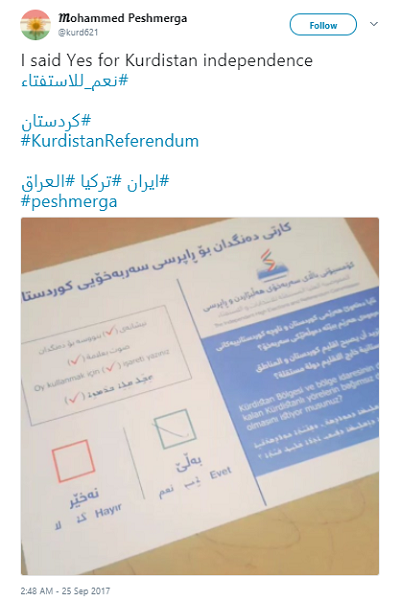
    Just as in the west, many want to broadcast their votes:

    I couldn’t tell if this voter was giving the finger to independence or to someone who voted against it. The caption wasn’t much help, but it’s nice to know that some gestures are universal.

    Many wish the Kurds well:

    Nevertheless, the bid for Kurdish independence has almost no support among the governments of the world, especially Turkey and Iran, who worry that their own Kurdish populations will get ideas.

    Some find significance in the decision of the Turkish and Iraqi armies to begin joint exercises near the Kurdish border today:

    Israel is one of the few nations that have announced support for Kurdish independence. Many welcome this,

    But others see something sinister, as in this loathsome anti-Semitic cartoon:

    Incidentally, despite being depicted as sitting next to Israel at the feast, the US government opposes independence.

    Julian Assange, of Wikileaks fame, posted this cartoon:

    It depicts the Kurdish nation, pierced by the arrows of Iraq, Turkey, ISIS, Iran, and a few others I don’t recognize. Nevertheless, the Kurds persist and climb the ladder of freedom out of the abyss and into the sunlight.

    As we await the results of the vote, I hope that proves prophetic.

    Michael Isenberg writes about the Muslim world, medieval and modern. His forthcoming novel, The Thread of Reason, is a murder mystery that takes place in Baghdad in the year 1092. It depicts the war for the Muslim soul between those who seek to enforce shari’a strictly, persecute Jews and Christians, and stamp out "un-Islamic" science, and those who wink at a few sins, tolerate their non-Muslim neighbors, and write science books instead of burning them.

    Thursday, September 21, 2017

    The UN General Assembly: Hypocrites on Parade

    We all saw highlights of President Trump’s speech. But what did other world leaders have to say?

    Sure, Donald Trump got all the publicity. That’s par for the course when you threaten to “totally destroy North Korea.”

    But this is a blog about Islam, so rather than North Korea, the focus here is the Muslim world. What did the various world leaders have to say about that?

    I'll start with President Trump: he called out the “vile and sinister ideology” of “radical Islamic terrorism.” In particular, he singled out Iran’s “corrupt dictatorship” and “murderous regime.” Good stuff, noticeably absent from his 9/11 and Afghanistan speeches. Still, it's mostly a rehash of his May 21 address in Riyadh, which I covered previously.

    Prime Minister Netanyahu of Israel shared President Trump’s concern about Iran: “From the Caspian Sea to the Mediterranean,” he said, “from Tehran to Tartus, an Iranian curtain is descending across the Middle East.” (If you don’t follow the reference, look it up. “Iron Curtain speech.” Get it? Iron Curtain/Iranian Curtain).

    Hassan Rouhani of Iran came back swinging. He called the accusations against his country “ignorant, absurd, and hateful rhetoric” from a “rogue newcomer.”

    Overall, President Rouhani wins the award for smarminess. “Our ambassadors are our poets, our mystics, and our philosophers,” he intoned piously. But my favorite part was, “The path of moderation nurtures beauty. Deadly-weapons exports are not beautiful; rather peace is.” He should know; his country is exporting weapons all over the Middle East to fight its proxy wars, including the humanitarian catastrophes in Yemen and Syria.

    Rouhani concluded with a sales pitch for investment in the Iranian economy. He invited “all those who seek peace, security, and progress through partnership and cooperation among nations to visit Iran.” I’d actually like to take him up on that. I discovered in the course of research for my book The Thread of Reason that Iran is a country of spectacular and diverse natural beauty which, to its credit, takes great pride in its wealth of historical monuments, even pre-Islamic ones. Those who seek to destroy the monuments of the Confederate States of America could take a lesson from the Iranians. Still I think I’ll postpone my visit until I can travel in Iran without fear of being arrested and tried behind closed doors on dubious charges of espionage, as has been the fate of other Americans in that country.

    Abdu’l-Fattah as-Sisi of Egypt presides over one of the world’s worst human rights abusers. It’s a place where Giulio Regeni, a Cambridge University student who was researching trade unions in 2016 mysteriously disappeared. His corpse, showing signs of excruciating torture, turned up in a ditch along a highway nine days later. In another story, just this week, an Egyptian court sentenced some 500 people in a mass trial for their role in the 2013 anti-government demonstrations. Amnesty International reported that 330 of them had already been detained for four years or more, and among these, there was evidence against only two of them. So one can only marvel at the irony of President as-Sisi lecturing the world body on “upholding the notion of the modern nation-state, which is based on the principles of citizenship, equality, rule of law, and human rights.” In a less hypocritical vein, he continued that he intended to defeat “any attempts at retracting to doctrinal, sectarian, ethnic, or tribal loyalties.” You read that right. No loyalty to religion, culture, or ideas allowed. One must be loyal only to the State.

    On the subject of terror, President as-Sisi said, “We in the Muslim world need to face our reality and work together to rectify misconstrued notions which have become an ideological pretext for terrorism and their destructive discourse. As you may recall, Egypt has launched an initiative to rectify religious discourse in order to revive the moderate and tolerant values of Islam.” This showed some insight in that the roots of terror are ideological, but as-Sisi is mistaken that Islam has been misconstrued. While the ideology of ISIS and al-Qaeda isn’t the only possible interpretation of Muslim scripture, it’s certainly an interpretation with deep roots in that scripture. As for the prospect of any government “rectifying” religious discourse, or any discourse—that is truly chilling.

    President as-Sisi also called for “global order that can face challenges, such as climate change.”

    Mahmud Abbas, leader of the Palestinians, called Israel a colonial, Apartheid, occupying power, but nevertheless he promised that “upon Israel’s withdrawal from the Palestinian and Arab territories occupied in 1967, the Arab and Islamic States would recognize Israel and normalize relations with it.” One has to wonder about his sincerity, since he then went on to denounce the “historical injustice” of the 1917 Balfour Declaration, the document which laid the foundation for Israel’s right to existence in the first place. In any case, we're unlikely ever to put Mr. Abbas's sincerity to the test. There's only a small chance he'll ever have to follow through on this promise. Territories "occupied" in 1967 include East Jerusalem, which Israel views as part of its eternal, undivided capital.

    As for Abbas’s view of the roots of terror, he claimed that “draining the swamp of colonial occupation of our land and ending its unjust, oppressive, and illegal practices against our people would greatly affect the fight against terrorism, depriving terrorist groups of one of the key rallying cries they exploit to promote their repugnant ideas.” This is an argument that Dr. Zuhdi Jasser, of the American Islamic Forum for Democracy, recently called “pure, unadulterated insanity.”

    Mr. Abbas also said, “We once again affirm our commitment to…the Paris Agreement on Climate Change.”

    Aung San Suu Kyi, First State Counsellor of Myanmar, chose not to attend, due to the anti-Muslim violence engulfing Rakhine State in her country; I wrote about that earlier this week. Instead, Counsellor Suu Kyi sent Vice President U Henry Van Thio, who for the most part parroted the awful speech that the First Counsellor delivered on Tuesday. But not to worry. Despite the atrocities in Rakhine, Mr. Van Thio assured the world that, “Myanmar welcomes the Paris Agreement on Climate Change.”

    Well, that gives you some flavor of the 72nd UN General Assembly. As I read through page after page of self-inflicted grievances and smug hypocrisy, not to mention the pathological obsession with climate change, there was one question that kept nagging at me:

    Why is the United States part of this?

    Michael Isenberg drinks bourbon and writes novels. His latest book, The Thread of Reason, is a murder mystery that takes place in Baghdad in the year 1092, and tells the story of the conflict between science and shari’ah in medieval Islam. It is available on Amazon.com

    Transcripts and video of the speeches from the 72nd UNGA may be found on the UN Website.

    Wednesday, September 20, 2017

    Tales of Medieval Islam

    How an ass-herder became a king.

    In my blog yesterday, I called on Aung San Suu Kyi, First State Counsellor of Myanmar (Burma), to speak out against the persecution of Rohingya Muslims at the hands of the Burmese army. I argued that even if the political realities of Myanmar prevented her from doing anything more forceful than speak out, that’s still a powerful thing.

    The story of Ahmad ibn Abdallah al-Khuzistani illustrates just how powerful words could be.

    Ahmad lived in the ninth century, a time when everyone in the Muslim world, low and high, immersed themselves in poetry. He started life as an ass-herder, but managed to work his way up to become Emir of Khorasan (eastern Iran, more or less). Nizami Arudi wrote, “[T]he affairs of Ahmad ibn ‘Abdu’llah prospered so greatly that in one night in Nishapur he distributed in largess 300,000 [gold] dinars, 500 head of horses, and 1000 suits of clothes, and to-day he stands in history as one of the victorious monarchs.”

    When asked how he managed to rise so high, from such humble beginnings, Ahmad replied, according to Nizami,

    One day I was reading the Diwan of Hanzala of Baghdis…when I chanced on these two couplets:—

    'If lordship lies within the lion’s jaws,
    Go, risk it, and from those dread portals seize
    Such straight-confronting death as men desire,
    Or riches, greatness, rank and lasting ease.'

    An impulse stirred within me such that I could in no wise remain content with that condition wherein I was. I therefore sold my asses, bought a horse, and [quit] my country.

    And thus, inspired by a poem about risking everything to snatch greatness, the one-time ass-herder embarked upon a glorious career.

    Michael Isenberg writes about the Muslim world, medieval and modern. His forthcoming novel, The Thread of Reason, is a murder mystery that takes place in Baghdad in the year 1092. It depicts the war for the Muslim soul between those who seek to enforce shari’a strictly, persecute Jews and Christians, and stamp out "un-Islamic" science, and those who wink at a few sins, tolerate their non-Muslim neighbors, and write science books instead of burning them.

    Quotations from Nizami come from Chahar Maqala (The Four Discourses), Edward G. Browne, tr., Mirza Muhammad, ed., London:Luzac & Co., 1921, Anecdote XII, pp. 27-29.

    Tuesday, September 19, 2017

    Aung San Suu Kyi to World: Nothing to see here

    Myanmar’s State Counsellor uses her eagerly awaited speech about the atrocities in Rakhine to discuss sustainable development and Five Year Plans.

    Yesterday I wrote about the persecution of the Rohingya Muslims, who live in Rakhine State, Myanmar (Burma). For some years they have been in conflict with the ethnic Burmese. Last month the situation escalated when Rohingya jihadists attacked government outposts. The jihadists, like jihadists everywhere, are a blight on the landscape. The military counterattacked, as they should. But the brutal nature of the counterattack, drawing no distinction between combatants and non-combatants, is shaping up to be one of the great crimes of our still young century. Together with Rakhine civilians, who they armed, the military burned dozens of Rohingya villages and murdered numerous women, children, and elderly, triggering a humanitarian crisis that sent nearly 400,000 Rohingya—almost half their population—fleeing to Bangladesh. A skeptical world may doubt some of the harrowing stories told by the refugees. But there is no doubting the burning of the villages. The flame and smoke are there for all to see.

    Despite the horrific nature of the crisis, I ended on an optimistic note:

    In the absence of any acceptance of responsibility by the government, all eyes have turned to Aung San Suu Kyi, holder of the Nobel Peace Prize and de facto leader of Myanmar…For some years now, she’s been evasive about Rakhine…But with the recent attention, perhaps she is reconsidering. A spokesman for Ms. Suu Kyi announced that she will deliver an address on the situation this week. The world will be watching.

    Ms. Suu Kyi gave her speech this morning.

    It was awful.

    I have sympathy for Ms. Suu Kyi, I really do. For decades, as leader of the opposition against Burma’s military government, she suffered numerous rounds of house arrest. And now, with the return of civilian rule, she has taken on the task of rebuilding a poverty-stricken and divided country. It’s an excruciatingly difficult job, and I realize I’m guilty of some Monday morning quarterbacking here.

    But, God, that speech was awful.

    She did not acknowledge the seriousness of the atrocities. “There are allegations and counter-allegations,” she said. “I have not gone into any of them because it is not my purpose to promote and encourage conflict.” So she hid behind the “both sides” argument, and not for the first time. And she did it disingenuously: when it came to the allegations against the Rohingya, she did go into them.

    There was no acceptance of responsibility on the part of the government. Instead she called for more study to find out what was really happening—which Amnesty International and Human Rights Watch have already been doing for weeks.

    There was no plan put forward for stopping the violence. Indeed she denied there was anything to stop. “Since the 5th of September, there have been no armed clashes and there have been no clearance operations,” she claimed, apparently incorrectly. CNN reports, “Satellite imagery examined by Amnesty International appears to show more than a dozen burned villages and fires since that date.”

    Some of what Ms. Suu Kyi said was downright absurd. “We are concerned that numbers of Muslims are fleeing across the border to Bangladesh. We want to find out why this exodus is happening.”

    See above, re: burning villages.

    And then there’s this jewel: “The great majority of Muslims in the Rakhine state have not joined the exodus. More than 50% of the villages of Muslims are intact.”

    What a relief to know that only half the Rohingya have been driven away!

    But more than anything else, Ms. Suu Kyi’s address was technocrat-speak. Instead of the leader that I know she is, she sounded like a Soviet apparatchik or an EU bureaucrat:

    We had established a central committee for rule of law and development in the Rakhine…

    In accordance with the counterterrorism law, section six, subsection 5…

    The final report of the advisory committee…

    A strategy with specific timeline has been developed to move forward the national verification process…

    Social development programs…

    Sustainable development…

    The Rakhine state socioeconomic development plan, 2017 to 2021, has been drafted to boost regional development in various sectors…

    Yes, she literally cited the Five Year Plan.

    Toward the end of her speech, Ms. Suu Kyi offered a metaphor which I thought was instructive. Her intent was to deflect attention from Rakhine state to the problems of Myanmar as a whole:

    I would like to use the analogy of a healthy human being. A healthy human has to be healthy all over—you cannot neglect his general health, just to concentrate on one particular ill.

    Yes, you can concentrate on one particular ill. When things are bad enough, you have to concentrate on one particular ill. Like if a patient is brought into the emergency room with a gunshot wound. Stop the bleeding. Don’t inquire into whether he gets enough exercise or has too much salt in his diet!

    So it is with nations. I’m all for sustainable development and strategies with specific timelines. But there are always unforeseen events that disrupt the Five Year Plan. That's one of the great insights of conservatism and one of the reasons socialism doesn't work. And when events occur, a leader has to deal with them, and that's what Ms. Suu Kyi is not doing. Stopping the bleeding.

    I recognize Aung San Suu Kyi has many constraints and few options. I recognize that, under Burma’s Constitution, she does not control the military. But at the very least, she can speak out against the very real atrocities happening in her country. Some say that words don’t make any difference, but I beg to differ: Aung San Suu Kyi’s whole life is proof that they do.

    Michael Isenberg writes about the Muslim world, medieval and modern. His forthcoming novel, The Thread of Reason, is a murder mystery that takes place in Baghdad in the year 1092. It depicts the war for the Muslim soul between those who seek to enforce shari’a strictly, persecute Jews and Christians, and stamp out "un-Islamic" science, and those who wink at a few sins, tolerate their non-Muslim neighbors, and write science books instead of burning them.